Free-fall Circle Counting: I can’t imagine ever not doing this

Today in class, we did a few circle counts for free-fall. [I’m pretty sure I stole this idea from Frank Noschese, who probably stole it from someone else Sadie Estrella, who blogs about it here. I can’t seem to the find the found the blog post where Frank wrote about it].

Of course, counting circles is more from elementary math classes, but it works for college physics really well. So with free fall, students in a circle “count off” the velocity of a thrown object each second, using 10 m/s/s change.

Easy ones might be like 30 m/s, 20 m/s, 10 m/s, 0 m/s, -10 m/s, -20 m/s, -30 m/s.

Medium ones like  25 m/s, 15 m/s, 5 m/s, -5 m/s, -15 m/s, – 25 m/s

Hard ones like:  18 m/s, 8 m/s, -2 m/s, – 12 m/s

I had student “circles” look more like motion diagrams, so a big “U” where the positive velocities head one way and the negative velocities head back down. I didn’t spend too much time on this, but we certainly could have. The activity was pretty enlightening for students, but what this activity actually did was provide us with fodder for later sense-making. Our conversations all day were always referencing back to the counting activity.

For example, one clicker question later in day was what does velocity vs. time graph look like for an arrow shot straight into the air and falling back down. Our discussion of the different answer choices was immensely helped by talking about it in relationship to the circle counting. “We keep counting down by -10, the count never turns around”.  Another clicker question about the acceleration at the top, circle counting really helped. “There’s never a time where you don’t count down by “10”… even if you are the person who says zero… you had to count down by ten, and the next person had to count down by 10″. No one is allowed to say the same number the previous person said. The final question it helped with was, “A ball is dropped from a height of 45m and takes 3s to hit the ground. What’s the instantaneous speed just before impact?” Tempting to say 15 m/s.

Anyway, if you are thinking of trying this. I highly encourage it. It forces participation in good way. Formative assessment is pretty easy. It provides lots of opportunities to “stop” and discuss issues that come up.

Notes:

  1. I think it’s probably important for students to say the units and to enforce it (and maybe even say “moving at a velocity of – 15 m/s”). Later students will start incorrectly count free-fall distance by 10m (each second). This came up in our 45 m in 3 seconds clicker question, where at least one student arrived at answer of 15 m/s… by counting down from 45m three times to 15m.  We had to talk about how that would be constant velocity of – 10 m/s.  Forcing them to say units or the phrase won’t eliminate this, but it can’t hurt?
  2. Plan ahead on what examples you want to give, what possible “stop and discuss” issues might come up. A good time to discuss is after mistakes, or even after any long pauses. Students tend to pause more when going from positive to negative, especially if it’s like 2 m/s to – 8 m/s.  In skip counting good questions come from, “How did you know to say __ without counting?” The discussion can be about strategy, but it can also be about keeping it connected to what’s physically happening.
  3. If doing it again, I would definitely do a few with the whole class, but then maybe give them examples to work out in smaller groups, and then “present” their motion diagram count. The whole class is nice, because it models and you can have those “stop”, but small group might work well, too.

Further extensions of this activity I didn’t do, but would consider for next time could include:

— Skip counting, like only saying the velocity every so often (having students count time in between)… so a drop from rest, that only counts velocity every 3 seconds would be First person says “0 m/s”, Second person just says (1s), Third person says  (2s),  But next person has to say” -30 m/s”… etc,… so (4s), (5s), then “-60 m/s. “

— Counting in intervals other than one second… I think 1/10th of a second is pretty important.

— Counting with other accelerations.

–[Much later]  Adding in distances:  Like for an acceleration of 2 ft/s/s from rest, you would count “0 ft/s”, the next person would count “2 ft/s” and take 1 ft step (because average velocity was 1 ft/s for that s”… then the next person would say, “4 ft/s” but would take 3 ft step, etc.  Our tiles are 1ft, so this wouldn’t be hard. It’s like a live motion diagram.

Week 3: 80% Wrong on a Clicker Question [Sign of Acceleration]

Last week, students worked through a lab using photogates to investigate how the speed of a cart changes as it descends a ramp. We didn’t have much time to talk about it too much because my broke ankle situation meant having to cut class early to see the doctor. Most students, however, were still able to make good interpretations of the intercept and slope of their linear equation for velocity vs. time. This was helped by having students to a “quick and dirty” experiment to figure out how much speed the cart gained in traveling 1 second (all groups adjusted the location of the 2nd photogate until it measured 1 second later from the first). It was also supported by asking students to think about what value was typical for the first photogate each trial, and why that stayed relatively constant. Both of these gave them something to hang their hat on when interpreting slope and intercept.

In this lab case, the intercept and slope are both positive, so today we ventured into talking more specifically about the sign of acceleration in various cases. Here’s how the day started:

  1. Warm up to review the photogate lab:  Question was “if your linear equation from our last lab had been v = 15 cm/s/s t + 10 cm/s, (1) how fast was the cart moving through the first gate, (2) how much speed does it gain each and every second? In asking students to say how they knew, we ended up drawing the graphs and talking about slopes and intercepts.
  2. A very brief mini-lecture to review definition of acceleration from their reading, how it connects our lab and the slope of velocity vs time, and some modeling of how to interpret the meaning of acceleration.
  3. A clicker question where students find acceleration at a particular time from a v vs t graph. Lots of discussion was needed here. Since the graph had an intercept, many students merely calculated v/t rather than dv/dt.
  4. A similar clicker question where students find acceleration for a graph but with negative slope.
  5. A very quick review of sign conventions for velocity vectors that we’ve established. (Knight in the algebra-based text always has positive be to the right).
  6. A clicker question with a motion diagram: the object is on the right side of the origin, slowing down as it approaches the origin. Students are asked to identify sign of velocity and position. Some discussion here, but pretty good here.
  7. 2nd clicker question with same motion diagram asking about sign of acceleration. About 80% said velocity was negative, which is incorrect.

What do you do when 80% of students have the wrong answer in a clicker question? My move here is to draw specific attention to a tool. I didn’t ask students to discuss. I didn’t lecture. I asked students to work in groups to draw a velocity vs time graphs for the situation, and to use the idea that the slope of velocity vs time. Many groups needed help with correct velocity vs time, but most of it involves reminding them that we had just said in the previous clicker question that the velocity was negative.

We drew a consensus velocity vs. time graph at the front and agreed that since the slope was positive, the graph implied that acceleration was positive. Now and only now I asked students to tell me why 80% of them had answered the acceleration was negative… it was the first time in class that students really opened up about wrong ideas… here’s what we got.

  1. “I thought that since the velocity was negative, the acceleration had to be negative”
  2. “I was thinking acceleration is v/t, so a negative velocity divided by a positive time is negative”
  3. “I was thinking that slowing down has to mean a negative acceleration, it’s taking away speed”

Then only then did I ask for, “How can we make sense of why the velocity vs. time time graphs says that acceleration is positive.” We got lots of good ideas here

  1.  Slowing down should be negative acceleration, but your velocity is already negative… its like the two negative, means the acceleration must be positive to counteract the negative velocity.
  2. You can’t think of acceleration as v/t, it’s about the change in v; we can see in the graph, that even though the velocity is negative (below the axis), the change in velocity is always positively going “up”
  3. If it had like -30 m/s velocity to start and later you have -20m/s velocity, it’s almost like it gained +10 m/s velocity… it’s less in velocity debt, and a positive acceleration helped get it less in velocity debt.

I added my vector interpretation of how acceleration “changes’ velocity vectors by either “widdling them down” or “pulling them out”, and how the sign of acceleration is just about which way the acceleration vector points.

I think “order” matters here… while one-on-one in office hours, I have and still would ask student to explain to me their thinking about what I know to be the wrong answer. Often times, I say back to them their idea and why it makes sense, and then say, “I want to tell you about another way of thinking about it. Hear me out, it’s different than your idea, but I want you to understand my idea like I think I’ve understood yours.”

In class, however, I want students to get in the practice of using tools we’ve developed. We spent all that time talking about acceleration as slope of velocity vs time, so I want us to use that. Once we were pretty sure we were almost all wrong, sharing your wrong thinking was less risky. I encouraged students to share their previous wrong thinking through an analogy I learned (I think) from David Hammer. To tell students to, “You know when you sometimes meet someone new, and you immediately don’t like them, but you don’t know why?” I tell them that having ideas in physics is like that… sometimes you have an idea, but you aren’t sure why you thought it. Once you figure out, “why” you don’t like the person (e.g., maybe they remind you of someone), you can let go of not liking them. We need to figure out “why” it’s so tempting to think that acceleration was negative.

Week 2: Broken Angle Puts the Brakes on Blog Updates

Tuesday afternoon this week, I broke my ankle playing ultimate frisbee, so I’m a little behind on the blog updates. Here’s a quick synopsis of the week with some reflection:

Monday: Maintaining Good Facilitation Choices Even When Tired

Monday Evening in Learning Assistant Pedagogy, we discussed and watched some videos from periscope. We watched two videos of Learning Assistants interacting with group as they engage in collaborative activities. We had some decent conversation, but everyone is always a bit tired by 6:00-7:30 pm. I have even noticed myself that I make poorer facilitation decisions in the evening–a lot of times out of sheer exhaustion / laziness.  For example, the day could have ended with a short summary discussion of things we’ve learned about being an “LA”. Through our discussions, ideas like, “making space for students to talk,” “not getting so excited about your own explanation that you take over the conversation, “Restating what students just said to keep the conversation going,” “asking other students if they agree or disagree”, etc. These are all really great insights. And while they came up in discussion, a summary conversation at the end could have helped crystallized these, rather than being merely ephemeral notions that come and go. I chose to end class at the end of the second video discussion, rather than quickly generate a list of good ideas about being an LA that had come up. A second poor decision I made was when a quieter student tried to gain access to the conversation, I cut off another student to give the floor to the quieter student. I did it in a way that came off as awkward. On a better day, I might have said something quickly, “Sarah, you go, and then lt’s hear from Janet.”

Tuesday:  Learning that we have packed too many things

In our revised algebra-based physics course, we have learned this week that we have tried to cram too much in. The days have felt a bit hectic. Not that any one day was bad, but if every day feels that hectic, it grinds on everyone. Some of our activities are just too long; some days we just have too many different things happening. For future planning, we have a goal of  prioritizing better and doing more with less.

Wednesday: Returning LAs are really fantastic to have

In LA prep, we had some really good physics conversations about velocity vs. time graphs. A good range of facility, but students worked well together. One thing that has been great is returning LAs. They really know how to collaborate well (even when it’s thing they already know). It’s nice that they can be there to model that. Instructors have given several compliments about how good those returning LAs are in their classes. One professor even noted that the LA might be better at asking good questions to students than they are.

Thursday: Short Class because of Orthopedic Appointment

I had to shorten class because of the my ankle, so our problem of having too many things was going to be made even worse. But it was a good exercise in cutting out the unnecessary. After a few clicker questions to review piece-wise constant velocity vs time graphs, basically all we did that day was a lab… learning how to use photogate to measure speed, and then taking data for how velocity changes for a cart on an incline ramp. Definitely some revising of the labs was needed, but it overall went well.

Friday:  Physics Tutor Workshop

A year ago, the university started centralized tutoring in the library. We hire physics majors to tutor for intro physics and astronomy. We’ve had a few common complaints about tutors, so we decided to do a brief workshop with them. I’ll be running that this afternoon. Part of the issue is that physics majors go through Matter and Interactions and the algebra-based course starts more traditionally with kinematics. It’s not helpful when the physics majors start by saying, “So you start this problem with the momentum principle.” Other complaints have been that physics majors do not understand second semester topics very well–I think this is especially true for optics. The third complaint has been that some tutors do not “circulate” well. There might be 15 students in the tutoring room, and the tutor spends all the time with just a few students. I may give more details about the workshop in a future post.

Day 5: Mostly A Day for Research (but a little bit of lab grading)

I don’t have classes on Friday this semester. I spent most of the day doing research (learning how to do exploratory factor analysis  on some survey data).

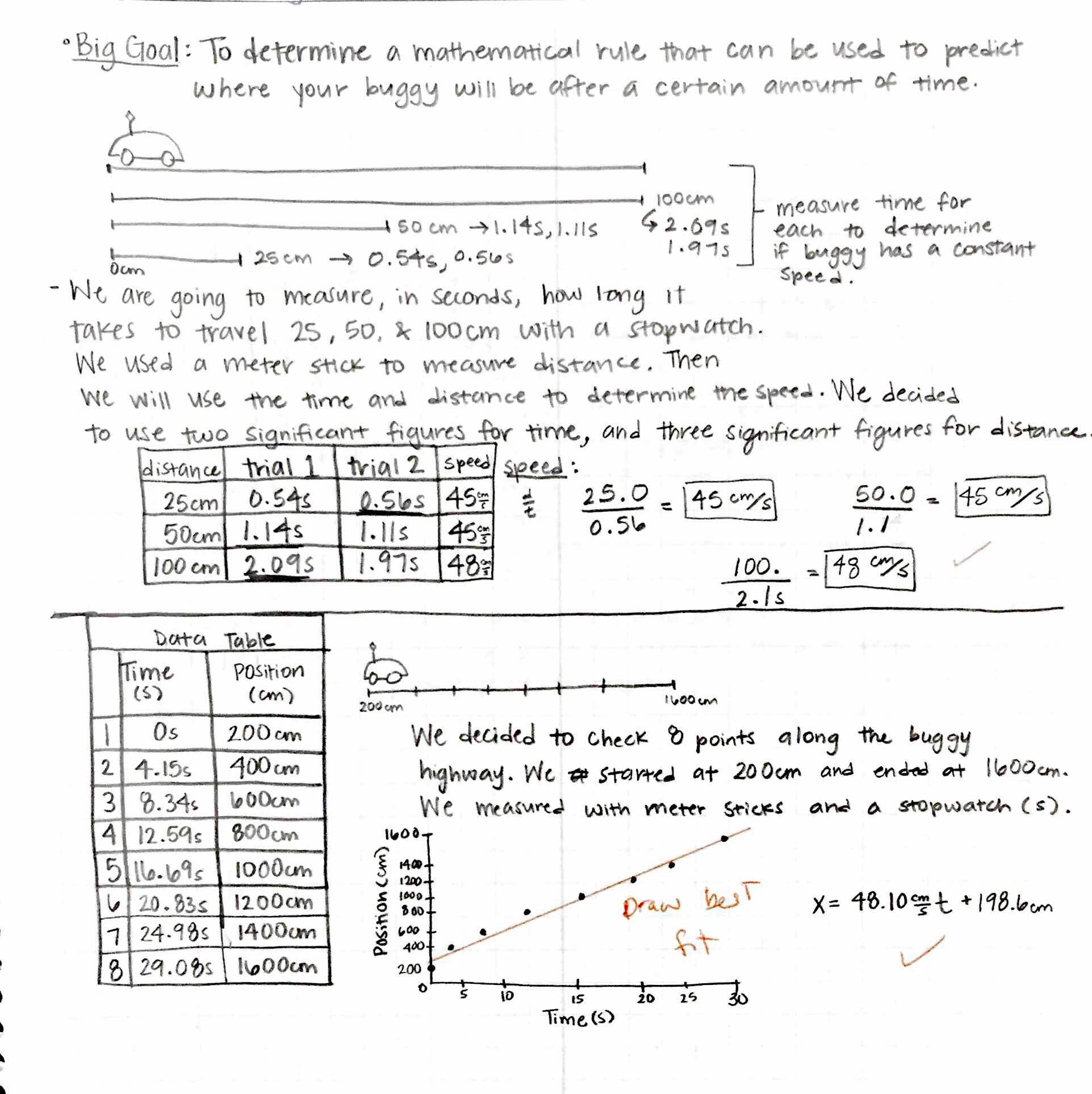
Teaching-wise, I started grading lab books. Here is a photo of one students’ lab book fro the buggy lab to offer a feel for the kind of work they are expected to turn in. Keep in mind, these are lab books (not lab reports).

Lab Book

There are also 4-6  summarizing at the end. This lab had following questions:

  1. How can you decide by looking at your position vs. time graph whether or not the buggy moved at (roughly) a constant speed or not?
  2. What value for the buggy’s speed did you get using your “quick and easy” method? How did this compare to the slope of the mathematical rule you determined?
  3. Write down the mathematical rule you determined for the buggy’s motion.
    1. What would be different if the buggy had moved faster?
    2. What would be different if the buggy had started at a different location?
    3. What would be different if the buggy had moved in the opposite direction?
  4. What did you learn today that might help you address the challenge lab?

Most groups were able to make good connections between slope and speed, intercept and initial position, and the sign of the slope with direction. Based on the lab books, one group, however, did struggle to make those connections.

Today, I have spent some of the day prepping for our next meeting. Students will have read over the weekend two sections from the text that will build on the buggy lab: a section on position vs time graphs and a section on uniform motion. We will also return to class next week with some clicker questions to review these ideas.

Then students will revisit motion detectors to make graphs. [Last time we just used them to make motion diagrams.] This lab exploration starts off just qualitative, with students making predictions and observations as well as doing some graph matching; but it transitions to quantitative stuff with students re-applying what they learned about linear fits (in Logger Pro) last week to extract velocity information. The last task of the lab exploration has them re-measure the speed of their buggy using this new technique.

Then we will have our first day of collaborative problem-solving.

The plan for problem-solving is

  1.  Staged Problem-solving:  We are following Knight’s break-down for problem-solving into “Prepare, Solve, Assess”. So students will be given a problem, and groups will first be asked just to prepare on whiteboard. Preparing at this point involves making pictures, collecting important information, and doing preliminary calculations. A little bit of discussion to highlight different aspects of students’ work. Before beginning the problem, we will ask students to make guesstimate for, “Best Guess, Definitely too Long”.  Then they will solve the problem. Discussion similar as needed. Then they will be asked to assess in variety of ways, including checking against their guesstimate, making sure they have actually answered the question, checking units.
  2. Un-staged Problem-solving:  Students have to do each of the steps, prepare, solve, assess, but we won’t pause to discus between each.

Both problems are two-body uniform motion that don’t involve simultaneous system of equation. For example, one has two cars traveling the same trip, one traveling faster but leaving leaving at an early time. Question is who will finish first and how long will they have to wait for the other to arrive? Students will be required as part of “solve” to make a position vs time graph. Groups who finish solving early will be asked to solve for other aspects, including when and where did they pass each other.

If we have time, I want students to use their skills to solve a real buggy collision problem. Since in the lab exploration, they already got the speed of their buggy again, this may be doable time-wise. I’d like to do this so they can use their skill to actually predict something, but it also rehearses something like our “Challenge Lab”.

Day 4: Finding the Smallest Trustworthy Digits (Lab Uncertainties this year)

Yesterday, in my pilot section of revised algebra-based physics, we talked about uncertainty for a bit and then students did the buggy lab. Lab went well. Only change was groups who finished early had to revise/apply their model to make a prediction and test it out (e.g., buggy starting somewhere new, going in opposite direction, where will it be/ or how long will it take to ___ ).

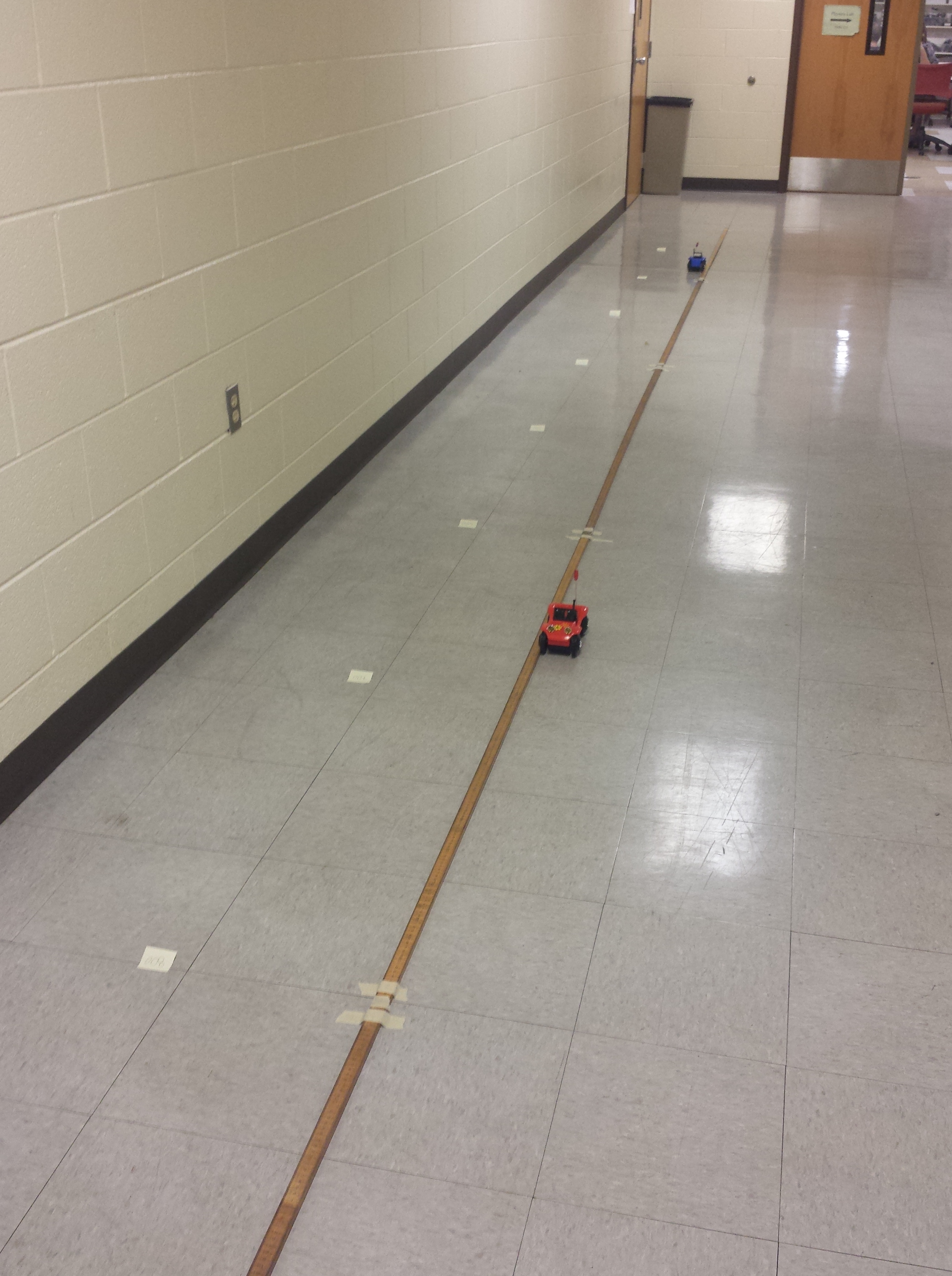
Here is a picture of the buggy highway we set up in the hallway:

IMG_20150828_075459

Lab Uncertainties: Last Year vs This Year

For uncertainties, we used to have students estimate measured uncertainties, calculate percentage uncertainties, and then have students identify the largest (average) percentage uncertainty of all their measurement types before using that to propagate uncertainty to any calculated results (e.g., slope).

Now, we have students take multiple or repeated measurements to help inform judgments about which digits seem “trustworthy”. We defined trustworthy digits as those that don’t change much upon repeated measurements. This leaves some room for ambiguity which is fine– for example, we had clicker question to identify where the smallest trustworthy digit was with repeated measurements of 12.69 ft and 12.91ft. Either the ones place or the tenths place could be justified. For propagating uncertainty, we have students use the rules for significant figures, because that’s what is taught in Knight’s College Physics. Overall, I’m pretty happy with this approach. In the first lab, we actually had interesting conversations about uncertainty instead of mind-numbing conversations about how to apply the rules.

For example, one group had measured time repeatedly in their “Quick and Easy” speed calculation (before a more careful investigation), and found that their time measurements really only had 1 sig fig (something like 5.87s, 7.07s, 6.32s). They were unhappy with rounding 24 cm/s down to 20 cm/s. They felt like this was losing accuracy. When they later found the speed using graphical methods, they got 19 cm/s. They were really surprised that their 1 significant figure rounding was closer than their 2 significant figure rounding. One student said that hadn’t realized that such a thing was possible.

Day 3: Launching the Buggy Lab

In our new algebra-based physics pilot tomorrow, we will be doing the fairly standard constant velocity buggy lab. Prior to lab, students will have read about coordinate systems, position, and time, and even calculating speed, but we have not studied uniform motion.  Here’s our particular twist on getting that lab going.

Launching the Lab:

The Buggy Highway:

We set up a long “buggy highway” across the length of the hallway outside our lab room. This consists of about eight 2m-sticks lined up back-to-back and taped to the floor. Using sticky pads, we mark out an origini and key landmarks at every 100 cm.

The Deliberately Vague Question:

After orienting students to our coordinate system, we turn on a buggy so students can see and hear the wheels move, and pose the question,”If I put the buggy down somewhere along our highway, where will it be when I yell stop.” (Alternatively you could ask,”If I put the buggy down somewhere along the buggy highway, how long will it take for the buggy to hit a wall?”) Following the Den of Inquiry model, we are hoping to cultivate the response that, of course, “It depends.” Our job is to draw out from students what they think it depends upon (e.g., how long I wait before yelling stop, how fast the buggy moves, where I place the buggy down, which direction the buggy moves, whether the buggy goes straight or curves, etc). Whatever they say, we try to value it by echoing back why that makes sense and writing it on the board.

Establishing Criteria for a Good Model:

The broad goal of the lab is to determine a mathematical rule (or model) that can be used to predict where the buggy at every moment (given I might yell stop at any moment). With that purpose, we draw attention to several specific factors from above because they map well to the parameters of the mathematical model they will be developing using graphical analysis. We want to frame at the outset that a good model better take into account things like how fast the buggy goes, where it starts, and which direction it goes. In addition to having a model that can actually make predictions, these three become criteria by which we will evaluate whether our model makes sense (intuitively).

Measuring Speed “Quick and Dirty“:

Before sending students off to take data in a more guided way (position and clock readings), we ask students to find a quick and easy way to estimate the speed of the buggy without taking a lot of measurements. We are hoping that this does two things: (1) Starts them off with something they know how to do (calculate speed as distance over time), and (2) maybe makes it more likely they will later recognize the slope as related to speed. [I’m slightly worried it will make it easier, but less meaningful.]

Everyone start somewhere different:

When sending students off to take data, we have students start at different locations and have a mix of cars going in different directions, with of course some having fast/slow buggies.

Tomorrow, I’ll let you know how it goes!

Day 2: New Pilot Section of Algebra-based Physics (First Day)

Today was the first day in a pilot section of a newly developed algebra-based physics course. I am piloting one section and a colleague is piloting the same in a second section.

Some details about the changes include

Text: Changed from a Home-grown text to Knight’s College Physics

Homework: Changed from no HW to Mastering Physics

Labs: Changed from confirmation labs to a variety of lab format including qualitative explorations of phenomena, guided investigations, and application/challenge labs.

Equipment: From teacher control over lab equipment to open student access to a variety of vernier lab equipment (sensors, cart, tracks, etc).  Each day students must retrieve and return at last some their equipment. On “challenge” labs, students have to decide what equipment they want to address the challenge.

Shelf Labels

Groups: From lots of unstructured group work to more structured group work (a lot of this came about from students having free access to equipment… we only wanted one person per day to be retrieving/returning equipment). This led us to think more critically about group roles. We still have some work to do in building assessment (peer/self/whatever) to our structure.

Hours:  From Two 2.5 hours studio session + one 1.5 hour lecture to two 3 hour student sessions.  Mini-lectures are interleaved with collaborative problem-solving, labs, clicker questions, etc.

Clickers: Clickers were used exclusively in the 1.5 hour lecture, now they are integrated into the studio sessions.

What are the biggest differences in philosophy?

– Units were organized around “Culminating Challenge Labs” (like practicals in Modeling Instruction).  We designed backwards–asking first what do we want students to understand and be able to do –> then what lab challenges would representatively sample that terrain of understanding –> then finally what learning experiences would give us confidence students would be able to succeed. Our lab activities and problem-solving sessions are intended to equip students with the skills necessary to be successful with the challenge lab. This semester, we’ll be discovering what gaps we’ve made to large and what gaps we’ve overly smoothed over.

– Students having open and free access to the lab equipment is rooted in us trying to give students more agency in the lab. Previously, it always felt like, “we owned the lab equipment” and we set it out for students to use when and how we wanted. We are trying to provide an environment where students feel like it’s their equipment and they get to use it when they need it. Part of that of course is helping them to feel confident in their ability to use it, but releasing control. We will be working on getting the balance right, but I’m happy this is a driving factor of our course.

– A stronger focus on qualitative understanding and conceptual reasoning. We have better balance, which is largely supported by having the new text, using “lab explorations” to introduce topics, and implementing collaborative exercises and clicker questions that focus on that aspect. We tend to move from phenomena –> qualitative representations –> quantitative representations.

Outline of First Day: Introduction and Motion Diagrams

1 hour for course introduction /logistics and pretest

1 hour to interactive lecture demos, clicker questions, and collaborative exercises about motion diagrams

1 hour for lab introduction to logger pro and motion detectors (I created a file to have motion detector make motion diagrams instead of graphs… students practice getting equipment for the first time, connecting their equipment, accessing software, and then they are guided to make predictions/observations for various motions of objects including their hands, fan carts, etc.)

Overall, it went well.

Day 1: Learning Assistant Seminar (First Day)

In the first day of our LA seminar, we did a fairly “standard” learning assistant activity from the original UC-Boulder LA Pedagogy Course handbook.

Students are presented with an interesting object (in my case a horse skull), and are told to work in pairs to come up with as many questions they can ask about the object. They have five minutes.

Afterwards, questions are collected the board. Once we have a varied collection, students are prompted to go back and look for any patterns or categories–questions that seem to go together. Here are some of the categories:

  • Present (Is the skull fragile?) vs Past (How did it die?)
  • Quantitative (How much mass?) vs. Curious (Was species is it)
  • Utility (Could it be turned into fossil fuel?) vs. Existential (Why is it in the room?)
  • Physical (what is the density) vs Historical (Who found it?) vs Fantasy (could it shoot lasers from its eyes?)

After talking about their categories, I introduce a new way of looking at the questions list in terms of convergent questions with (one right answer / closes possibilities) vs divergent questions (no right answer/ many right answers / opens up possibiltiies) We return to this list and find that only one questions was divergent (“What could we learn by studying this skull?)

Students are tasked with trying to take the convergent (or closed) questions and make them more open. The group came up with examples like

  • “How could we measure its mass?”
  • “What are different ways we could test its fragility”
  • “What evidence would confirm that it could shoot lasers from its eyes?”
  • “What physical properties could we measure?”
  • “What species can we rule out?”

We formalized the following strategies for making questions more open:

  • Focus on ‘How do we know?”,  rather than “What is”
  • Use conditional verbs such as “would” or “could” to emphasize possibilities
  • Ask at one category level higher

For HW, they are reading a paper about questioning, which will reinforce the open/closed, but also introduce others issues related to questioning such as “Wait Time”, “Bloom’s Taxonomy”, etc.

The rest of the day went to introductions, logistics, and “questions and concerns” discussion.

LA seminar Update


See other similar posts for more background:


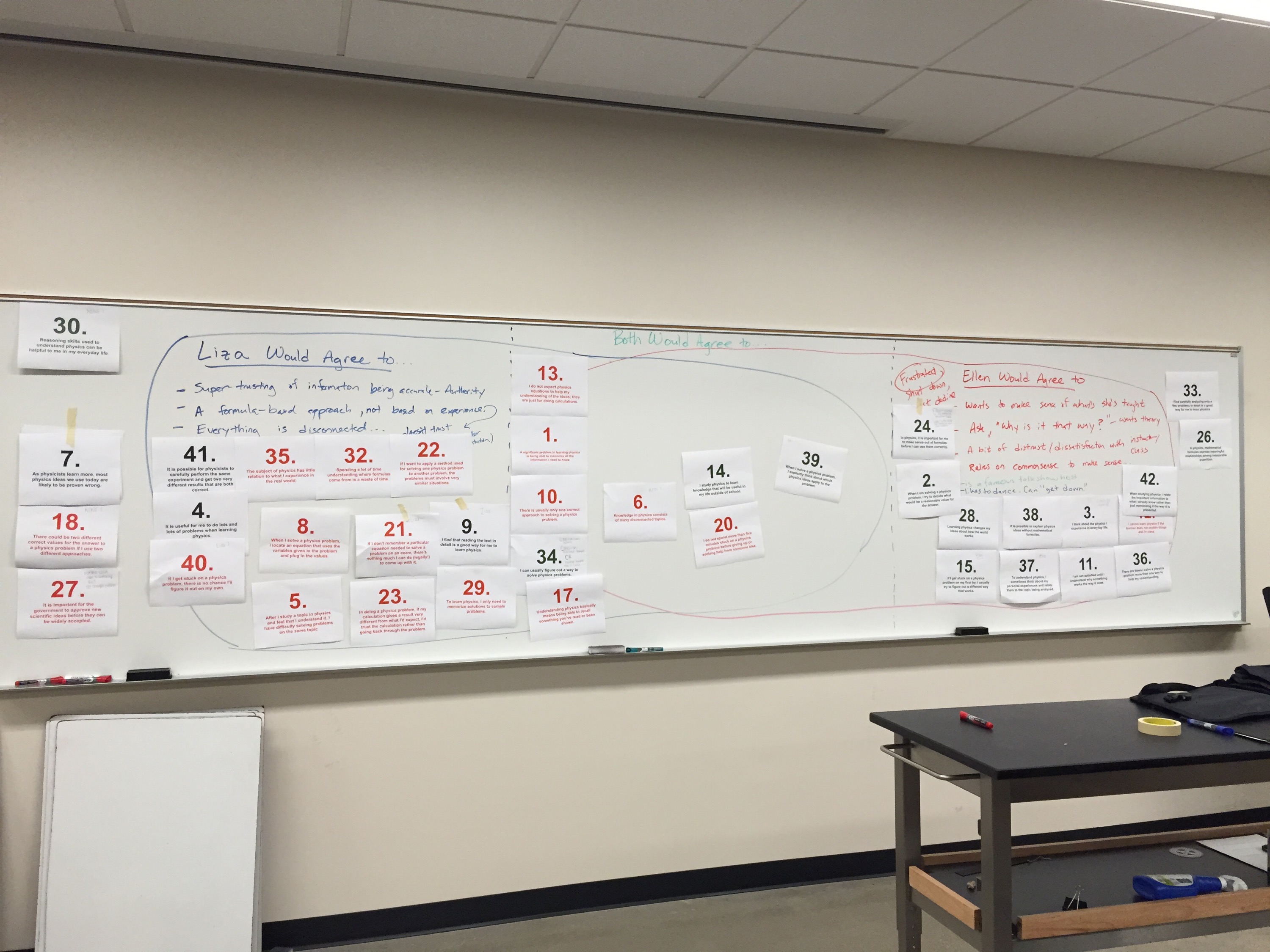
For the LA seminar class on student attitudes about and approaches toward science learning , I ended up color-coding the statements from the CLASS, according to expert concensus: Green for agree, red for disagree, and black for no concensus. I didn’t tell them what the colors meant as they sorted them. To a really good measure, the favorable statements ended up being attributed to Ellen’s approach and the unfavorable responses attributed to Liza’s approach. This is what I expected would happen, and when I revealed what colors meant, it gave us the opportunity to talk about what we’d done and found in a new light.

Next time, I’ll have students jot down their explanations directly on sheets, and then have the class explore the wall, noting any that they think should/could be placed differently. Focus conversation around those. Students had really thoughtful explanations for why both would agree to certain statements, for different reasons. While the small group conversations were rich, the whole class was a little flat, and I suspect that getting a chance to explore the wall would enrich it.

All and all it was a good lesson that should be even better with some minor tweaks.

LA Seminar Brain Dump:

A lesson I’m teaching tomorrow for my LA seminar goes like this:

I.  For homework, students will have already read and wrote a 1-2 page reflection: Hammer, D. (1989). Two approaches to learning physics. The Physics Teacher, 664-670. 

2. At the start of class, students will start taking the Colorado Learning Attitudes about Science Survey. [8-12 minutes] Some time will be allotted for pairs to talk about any items, especially ones they answered differently. [12-8 minutes]

3. I have printed off large index cards with each of the survey statements. Groups will be given 8-10 of the survey statements and have to decide, how two students from the reading would respond to statement–would “Liza” be likely to agree to this statement, or “Ellen”, or both, or neither?  [20-25 minutes]

4. For whole-class discussion, a large Venn Diagram will have been made on the white board is for groups to place their choices and to give reasons for why.  Why do you think Ellen agree but not Liza? Why do you think both of them would agree? Etc. The hope here is that opportunities will arise to dig into each of these approach–both in terms of the reading and our own personal experiences. [20-25 minutes]

[I need to think through a little more clearly the logistics of how I want this to unfold]

5. I’m not committed to getting through all 41 statements (and it wouldn’t pay off), so with about 25 minutes remaining, I want to shifting the conversation to two questions [10-15 minutes]

(1) What are the upsides and downsides to approaching physics either like Ellen and Liza? (In terms of learning? Enjoyment? Doing well in school?)

(2) What are the factors that influence how students choose to approach physics?

[I need to think through this transition, and any need to go back to small groups, etc.]

6. Lastly, I want to just briefly share some of the research results from the CLASS [5-10 minutes]:

(1) Most physics courses negatively impact students attitudes, although there are some exceptions

(2) Student attitudes /approach impact their learning as measure by instruments such as FCI.

Note 1: Somewhere in here I want students to “score” their survey… or at least know what the expert responses are. I might do this just after they take it, but I could also have them identify the expert response for their index cards only, lastly, I could have them return to the surveys to score themselves just before I share results]…  I’m learning toward given that information on the index cards, so that can be part of the conversation when students talk about why/where they placed their index card.

Note 2: I worry somewhat about conflating David’s paper (and research) with the CLASS instrument (and research). They aren’t driving at exactly the same thing, but they are related enough, and I think they offer an opportunity for us to dig deeper into both. Sometimes, papers are worth digging into by themselves, but I’m finding it useful to access the ideas in papers by using other ideas/tools as levers– in this case,the CLASS is a tool that gives us leverage on the paper.

Note 3: I’ve had a lot of success in classes using whiteboard space this way. It makes thinking public during whole class discussion in a way that nicely structures turn-taking, but also splits the task up spatially and temporally. It’s also an opportunity to get up, move around, etc.

Blog at WordPress.com.

Up ↑