Week 2: Broken Angle Puts the Brakes on Blog Updates

Tuesday afternoon this week, I broke my ankle playing ultimate frisbee, so I’m a little behind on the blog updates. Here’s a quick synopsis of the week with some reflection:

Monday: Maintaining Good Facilitation Choices Even When Tired

Monday Evening in Learning Assistant Pedagogy, we discussed and watched some videos from periscope. We watched two videos of Learning Assistants interacting with group as they engage in collaborative activities. We had some decent conversation, but everyone is always a bit tired by 6:00-7:30 pm. I have even noticed myself that I make poorer facilitation decisions in the evening–a lot of times out of sheer exhaustion / laziness.  For example, the day could have ended with a short summary discussion of things we’ve learned about being an “LA”. Through our discussions, ideas like, “making space for students to talk,” “not getting so excited about your own explanation that you take over the conversation, “Restating what students just said to keep the conversation going,” “asking other students if they agree or disagree”, etc. These are all really great insights. And while they came up in discussion, a summary conversation at the end could have helped crystallized these, rather than being merely ephemeral notions that come and go. I chose to end class at the end of the second video discussion, rather than quickly generate a list of good ideas about being an LA that had come up. A second poor decision I made was when a quieter student tried to gain access to the conversation, I cut off another student to give the floor to the quieter student. I did it in a way that came off as awkward. On a better day, I might have said something quickly, “Sarah, you go, and then lt’s hear from Janet.”

Tuesday:  Learning that we have packed too many things

In our revised algebra-based physics course, we have learned this week that we have tried to cram too much in. The days have felt a bit hectic. Not that any one day was bad, but if every day feels that hectic, it grinds on everyone. Some of our activities are just too long; some days we just have too many different things happening. For future planning, we have a goal of  prioritizing better and doing more with less.

Wednesday: Returning LAs are really fantastic to have

In LA prep, we had some really good physics conversations about velocity vs. time graphs. A good range of facility, but students worked well together. One thing that has been great is returning LAs. They really know how to collaborate well (even when it’s thing they already know). It’s nice that they can be there to model that. Instructors have given several compliments about how good those returning LAs are in their classes. One professor even noted that the LA might be better at asking good questions to students than they are.

Thursday: Short Class because of Orthopedic Appointment

I had to shorten class because of the my ankle, so our problem of having too many things was going to be made even worse. But it was a good exercise in cutting out the unnecessary. After a few clicker questions to review piece-wise constant velocity vs time graphs, basically all we did that day was a lab… learning how to use photogate to measure speed, and then taking data for how velocity changes for a cart on an incline ramp. Definitely some revising of the labs was needed, but it overall went well.

Friday:  Physics Tutor Workshop

A year ago, the university started centralized tutoring in the library. We hire physics majors to tutor for intro physics and astronomy. We’ve had a few common complaints about tutors, so we decided to do a brief workshop with them. I’ll be running that this afternoon. Part of the issue is that physics majors go through Matter and Interactions and the algebra-based course starts more traditionally with kinematics. It’s not helpful when the physics majors start by saying, “So you start this problem with the momentum principle.” Other complaints have been that physics majors do not understand second semester topics very well–I think this is especially true for optics. The third complaint has been that some tutors do not “circulate” well. There might be 15 students in the tutoring room, and the tutor spends all the time with just a few students. I may give more details about the workshop in a future post.

Day 5: Mostly A Day for Research (but a little bit of lab grading)

I don’t have classes on Friday this semester. I spent most of the day doing research (learning how to do exploratory factor analysis  on some survey data).

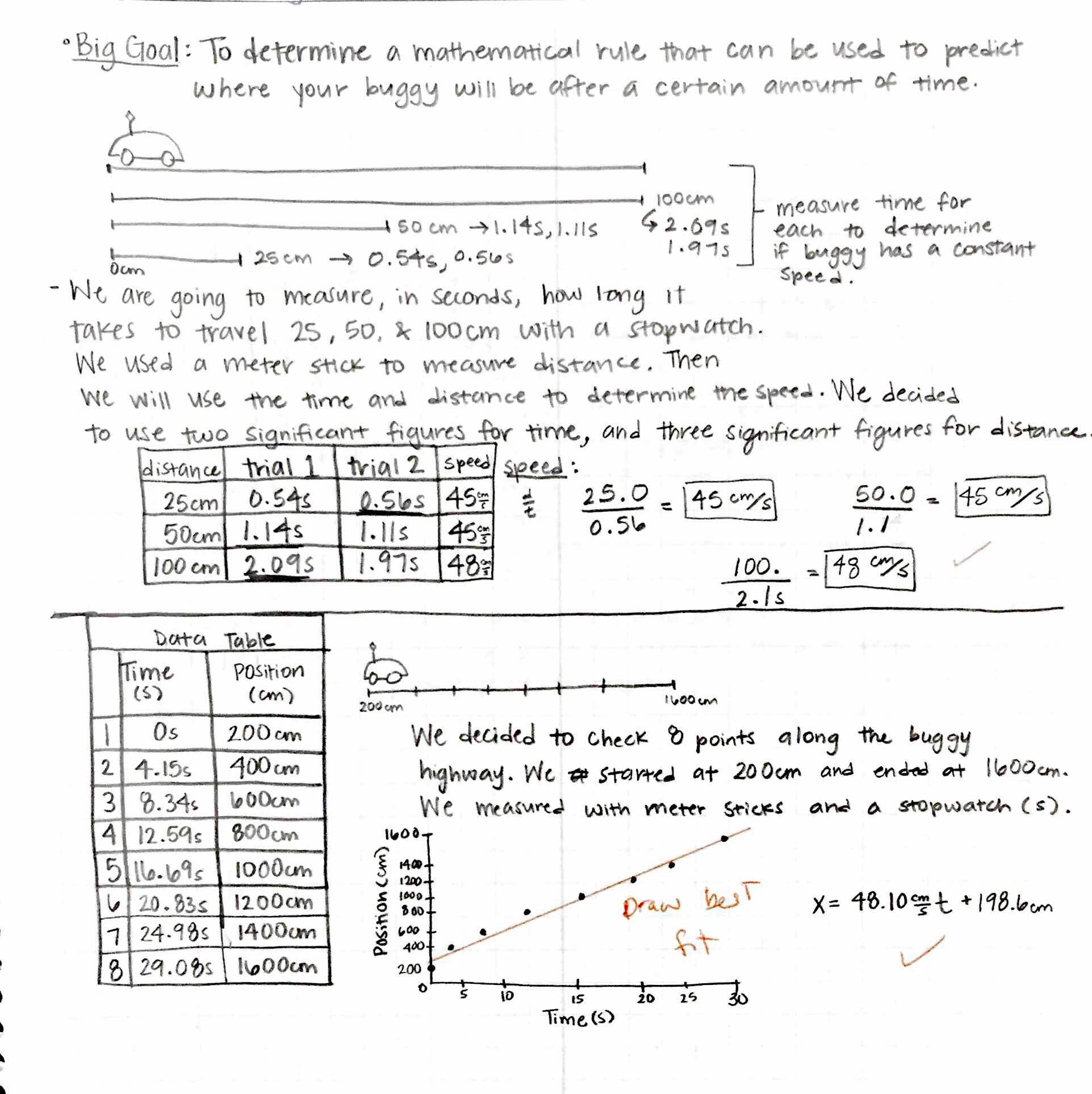
Teaching-wise, I started grading lab books. Here is a photo of one students’ lab book fro the buggy lab to offer a feel for the kind of work they are expected to turn in. Keep in mind, these are lab books (not lab reports).

Lab Book

There are also 4-6  summarizing at the end. This lab had following questions:

  1. How can you decide by looking at your position vs. time graph whether or not the buggy moved at (roughly) a constant speed or not?
  2. What value for the buggy’s speed did you get using your “quick and easy” method? How did this compare to the slope of the mathematical rule you determined?
  3. Write down the mathematical rule you determined for the buggy’s motion.
    1. What would be different if the buggy had moved faster?
    2. What would be different if the buggy had started at a different location?
    3. What would be different if the buggy had moved in the opposite direction?
  4. What did you learn today that might help you address the challenge lab?

Most groups were able to make good connections between slope and speed, intercept and initial position, and the sign of the slope with direction. Based on the lab books, one group, however, did struggle to make those connections.

Today, I have spent some of the day prepping for our next meeting. Students will have read over the weekend two sections from the text that will build on the buggy lab: a section on position vs time graphs and a section on uniform motion. We will also return to class next week with some clicker questions to review these ideas.

Then students will revisit motion detectors to make graphs. [Last time we just used them to make motion diagrams.] This lab exploration starts off just qualitative, with students making predictions and observations as well as doing some graph matching; but it transitions to quantitative stuff with students re-applying what they learned about linear fits (in Logger Pro) last week to extract velocity information. The last task of the lab exploration has them re-measure the speed of their buggy using this new technique.

Then we will have our first day of collaborative problem-solving.

The plan for problem-solving is

  1.  Staged Problem-solving:  We are following Knight’s break-down for problem-solving into “Prepare, Solve, Assess”. So students will be given a problem, and groups will first be asked just to prepare on whiteboard. Preparing at this point involves making pictures, collecting important information, and doing preliminary calculations. A little bit of discussion to highlight different aspects of students’ work. Before beginning the problem, we will ask students to make guesstimate for, “Best Guess, Definitely too Long”.  Then they will solve the problem. Discussion similar as needed. Then they will be asked to assess in variety of ways, including checking against their guesstimate, making sure they have actually answered the question, checking units.
  2. Un-staged Problem-solving:  Students have to do each of the steps, prepare, solve, assess, but we won’t pause to discus between each.

Both problems are two-body uniform motion that don’t involve simultaneous system of equation. For example, one has two cars traveling the same trip, one traveling faster but leaving leaving at an early time. Question is who will finish first and how long will they have to wait for the other to arrive? Students will be required as part of “solve” to make a position vs time graph. Groups who finish solving early will be asked to solve for other aspects, including when and where did they pass each other.

If we have time, I want students to use their skills to solve a real buggy collision problem. Since in the lab exploration, they already got the speed of their buggy again, this may be doable time-wise. I’d like to do this so they can use their skill to actually predict something, but it also rehearses something like our “Challenge Lab”.

Day 4: Finding the Smallest Trustworthy Digits (Lab Uncertainties this year)

Yesterday, in my pilot section of revised algebra-based physics, we talked about uncertainty for a bit and then students did the buggy lab. Lab went well. Only change was groups who finished early had to revise/apply their model to make a prediction and test it out (e.g., buggy starting somewhere new, going in opposite direction, where will it be/ or how long will it take to ___ ).

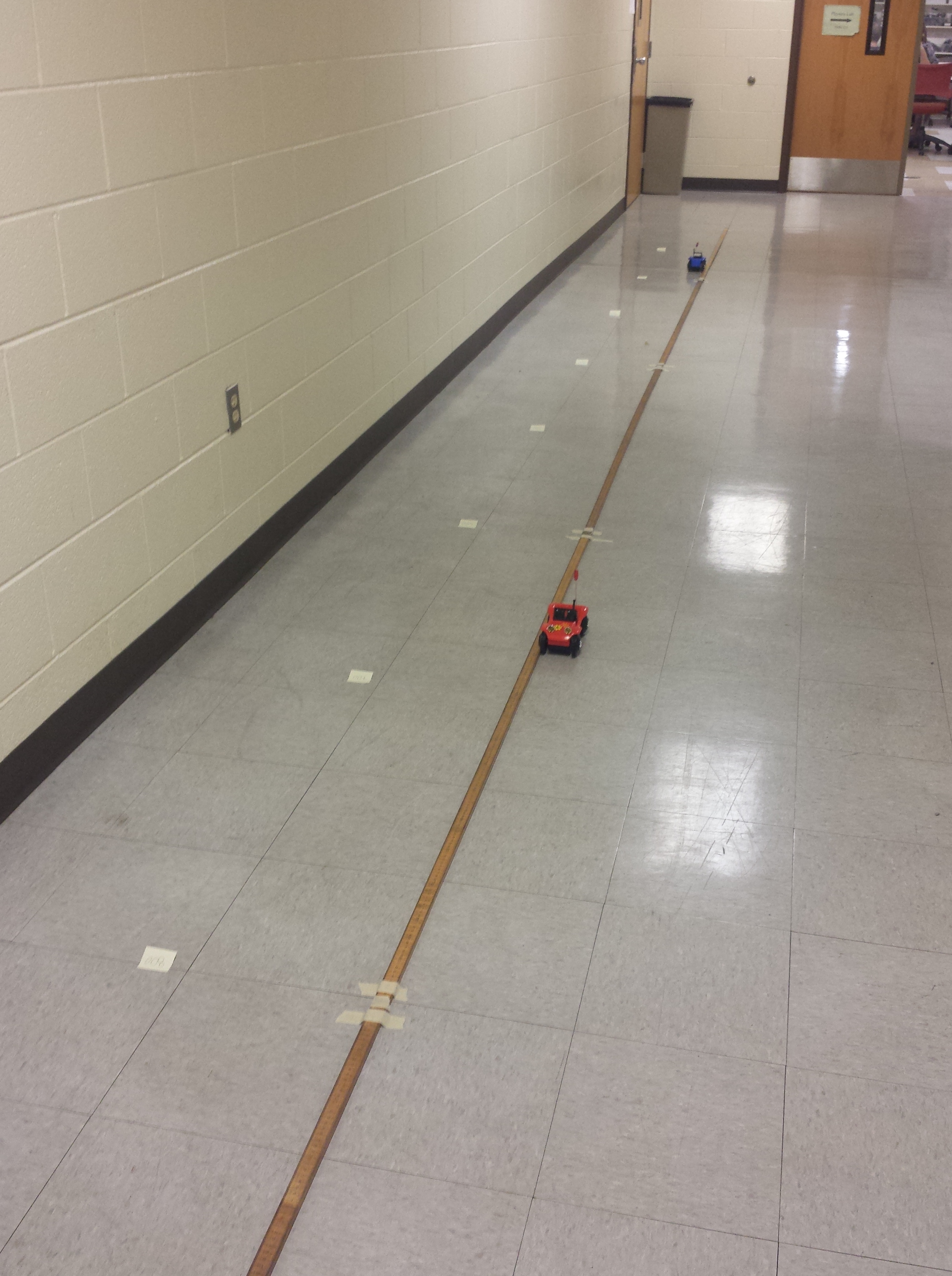
Here is a picture of the buggy highway we set up in the hallway:

IMG_20150828_075459

Lab Uncertainties: Last Year vs This Year

For uncertainties, we used to have students estimate measured uncertainties, calculate percentage uncertainties, and then have students identify the largest (average) percentage uncertainty of all their measurement types before using that to propagate uncertainty to any calculated results (e.g., slope).

Now, we have students take multiple or repeated measurements to help inform judgments about which digits seem “trustworthy”. We defined trustworthy digits as those that don’t change much upon repeated measurements. This leaves some room for ambiguity which is fine– for example, we had clicker question to identify where the smallest trustworthy digit was with repeated measurements of 12.69 ft and 12.91ft. Either the ones place or the tenths place could be justified. For propagating uncertainty, we have students use the rules for significant figures, because that’s what is taught in Knight’s College Physics. Overall, I’m pretty happy with this approach. In the first lab, we actually had interesting conversations about uncertainty instead of mind-numbing conversations about how to apply the rules.

For example, one group had measured time repeatedly in their “Quick and Easy” speed calculation (before a more careful investigation), and found that their time measurements really only had 1 sig fig (something like 5.87s, 7.07s, 6.32s). They were unhappy with rounding 24 cm/s down to 20 cm/s. They felt like this was losing accuracy. When they later found the speed using graphical methods, they got 19 cm/s. They were really surprised that their 1 significant figure rounding was closer than their 2 significant figure rounding. One student said that hadn’t realized that such a thing was possible.

Day 3: Launching the Buggy Lab

In our new algebra-based physics pilot tomorrow, we will be doing the fairly standard constant velocity buggy lab. Prior to lab, students will have read about coordinate systems, position, and time, and even calculating speed, but we have not studied uniform motion.  Here’s our particular twist on getting that lab going.

Launching the Lab:

The Buggy Highway:

We set up a long “buggy highway” across the length of the hallway outside our lab room. This consists of about eight 2m-sticks lined up back-to-back and taped to the floor. Using sticky pads, we mark out an origini and key landmarks at every 100 cm.

The Deliberately Vague Question:

After orienting students to our coordinate system, we turn on a buggy so students can see and hear the wheels move, and pose the question,”If I put the buggy down somewhere along our highway, where will it be when I yell stop.” (Alternatively you could ask,”If I put the buggy down somewhere along the buggy highway, how long will it take for the buggy to hit a wall?”) Following the Den of Inquiry model, we are hoping to cultivate the response that, of course, “It depends.” Our job is to draw out from students what they think it depends upon (e.g., how long I wait before yelling stop, how fast the buggy moves, where I place the buggy down, which direction the buggy moves, whether the buggy goes straight or curves, etc). Whatever they say, we try to value it by echoing back why that makes sense and writing it on the board.

Establishing Criteria for a Good Model:

The broad goal of the lab is to determine a mathematical rule (or model) that can be used to predict where the buggy at every moment (given I might yell stop at any moment). With that purpose, we draw attention to several specific factors from above because they map well to the parameters of the mathematical model they will be developing using graphical analysis. We want to frame at the outset that a good model better take into account things like how fast the buggy goes, where it starts, and which direction it goes. In addition to having a model that can actually make predictions, these three become criteria by which we will evaluate whether our model makes sense (intuitively).

Measuring Speed “Quick and Dirty“:

Before sending students off to take data in a more guided way (position and clock readings), we ask students to find a quick and easy way to estimate the speed of the buggy without taking a lot of measurements. We are hoping that this does two things: (1) Starts them off with something they know how to do (calculate speed as distance over time), and (2) maybe makes it more likely they will later recognize the slope as related to speed. [I’m slightly worried it will make it easier, but less meaningful.]

Everyone start somewhere different:

When sending students off to take data, we have students start at different locations and have a mix of cars going in different directions, with of course some having fast/slow buggies.

Tomorrow, I’ll let you know how it goes!

Day 2: New Pilot Section of Algebra-based Physics (First Day)

Today was the first day in a pilot section of a newly developed algebra-based physics course. I am piloting one section and a colleague is piloting the same in a second section.

Some details about the changes include

Text: Changed from a Home-grown text to Knight’s College Physics

Homework: Changed from no HW to Mastering Physics

Labs: Changed from confirmation labs to a variety of lab format including qualitative explorations of phenomena, guided investigations, and application/challenge labs.

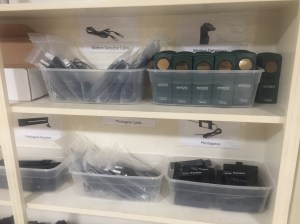
Equipment: From teacher control over lab equipment to open student access to a variety of vernier lab equipment (sensors, cart, tracks, etc).  Each day students must retrieve and return at last some their equipment. On “challenge” labs, students have to decide what equipment they want to address the challenge.

Shelf Labels

Groups: From lots of unstructured group work to more structured group work (a lot of this came about from students having free access to equipment… we only wanted one person per day to be retrieving/returning equipment). This led us to think more critically about group roles. We still have some work to do in building assessment (peer/self/whatever) to our structure.

Hours:  From Two 2.5 hours studio session + one 1.5 hour lecture to two 3 hour student sessions.  Mini-lectures are interleaved with collaborative problem-solving, labs, clicker questions, etc.

Clickers: Clickers were used exclusively in the 1.5 hour lecture, now they are integrated into the studio sessions.

What are the biggest differences in philosophy?

– Units were organized around “Culminating Challenge Labs” (like practicals in Modeling Instruction).  We designed backwards–asking first what do we want students to understand and be able to do –> then what lab challenges would representatively sample that terrain of understanding –> then finally what learning experiences would give us confidence students would be able to succeed. Our lab activities and problem-solving sessions are intended to equip students with the skills necessary to be successful with the challenge lab. This semester, we’ll be discovering what gaps we’ve made to large and what gaps we’ve overly smoothed over.

– Students having open and free access to the lab equipment is rooted in us trying to give students more agency in the lab. Previously, it always felt like, “we owned the lab equipment” and we set it out for students to use when and how we wanted. We are trying to provide an environment where students feel like it’s their equipment and they get to use it when they need it. Part of that of course is helping them to feel confident in their ability to use it, but releasing control. We will be working on getting the balance right, but I’m happy this is a driving factor of our course.

– A stronger focus on qualitative understanding and conceptual reasoning. We have better balance, which is largely supported by having the new text, using “lab explorations” to introduce topics, and implementing collaborative exercises and clicker questions that focus on that aspect. We tend to move from phenomena –> qualitative representations –> quantitative representations.

Outline of First Day: Introduction and Motion Diagrams

1 hour for course introduction /logistics and pretest

1 hour to interactive lecture demos, clicker questions, and collaborative exercises about motion diagrams

1 hour for lab introduction to logger pro and motion detectors (I created a file to have motion detector make motion diagrams instead of graphs… students practice getting equipment for the first time, connecting their equipment, accessing software, and then they are guided to make predictions/observations for various motions of objects including their hands, fan carts, etc.)

Overall, it went well.

LA seminar Update


See other similar posts for more background:


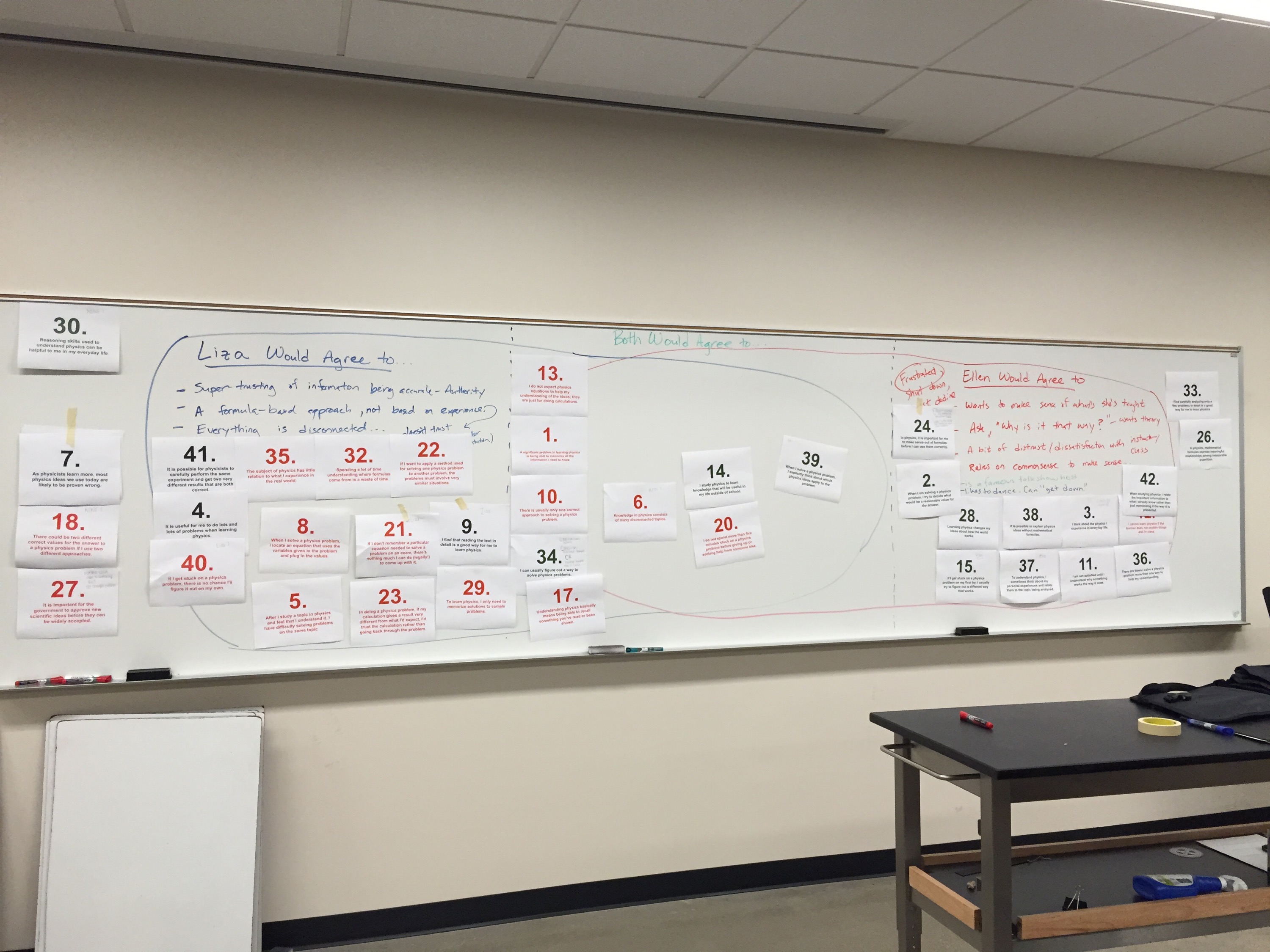
For the LA seminar class on student attitudes about and approaches toward science learning , I ended up color-coding the statements from the CLASS, according to expert concensus: Green for agree, red for disagree, and black for no concensus. I didn’t tell them what the colors meant as they sorted them. To a really good measure, the favorable statements ended up being attributed to Ellen’s approach and the unfavorable responses attributed to Liza’s approach. This is what I expected would happen, and when I revealed what colors meant, it gave us the opportunity to talk about what we’d done and found in a new light.

Next time, I’ll have students jot down their explanations directly on sheets, and then have the class explore the wall, noting any that they think should/could be placed differently. Focus conversation around those. Students had really thoughtful explanations for why both would agree to certain statements, for different reasons. While the small group conversations were rich, the whole class was a little flat, and I suspect that getting a chance to explore the wall would enrich it.

All and all it was a good lesson that should be even better with some minor tweaks.

LA Seminar Brain Dump:

A lesson I’m teaching tomorrow for my LA seminar goes like this:

I.  For homework, students will have already read and wrote a 1-2 page reflection: Hammer, D. (1989). Two approaches to learning physics. The Physics Teacher, 664-670. 

2. At the start of class, students will start taking the Colorado Learning Attitudes about Science Survey. [8-12 minutes] Some time will be allotted for pairs to talk about any items, especially ones they answered differently. [12-8 minutes]

3. I have printed off large index cards with each of the survey statements. Groups will be given 8-10 of the survey statements and have to decide, how two students from the reading would respond to statement–would “Liza” be likely to agree to this statement, or “Ellen”, or both, or neither?  [20-25 minutes]

4. For whole-class discussion, a large Venn Diagram will have been made on the white board is for groups to place their choices and to give reasons for why.  Why do you think Ellen agree but not Liza? Why do you think both of them would agree? Etc. The hope here is that opportunities will arise to dig into each of these approach–both in terms of the reading and our own personal experiences. [20-25 minutes]

[I need to think through a little more clearly the logistics of how I want this to unfold]

5. I’m not committed to getting through all 41 statements (and it wouldn’t pay off), so with about 25 minutes remaining, I want to shifting the conversation to two questions [10-15 minutes]

(1) What are the upsides and downsides to approaching physics either like Ellen and Liza? (In terms of learning? Enjoyment? Doing well in school?)

(2) What are the factors that influence how students choose to approach physics?

[I need to think through this transition, and any need to go back to small groups, etc.]

6. Lastly, I want to just briefly share some of the research results from the CLASS [5-10 minutes]:

(1) Most physics courses negatively impact students attitudes, although there are some exceptions

(2) Student attitudes /approach impact their learning as measure by instruments such as FCI.

Note 1: Somewhere in here I want students to “score” their survey… or at least know what the expert responses are. I might do this just after they take it, but I could also have them identify the expert response for their index cards only, lastly, I could have them return to the surveys to score themselves just before I share results]…  I’m learning toward given that information on the index cards, so that can be part of the conversation when students talk about why/where they placed their index card.

Note 2: I worry somewhat about conflating David’s paper (and research) with the CLASS instrument (and research). They aren’t driving at exactly the same thing, but they are related enough, and I think they offer an opportunity for us to dig deeper into both. Sometimes, papers are worth digging into by themselves, but I’m finding it useful to access the ideas in papers by using other ideas/tools as levers– in this case,the CLASS is a tool that gives us leverage on the paper.

Note 3: I’ve had a lot of success in classes using whiteboard space this way. It makes thinking public during whole class discussion in a way that nicely structures turn-taking, but also splits the task up spatially and temporally. It’s also an opportunity to get up, move around, etc.

Mid-Semester Feedback in Physics I

I always post these, because they help me to process when I write them, but it’s also interesting to share. I’ve been sharing these ever since I started, so I figured I keep it up.

What do we do in class that is helpful for your learning? Why specifically do you think it is helpful?

– The group work is helpful because it provides the input and collection of ideas, by solving the problems together.

– Whiteboard exercises and emphasis on showing all work and graphs. Good tool for working together and talking through each and every step. Coming around and questioning our methods and helping us understand why. The emphasis on showing work is great and help you learn more solidly. Before I used to zoom right to the answer, but I know I write out every formula, process, and graph and it has spilled over into my other classes, improving my grades.

– Test example questions are helpful because they give a clear view of what to expect.

– For me, having to work out problems step by step helps me because I can go home and have those guidelines to do HW. This is helpful b/c I have a hard time memorizing things quickly. The labs are helpful because I learn things better by doing hands on activities than from reading.

– Thorough explanations are good, needless to say.

– The amount of practice each class session we get. Working as a group helps other to catch up.

– Working out and explaining problems on the board, because it allows one to see if they actually understand the problem and if not they see where they don’t understand and can ask questions.

– Group work is good way that helps me a lot in this class. I always ask them when I face a problem I don’t understand and they help me out. It seems to me that the problems you give us to work are helpful.

– I don’t like group work, however I find it aids the learning process greatly. Group works puts everyone in that group in a teaching role at some point, which is a better way to learn something.

– Whiteboard problems, worksheets, reading quizzes. All these provide repetition, Practice makes perfect. With the LAs on Fridays we also have the ability to work problems with most of our questions answered.

– The most helpful thing is coloring the different quantities different colors.I

– Not only do we work problems on the board while you guide us, we also work in groups. This helps because any questions I am stuck on, someone who is learning something new can help me understand how they did it. All of the extra practice problems and being able to apply physics to real life in labs helpme

– Working in groups and whiteboard problems, we support each other and drawing is fun

– Working together for about 45 minutes is so helpful, save in time plus more and more things to learn from the group.

– Hands on Labs and working in groups. This is helpful because we help each other learn.

– Solving a lot of problems is one of the most helpful things. Also,the LAs who come to class to help on Fridays are so helpful.

– Group work seems to be helpful because you can get other people’s ways of solving problems. With different ideas, I think that is a helpful way for me to learn.

– Having problems worked out with the group is beneficial to me because if I don’t understand the problem or mess up one of the steps, I can turn and talk to one of them to figure what I did wrong.

– Working in groups is nice. Not just doing lab after lab as well, LA, time, and worksheets change the pace. I also think that the amount of work given is helpful.

– Working out problems on whiteboards are helpful, because it keeps the group on the same page and doesn’t let one be ahead of the everyone else of behind.

– When you go through problems step by step and then allow us to go back to our desk (to try to do it on our own). It allows us to break down a long problems into more “simple”steps.

– I enjoy working on practice problems in class, because it helps understand what different parts of the problems are and it’s more practice.

–Working in groups is helpful because it’s like a system of checks and balances.

– Group work, whiteboard problems, labs, etc.

– Worksheets help me because they give me problems to work in class, however, they also give me problems to work outside of class.

– The most helpful is when the instructor starts explaining  a problem and then he gives us a similar problems.

– I think when all of us roll up to the board, it’s very engaging.

What do we do in class that is NOT helpful for your learning? Why specifically do you think it is unhelpful?

– Nothing specifically I can think of… but a slower pace of problem-solving would be more effective. I think sometimes we are rushing.

– Everything is helpful. The only less-helpful thing is getting around the front board to watch your work a problem. I already understand most of the material, but I can see how it is needed in this class and will be helpful for me in the future.

–Color coding problems. I already have to remember how to solve the problem. I feel that trying to remember what each color means is just added stress.

–I am having a hard time in my new group–they are catching on quicker than I am and they rush through the problem. When I ask for clarification, the problem is explained, but too quickly. I felt like my first group worked much more as a team than my current group.

– Can’t think of anything.

– I cannot think of anything

– Whiteboarding and color-coding. I can’t work with others on the test, and I can’t use color pencils on the test, so it it seems like a waste of time and resources. I suggest everyone work by themselves.

–Everything we do in this class related to the main idea, so nothing is unhelpful.

– I feel like my first group had a great dynamic, and I can understand how others might not want to stay in their first group. I felt so comfortable with my first group, which for me helps the learning process.

– Sometimes we go at too fast of a pace than I can handle. I know we have  a  schedule that is set, but sometimes it’s hard to grasp certain concepts in the designated time.

– I find some of the labs to be less helpful, because the problems tend to explain themselves. But I guess I know some people learn more through actions and visualizations. So I guess they are helpful.

– Everything we do is helpful in some way.

– Switching groups. I can work easier with my first group, because I was accustomed to their way of thinking and working. That made for a good learning environment.

– We should have a quiz toward the end of class, so we can be more confident and have an indication of what we learned that day, or if there is still progress to be made.

– Working in groups can also not be helpful a times, because we don’t always work at the same pace. Some could work faster and sometimes people do not feel like slowing down.

– Counting off  a lot of points on labs is not helpful.

– Certain days, we rush through topics because we have too many activities to do. We buzz on from one thing to the next, and sometimes I hardly understood the first. Maybe we could only do one thing at a time.

– Everything that we have to do in lab in one class is too much to get finished before the end of class.

– Mandatory group changes. I had a real solid and helpful group at the beginning.

– Always doing group work is not helpful, because when I get home by myself, there is not one to get feedback. I know it’s my responsibility to work independently outside of class, but I feel group work is making me too dependent on others.

– Working in groups all the time. Sometimes my group understand something better than I do and finishes the work before I even know what’s going on.

– Nothing is unhelpful.

– I can’t think of anything.

– Nothing really.

– Sometimes working in groups is confusing. This can be unhelpful when I get home and have to work alone.

– Nothing is unhelpful, but we could work in groups a little less, because I feel I just want to finish the problem instead of understand everything.

– Nothing.

Is there anything you want to tell me? Something that’s been on your mind?

– Slow down a little sometimes?

– Nope

– (Blank)

– I am enjoying your class and it’s challenging me.

– It helps me when I am given deep, complete explanations as to “Why?” Once I understand something intimately, I know it. If we do not understand the murky depths, how could we hope to venture?

– This is the best lab I’ve had for a long time.

– I like the LAs, because I’ve appreciated having women in the classroom to teach us, they help keep our attention on topic a little more.

–(Blank)

– I wish we had more coffee. Never ending coffee. This 8:00 AM business is crazy. Coffee.

– As of now, things are going well.

– This class does a good job of teaching to different learning styles. I happen to be fond of math, so I tend to pick up the problem without the extra help, but I’m still enjoying the class even if it sometimes seems repetitive.

– I wish you had more office hours.

– Nope

– You rock, Frank!.

– I understand why you grade labs the way you do, I just wish you didn’t.

– No

– Everything seems to be OK. I do enjoy the content and challenge of this class.

– Nothing is on my mind about how this class could be different.

– Group changes. I enjoyed working with my friends. Reading quizzes should start 10 minutes later, to give grace to those who are trying to get here, but are having one of those days. We also need morning incentives, like coffee. Once a week? We need more than a lab activity to get us here on Fridays.

– Nope!

– (Blank)

– Nope 😉

– No

– Nope =)

– I wish we had more problems solving, because that’s what the test consisted of.

– (Blank)

– I’m confused about LA activities versus Lab activities, so I sometimes get the reading quiz questions wrong when it’s about what we are doing today.

Brain Dump about Promoting Collaborative Work in Physics I

This semester I am back to teaching first-semester physics. One thing I have noticed about myself this year is how much more direct I am with students about my expectations for collaborating in groups and for the quality /care that should go into whiteboards.

Beyond just communicating expectations more explicitly, I am assessing more and intervening as necessary. I have noticed myself deploying three different kinds of interventions:

– Discussing with students that collaborating over intellectual work is a skill that one develops with practice and that it’s a specific goal I have for them. In these conversations, I’m not only reiterating expectations and communicating that I am serious but I am trying to situate it within a growth mindset. I try to be sympathetic but firm with students here. When I see them making efforts or progress here, I specifically let them know they what I am seeing.

– Modeling and providing specific talk moves. There is a range here, but a common one I model and give them is simply for one person to verbalize their thinking and then someone else has to either affirm (agree) and say why, or ask a question back about what they said, or disagree and give reasons. Often times I do this after I’ve helped facilitate such a dialogue. For example, I’ll ask one student to explain something and then reflect that back to the group. Another student agrees and I probe them to say why. Then I’ll recap what happened with group, pointing out the good contributions that each made, and talk about how they could have that same conversation without me.

– Making analogies to help students get in the right mindset for noticing each other’s bids for collaboration and being kind to reciprocate. The two I’ve been using are dancing and conversation with a friend. The friend analogy that has come up is when you are really trying to get something across to your friend and then all they say back is, “yeah” or “ok”, and you sort of feel like, “well they don’t even really care, or weren’t even listening.” We talk about how a good friend conveys they were listening and that they care by stating back the gist of what was said, and by perhaps affirming or acknowledging parts of the story. The dancing analogy has mostly been about how it takes more than one person to dance, and that both partners have to be attentive to each other to make it go smoothly. After this conversation, I might walk by a group and notice a student verbalize their thinking and no one looking up from their own work, and just say in passing, “Wyatt is asking someone to dance…”

Some students have told me that they are not talkative, implying that it’s a burden or just won’t happen. I realize that there are differences between introverts and extroverts, and a lot of our classrooms can favor extroverts. But I have introverted students who quietly and productively collaborate with each other, so… ?? What I’ve been telling students is that I’m not asking them to jabber jaw or to just be chatty. I’m asking them to practice the skill of talking as you engage in collaborative intellectual work. I negotiate with some groups about the balance between “think, then talk” vs “talk as thinking”. We’ve also talked about how sometimes you need to say, “hold on hold on, I need to think about this for a second.” So far, listening to students concerns, negotiating forms of engagement, while holding my ground, has gone well with students.

Overall, each day we’ve been making incremental progress, but yesterday seemed like a lot of groups passed a threshold, where they are naturally and enjoyably engaging in intellectual work with each other. I had a dozen students staying after class ended to continue working on physics problems, and the quality of work and collaboration made me think that these students could easily be mistaken for physics majors.

I’ll keep tending to the fire.

And I definitely have one group that is not clicking well. I’ll need to devote some time to observing them as they work.

And I need to build in some time where students have choices about how to work–by themselves, with others, on paper, on whiteboards, etc.

Questions from Teaching of Physics

On the first day of my teaching of physics class, I asked students what questions / concerns they had about physics teaching and what they hoped to take away from this class.

Here is our list:

1. So far, I’ve been given frameworks for planning individual lessons (and maybe a sequence of lessons). How do I plan for meaningful instruction on time scales beyond a lesson? Like a whole course?

2. I’ve learned that I came out of introductory physics with much my conceptions inadequately addressed. How can I teach in ways that address students’ (mis)conceptions?

3. I know that explaining isn’t all there is too teaching, but there are many concepts in physics I feel inadequately prepared to explain, even to myself. How do I develop my repertoire of explanations of physics concepts for learners?

4. I’ve learned that I will likely teach physics at many different levels–physical science, freshman physics, honors physics, junior/senior physics, AP physics. How am I to adjust instruction and curriculum to all these different levels?

5. What determines the pace of instruction? How much time do you devote to specific topics? When is it time to move on?

6. Is it possible to teach effectively in this era of high stakes testing? Can you teach AP physics through inquiry and prepare them for the AP exam?

I’m glad I did this. Already students seem to be oriented to the class as potentially meaningful and relevant. They have a stake in shaping what we do and what issues our efforts speak to. I’ve left room in my plans to move in on their questions, but I know that we will ultimately address some of these much more than others.

I do plan on asking students to revisit these questions regularly during the semester, and also to add to and refine these questions.

Lastly, I’d love to hear people’s thoughts. Or if anyone feels passionate about one of these questions, I’d love to talk about having you talk with our class.

Blog at WordPress.com.

Up ↑