QM Derivations: “Pause to Think” Questions

I don’t spend a crazy amount of time deriving everything little thing in QM class, but I do work through some of our text’s derivations at the board. I try to chose those that I feel either give us an opportunity to grapple with important ideas, emphasize certain techniques, or those that help us keep a coherent narrative through our course of study.

I’ve been trying to use clicker questions at key points during the derivations to keep students engaged and hold them accountable for reasoning. Today we were working through ideas about how commuting operators have simultaneous eigenvalues, and how this leads to fact that QM states must exist with both definite values of angular momentum (magnitude) and one component of angular momentum (but not more than one).

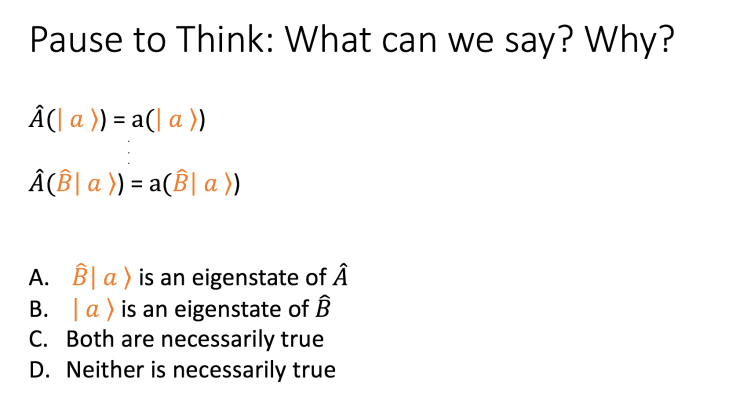
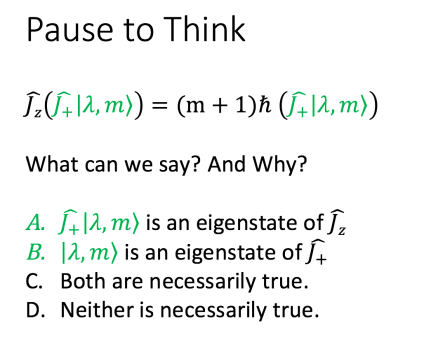
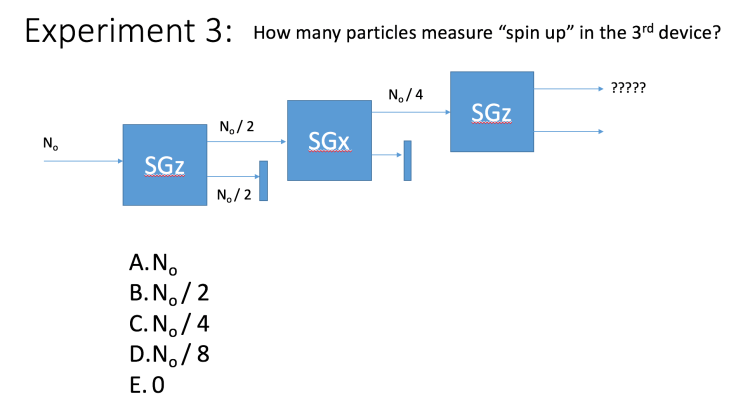
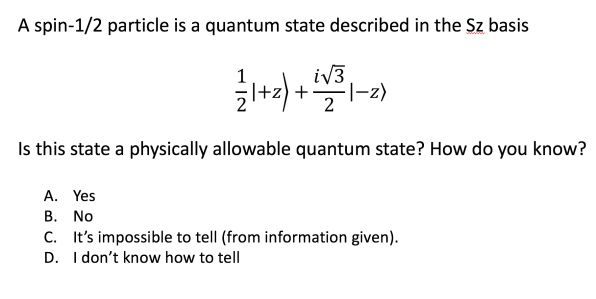
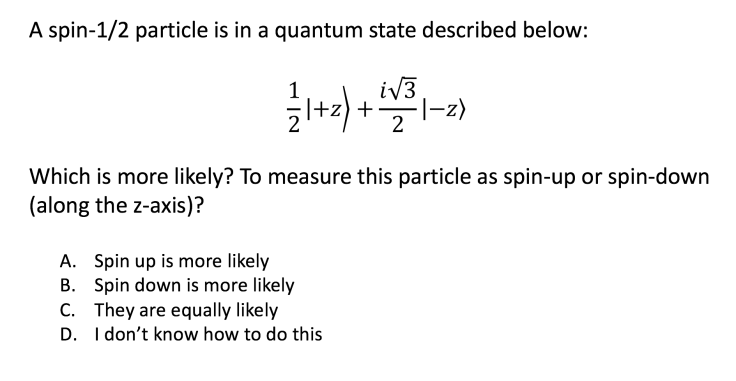
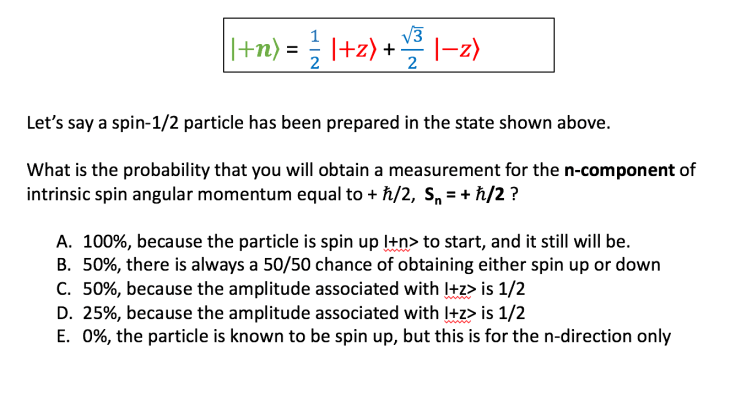
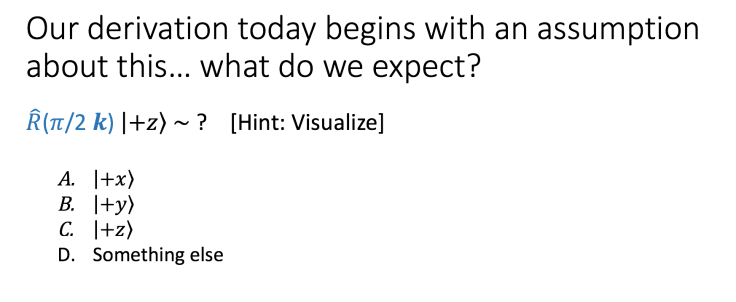
Here are two examples of places where we paused to think about what we can and can’t conclude.

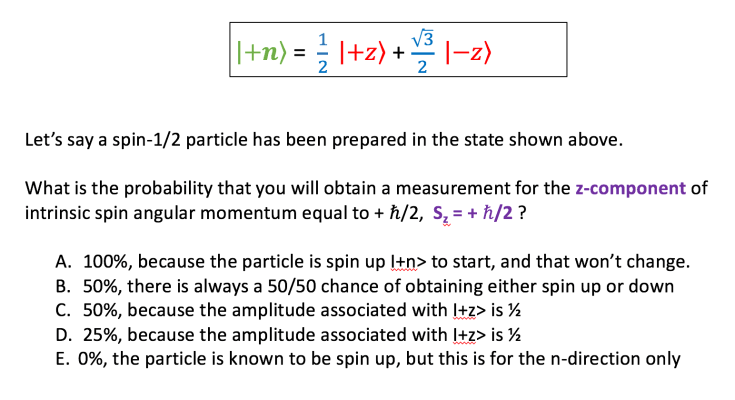
screen-shot-2016-09-13-at-6-35-44-pm

Screen Shot 2016-09-13 at 6.35.54 PM.png

I’m not sure if doing these is optimal, but so far it’s not been awful either.


Physics I Mid Semester Feedback

As usual, I give a early semester feedback survey to students. I have for years now been reporting students results, so here they are. No surprises here.

What do we do in class that is helpful for your learning? Why?

Summary: Students like a variety of things, including discussion, group work, whiteboard problems, seeing examples, hearing and explain thinking. Students reasoning touch upon a lot of important notions, such as active engagement, self-assessment, coaching, peer learning, self-explanation, etc. A few students mention ideas that are more focused on test prep.

My Response: Help them to see that there are a variety of things that people like. It is useful for them to know that their opinion is not necessarily “the opinion of the class”. If I have time, I might tell them about a few educational things.

It’s helpful that you provide visual examples and explain what is happening and why it is happening. It helps put into perspective.

Whiteboard problems are helpful. It allows me to think for myself and how to solve the problem.

Clicker questions and whiteboard problems. Help me to think on my own and discuss with my group why and how I got my answer. Whiteboards because it makes it easier to know if I really understand it or not.

The interactive stuff like the position vs time graphing with the motion detector, and the small group stuff.

Whiteboard problems and examples

When we do whiteboard problems, it allows me to practice while helping others or get the help from others that I need.

Making us explain concepts to each other. I tend to grasp concepts better when I am explaining it, like with the clicker questions.

When you walk through a problem step-by-step and have us immediately solve a similar problem. This allows us to understand what we are looking for without just giving us the answers.

I like the group work, I feel like I understand better from […] especially.

Being able to see a problem being done (or even just set up), and then working problems together in our groups, because I can see where I need to work on.

Practice problems on the whiteboards. Questions and discussions as a group.

Examples, because it let’s me see what kind of problems to expect on a test.

Clicker questions, because we discuss we each other. Sample problems and then letting us practice on our own.

Practice problems. The extra lecturing on learning strategies and techniques help with problem solving as well. Having students engage and interact in activities (like the one with the graphs). The quizzes keep me up to date on the reading.

I love the group work. I love having to figure out of problem in groups. I love the whiteboard work in groups.

Going over and practicing many different types of problems.

Solving problems on whiteboards in groups.

Whiteboard problems, because we work together to answer questions.

You breaking down everything is helpful, even though it is annoying.

Going over and working problems that are similar to exam problems. It helps because many times reading the lectures is confusing, so going over it in class helps to clarify.

Individual discussion among tables for explanation can be helpful for cementing a concept and help retain it,

I really like the example problems we do in class.

Practicing questions together.

Whiteboard problems together, because we can ask what we did wrong when we are in class.

The whiteboard problems help because writing it out and working on them with other people helps me when I make a mistake.

I like the quizzes. I find it helpful to focus my reading. And going over problems.

The practice questions that we work out in class is very helpful, because it helps me see the process, step-by-step.

Working with groups. It helps because if I get confused, I can ask my group for help.

When other students explain how they got their choices to the whole class. Even though you explain things well, some professor just don’t.

When the instructor does a problem and give us a problem that is similar. We team up to do it and on own, and it this helps me learn the material more effectively.

What is unhelpful for your learning and why?

Summary: Reading quizzes are stressful as is the idea of changing group.

My response: I will re-explain the purposes that the quizzes serve (getting students on time and them reading means we can “make the most” of our time together). I will change the grading so that showing up for the reading quizzes gets you 5/10, the five questions will be worth the remaining 5 points. For group stress, students will be able to request one person to work with and one person not to work with. When we change groups I will also structure an activity where they reflect and and discuss what worked and didn’t work well with their last group, and get them to form a plan/ norms for working well together.

Nothing.

I like group work, but sometimes it is more helpful to do things on your own.

Spending time on problems, when I feel like most of the class gets it.

The quizzes stress me out, and even though I’ve done well on them, I feel that they haven’t been as helpful to my learning as they are supposed to be.

Changing groups won’t be helpful, because now I have to relearn people and become comfortable with them, when I could just stay with my group and focus on learning, and how the awkwardness of meeting new people.

The reading quizzes don’t help me because I read the reading and study and still can’t seem to do well.

I’m sometimes confused about lab… [they are not unhelpful] they don’t always make sense, especially the questions in the back of the lab.

Doing practices that are not going to be on the test.

Nothing. The class is eclectic in all its phases.

The limited ability to go beyond the current situation, whether the lab or the topic.

Nothing is unhelpful, but working on whiteboards is the least helpful. I still think it is valuable.

Nothing.

(Blank)

I don’t have any complaints.

Switching groups. I connected with my group on the first day, which is very unusual. No one is looking down on anyone base on whatever question they had. Every single one of us literally have something to offer to the rest of the group.

Nothing, this lab is very helpful and is much more interesting than I thought it would be.

I don’t find the reading quizzes helpful. They add anxiety and stress towards coming to class. and they take away from the excitement of being here.

Everything we do is helpful.

Can’t think of anything.

Nothing is unhelpful. It might not help me, but it doesn’t hurt.

Everything we do so far seems to have a purpose.

Everything seems helpful, but the least helpful is making us explain our answers to each other when sometimes we all have the same answer at our group.

Nothing.

Reading quizzes. Either way I’m going to read the lecture.

Too many whiteboard problems, maybe try doing some individually. That way we actually test if we can do it ourselves, and not just one person in the group.

Nothing.

Can’t think of anything.

Nothing.

Most things seem optimized to help us learn as well as we can.

——–

What else do you want to tell me?

Summary: Students want more problems to practice problems.

My Response: I will guide / remind them in how to effectively work out problems at home. Give class time at end of the day to “deciding with their group” what problems they might like to try before next time, and making a plan for when you get stuck (email/call a friend, sign up for office hours, go to tutoring, etc).

(Blank)

I would like more test review. On the test, I had a hard time reading the questions and understanding them. There are so many different ways they can be worded.

I just wanted to say thank you. I was really nervous about this class, but you have made us feel comfortable and make it easy to ask questions.

(Blank)

More practice questions.

Labs are fun, but I wish we had more time to work on labs

Please don’t make us change groups. I am actually comfortable with my group.

I know its early in the semester, but when doing practice problems, everyone once and a while I’d like be given a problem that really makes everyone think outside the box.

It’s too bad Gene Wilder passed away. Really enjoyed his career even thought he hasn’t bee in a  film for quite some time.

I just wish we had more problems to work. Maybe do a practice exam in class that is timed?

I know reading quizzes are helpful, but quizzes everyday are a drag.

I’m very appreciative of this class. Thank you.

This is my favorite class this semester.

I wish we did more whiteboard problems it really helps you prep.

I feel this class is working out well.

So far so good, the only thing is I took physics in high school, and its been boring and frustrating at times to have to go over material I already know.

For my first physics class at MTSU, I have no complaints. Keep Rocking!

I wish we worked more whiteboard problems.

We need more breaks, to help with transitioning between things.

Can we practice more problems?

I love class discussions.

So far this class has been better than my high school physics class.

I would like to do more problem-solving in class.


Just sharing QM Clicker Questions, Matching/ Ranking Tasks

Just sharing my QM clicker questions… feel free to use. [Edit: I’ve added some commentary.]

Day 1: Magnetic Moments and Introduction to QM

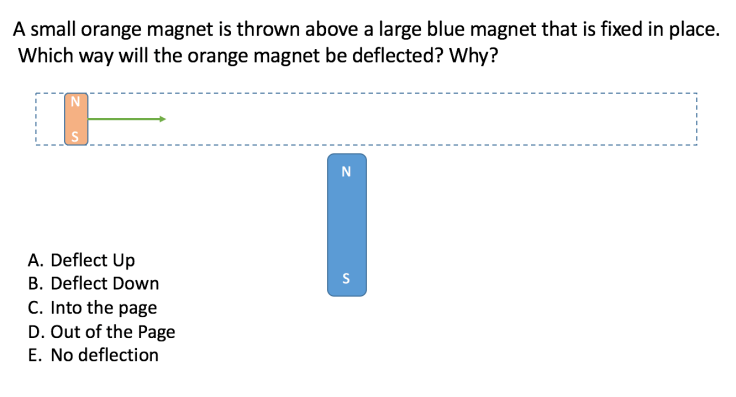
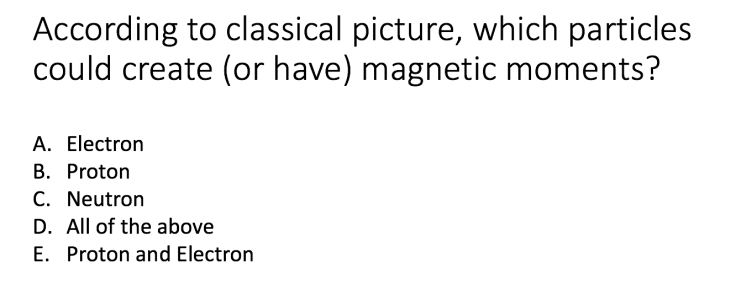
Question 1.1: Classical Stern-Gerlach thought Experiment. I

I used this question before a mini-lecture on magnetic moments, the magnetic potential energy associated with dipoles in a magnetic field, and then derived the magnetic force from the gradient of the potential.

In hindsight, I wish I began with (or also discussed), clicker questions about charged particles moving through magnetic fields (because students are more familiar with this). On a HW problem, many students did not clearly understand that this magnetic force was the result of a neutral atom having a magnetic moment in a magnetic field gradient, rather than a charged particle experiencing a magnetic force due to its motion through a magnetic field.

Screen Shot 2016-09-04 at 10.09.35 AM.png

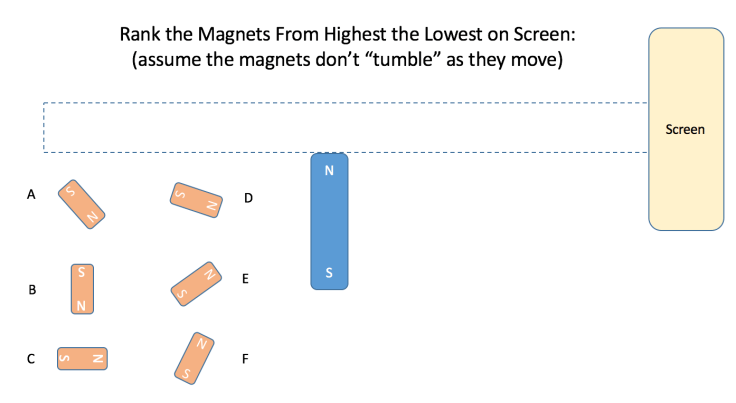
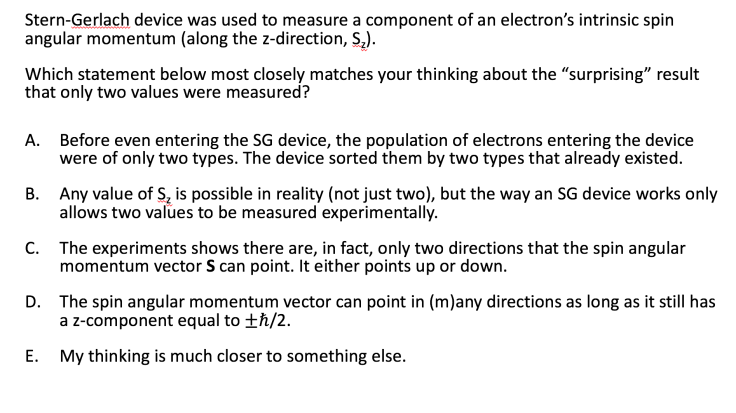
Question 1.2:

After deriving the relation ship between, magnetic moment and force, I wanted them to think about how only the z-component matters for the deflection. After this, we talked explicitly about the SG experiment, and how the result is surprising because we only see two possible values, rather than a continuous distribution of values.

Screen Shot 2016-09-04 at 10.11.29 AM.png

After the Stern-Gerlach experiment discussion, we returned to question of “Why do particles or atoms even have magnetic  moment? After deriving an expression that relates angular momentum and magnetic moment, I asked the following question

1.3:  Classical Magnetic Moments

Screen Shot 2016-09-04 at 10.10.41 AM

I wish I had spent more time (or pushed to the HW), discussion about why with the silver atoms we are measuring the intrinsic magnetic moment of the electron.

Day 2: More SG Experiments.

Question 2.1:

This question was the warm-up, serving to remind them about the SG experiment, and also challenging them on their interpretations of the results.

Question C should be revised to say, “straight up or down”. The goal here is to make sure that students know that the device only measures the z-component. Answers D is an good “classical” interpretation for them to be at this point.This question gets returned to at the end of the day, after we discuss other SG experiments.

Screen Shot 2016-09-05 at 6.29.25 AM.png

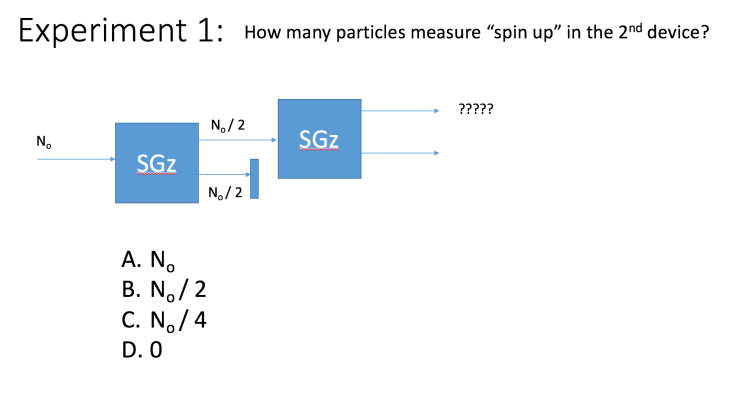
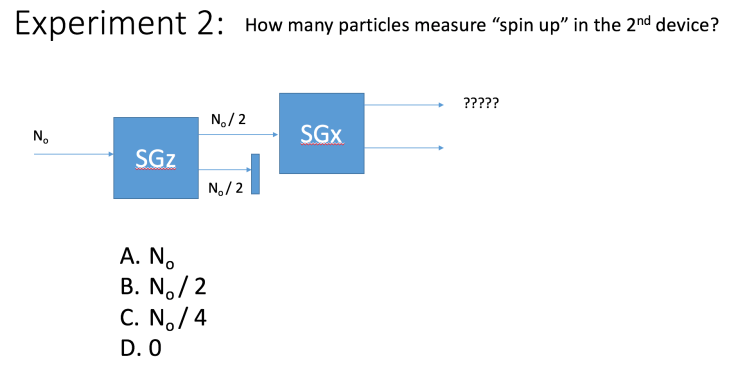
Question 2.2: Students were supposed to have read through these experiments. Instead of lecture through them, we did clicker questions. We did lots of “how are you making sense of this?” Lots of “classical” interpretations naturally arise, such as “randomizing”, “filtering”, … these aren’t bad ideas. Later we’ll want to push them toward QM ideas about incompatible measurements, uncertainty relationships, etc, but now is not the time. I need them to “sense-make” with the results.

After each experiment, I introduce the formalism of dirac notation and how we “encode” states and the experimental results using bra, kets, inner products, etc.

Next time, I want to introduce the “frequency vs angular momentum” graphs now rather than later. And informally “notice” things about those distributions.

Screen Shot 2016-09-05 at 6.57.03 AM

Screen Shot 2016-09-05 at 7.00.35 AM

Screen Shot 2016-09-05 at 7.01.16 AM.png

Question 2.3:

After introducing the formalism, I want to give students a chance to practice.

Screen Shot 2016-09-04 at 9.54.45 AM

Screen Shot 2016-09-04 at 9.57.07 AM

Day 3 Clicker Questions:

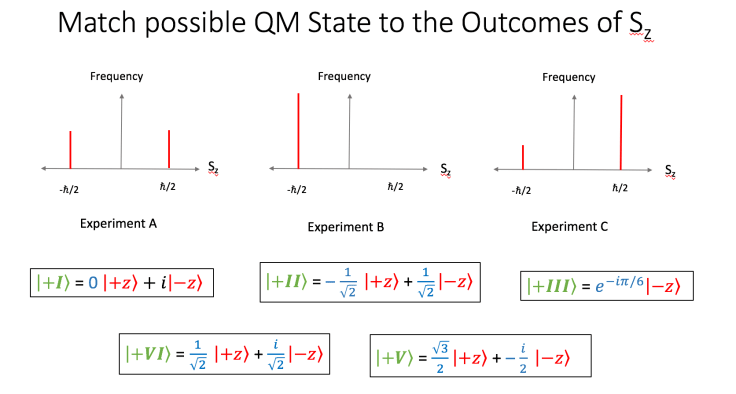
Question Set 3.1:  Sense-making about Off-Axis Measurements

These questions are after a HW problem where students looked at QM spin states that are prepared “off-axis”. Good warm-up for the day.

Screen Shot 2016-09-04 at 9.58.06 AM

Screen Shot 2016-09-04 at 9.59.38 AM.png

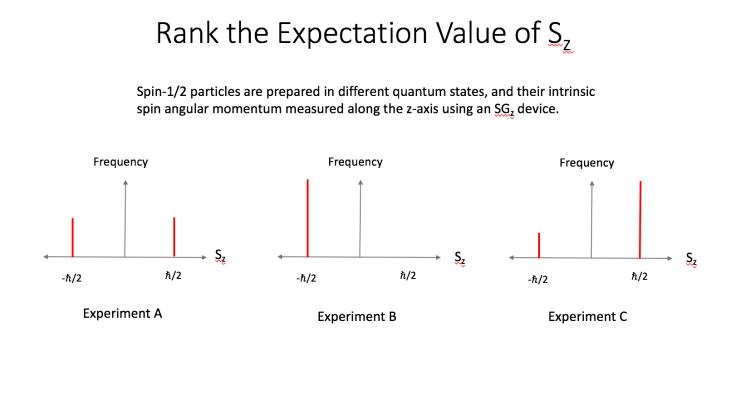
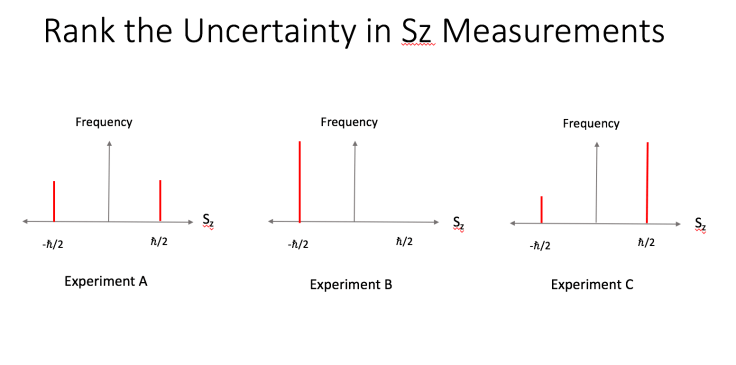
Question Set 3.2: “Seeing” Uncertainty and Expectation Value

In previous week, we didn’t talk in class a lot about expectation value and uncertainty. Students had calculated them for the HW, but I wanted to help students understand what they were even calculating. These ranking tasks were great for the job.

Screen Shot 2016-09-04 at 10.00.10 AM.png

Screen Shot 2016-09-04 at 10.00.47 AM

Screen Shot 2016-09-04 at 10.01.19 AM.png

The rest of the day was spent doing example problems and introducing rotation operators.

Day 4: Reviewing Trouble Spots and Representations of Operators

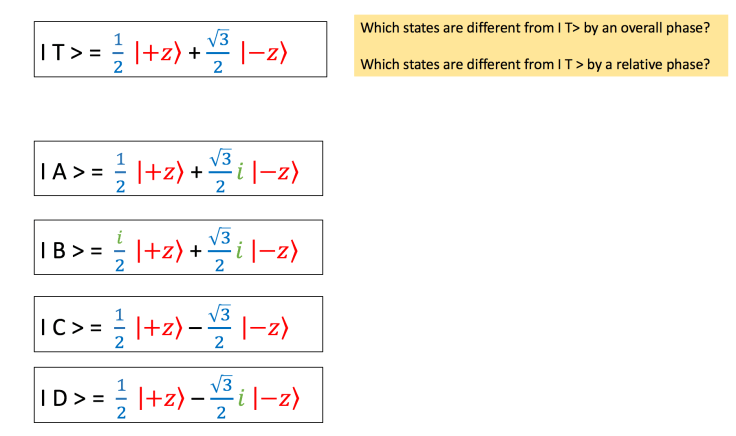
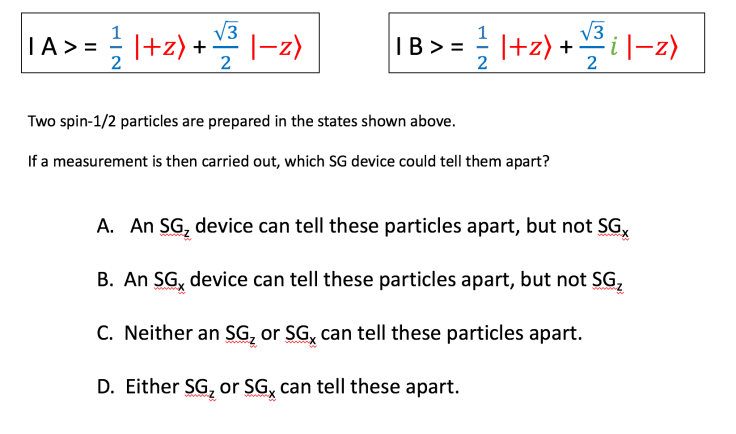
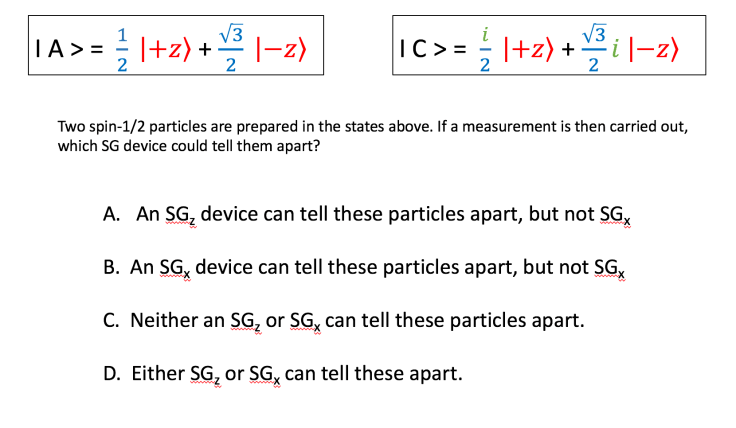
Question Set 4.1: Overall Phases vs. Relative Phases

Students struggled on a HW assignment about relative phases, and it was clear we needed to discuss it more. So we spent the beginning of the day hashing it out.

The second of these three questions is pretty challenging.

Screen Shot 2016-09-04 at 10.02.10 AM.png

Screen Shot 2016-09-04 at 10.02.40 AM

Screen Shot 2016-09-04 at 10.03.50 AM.png

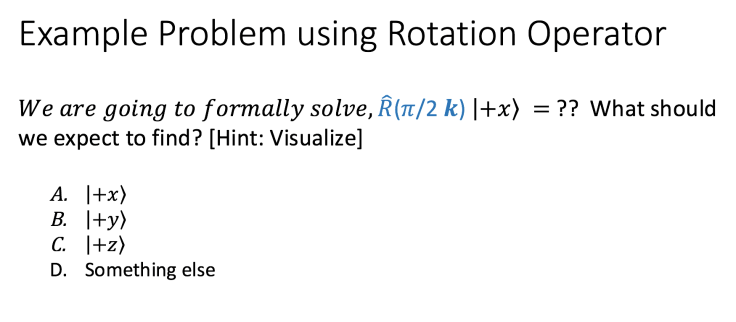
Question Set 4.2:  Rotation Operators and Phases

One kind of clicker question I try to use is “getting started”, “or checking for understanding” in derivations I do in class. I try not to lecture too much, but certain derivations are useful to go over in class. My way of engaging students is ask questions along the way, that force them to think about what we are doing.
These questions are doable if you understand what the operators are doing, what the notation means, and can visualize rotations in a right-handed coordinate system.

Screen Shot 2016-09-04 at 10.13.35 AM.png

Screen Shot 2016-09-04 at 10.06.11 AM

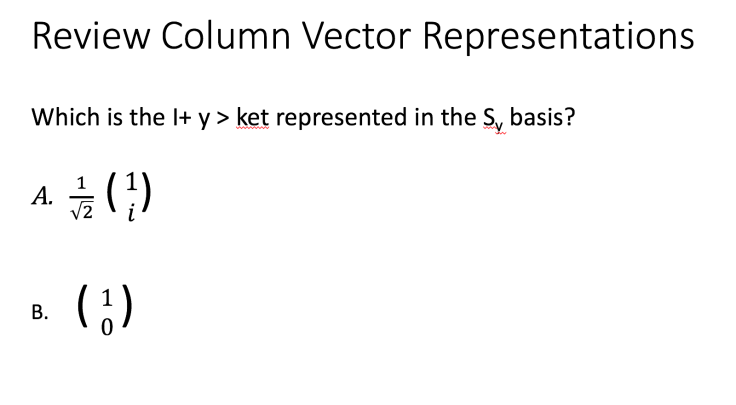
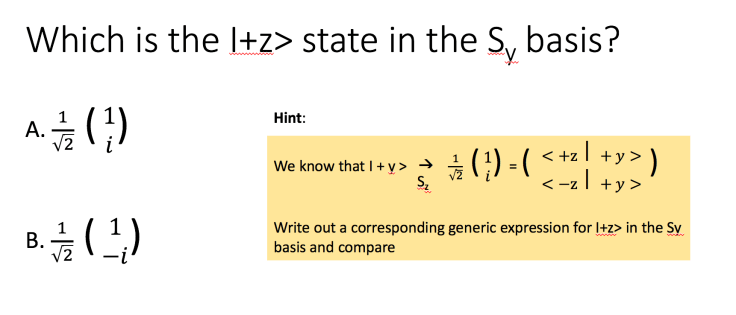
Question Set 4.3: Representations in Other Bases

The day ended with a review of representing bra/kets in column and row vectors. An upcoming HW problem asked students to do similar work, so I wanted to make sure we discussed it. Prior to this we had only explicitly represented states in the Sz-basis.

Screen Shot 2016-09-04 at 10.06.36 AM.png

Screen Shot 2016-09-04 at 10.08.17 AM.png

We spent the rest of the day introducing operator representations.

Magnetic Dipoles Oscillating Near Coils

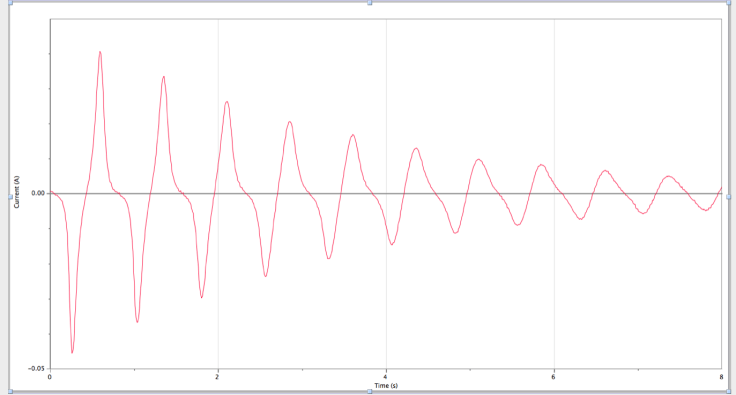
In class this semester, we used bar magnets oscillating on springs through solenoids to induce alternating currents. In getting ready for lab, I noticed that, in certain configurations, the current induced was sinusoidal (as desired), but in other configurations they induced current was periodic but not very sinusoidal. This got me wanting to model the phenomena a little more closely.

By Faraday’s law, the induced potential (and current) is related to change in magnetic flux through the coil. A big reason for the non-sinusoidal regime it turns out is due to how a magnetic dipole field (on axis ) goes like B ~ 1/z^3, where z is the distance from the center of the dipole.  Anyway, since the area isn’t changing, the change in magnetic flux will be driven by the change in magnetic field in the coil as the magnet moves, which goes like 1/z^3.

Using the Chain Rule, we can write, dB/dt = dB/dz* dz/dt. This shows that the change in flux is driven by two factors, the gradient of the B-field and the velocity of the bar magnet.

Assuming the motion of the bar magnet is roughly damped harmonic oscillation, we can write z(t) = A exp(-rt) cos(wt) + C.  A is the amplitude of the oscillation, C is the offset equilibrium position of the magnet above the  coil.

Making additional assumptions that the damping is small, the velocity will be roughly, dz/dt = wA exp(-rt)sin(wt) [The other term in the product rule will be small]

Anyway, plugging in our expression for z into our expression for the dB/dt, we get V ~  exp(-rt) sin(wt) / (A(cos(wt) +C)^4

To make sense of this, we have to think about large amplitudes vs. small amplitudes (relative to the offset C).

When A is really small relative to offset C, the denominator is roughly constant, so the change in magnetic field is dominated by the numerator and should be roughly sinusoidal. This means that the change in magnetic flux should be in sync with the velocity. High velocity means rapidly changing flux. When the amplitude is significant compared to the the offset, the denominator comes close to zero, and so has a big impact. That is, the magnetic flux is strongly affected by gradient of the magnetic field.

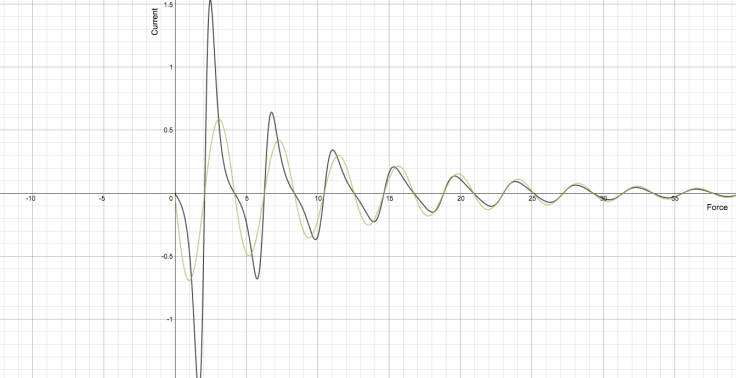
Here is a graph of the induced current vs time (black) and speed vs time (green), based on the models above.

73hethji3p

You can see that the model shows that as the amplitude decays, the induce current and speed of the bar magnet get in sync (and both are sinusoidal). When the amplitude is large, the peak current does not correspond with peak velocity.

Actual data for the induced current looks something like this:

Screen Shot 2016-05-11 at 7.45.29 PM.png


There are a lot of assumptions and simplifications of this model, but it gets a lot of the behavior right. Lots more to dig into, but don’t have the time to get distracted right now!


Students Explaining Diffraction Fringes

After a diffraction problem on our recent, I asked students to explain why the bright fringes even occur. The quotes below included diagrams not shown (which made them even strong), but you can get the gist of student explanations from what they have written. These were definitely the strongest in the bunch.


Strong Examples:

“Bright Fringes are caused, because when the laser light passes through the diffraction grating, it can be treated as a wave. The slit is so narrow that the wave spreads out in a circular pattern toward a screen., and all of this happens in multiple locations on the grating. Along the screen, where the wavelengths of light meet correctly–where they’ve traveled a difference of an integer number of wavelengths (meaning the path difference is a whole number of wavelengths), there is constructive interference. At places where the path difference is  m + 1/2 wavelengths, there are dark spots caused by destructive interference. This destructive / constructive interference can happen in multiple places, so you get a pattern of bright and dark fringes.”

“When light passes through the small slits (they sit side-by-side), the light wave spreads out from each slit in circular patterns. All of this happens right on top of each other so that the waves interference with each. It gets kind of crazy. At places where all the waves land in phase–when one crest occurs will all the other crests for example,  the light waves amplify each other to create a bright fringe. Because there are lots of slits in a diffraction grating, these bright fringes occur more and more infrequently the further you go away from the central bright fringe. They are also very thin–constructive interference only happens in a very precise location. What happens more commonly, on the other hand, is that destructive interference occurs. Because of the many wave fronts overlapping from different slits, they are much more likely to be out of phase, thus creating large sections of dark regions between the bright ones.”

“The bright fringes are caused by constructive interference of the light waves. When the waves are in phase, their crests and trough lines up causing constructive interference. This is a wave property of light. As the waves pass through the slits, they diffract away from grating in spherical wave fronts. When waves from one slit have traveled a certain number of wavelengths, they constructively interfere with waves that came from other slits that have traveled “m” number of wavelengths (m being whole number). When all the waves constructively interfere, the amplitudes of the wave is increased dramatically, making intensely bright fringes.”

—–

Slightly weaker ones usually had nothing incorrectly said, but may have had idea of constructive / destructive but not clearly linked to path difference and wavelengths. Or a student might have commented on the importance path difference and wavelength, but not linked to the mechanism of constructive interference clearly.

The weakest ones without incorrect information might just have said, “constructive interference”, or mentioned something vague about wave-like behavior with out details.

The incorrect ones almost almost always mentioned either refraction (I think confusing refraction with diffraction/interference) or mentioned something about how only certainly rays make it through the slit (confusing I think with discussion of a pinhole camera, how rays are blocked from entering the camera).

——

I didn’t, but I’d like to assess these explanations using something similar to PSET (clarity, completeness, correctness), so that simply saying the word, “constructive interference” would might get less credit than a thoughtful attempt to explain using refraction.

Converging Lenses

Lots of refinement needed, but this overall was a good day:

1. We started with some prompts to qualitiatively explore real images formed with a converging lens. We use optics kits from pasco, which are nice because it’s all magnetic and easy to use. Students found an image with object far away, noting orientation, relative size, relative location, and explored how that changed. Guiding questions helped focus their exploration, including one prompt to find where image and object appear about same size. Student observations went in their notebooks and we discussed key relationships we had seen. 
2. Then there was some brief Direct Instruction about Converging Lenses, followed by an example of ray tracing to locate an image (no equations). 

3. Students were prompted to use a ray diagram to predict where an image would form with their setup, and then check their prediction.
4. Getting Quantitative. I put up a graph of image distance vs object distance, and included two data points we had seen: one where we had seen the image size equal object size and the one students had predicted using diagrams. Each group was given a data point to think about (object distance), and a sticker. They were asked to discuss where on graph they expect to their data point to end up. 

At first our graph looked sort of like a “V”. I prompted groups to find a point that they disagreed with and to explain why they think it’s wrong and where they would move it to and why. We had two lines of reasoning: some based on our qualitative exploration, some based on ray diagrams. 

After first round of changes our graphs looked like a line with negative slope, but with one point very clearly not on the line, showing a much more drastic change as the object position got small.

I can’t remember my exact prompt, but goal was to get them thinking about whether we expect the trend to follow a line or not. A big idea emerged:

An object at the focal point can’t create an image, because the Rays come out parallel and will never form a point. 

I gave some space to this idea, making sure it was understood, but also helped usher this idea toward infinity/asymptote like ideas. After much discussion, we adjusted our points to reflect the vertical asymptote idea.

5. Each group was then tasked with taking data and adding it to our graph. We took a brief break. Over the break, a few students were debating whether or not a horizontal asymptote existed and whether it was at 0 or focal distance. 

6. After break, students recorded the collective data in lab notebooks, and I gave some direct instruction on the Thin Lens Equation. This needs to be done better, with more students exploring graph properties and less me showing. Anyway, we ended up modeling the data and finding a focal length that was within 1 mm of advertised focal length. 

7. Students were then given some practice problems with the thin lens equation. If I did this again, I would ask groups to change to a different lens, and use both ray tracing and thin lens equation to predict something. This time probably to predict object location of you want an image to appear somewhere. Or maybe ask them to determine an unknown focal length. 

8. I ended the day by working an example with a virtual image (magnifier), both diagramming and using thin lens equation. This led to an introduction to sign conventions. We practiced those conventions with clicker questions. 

That was 3 hours full of stuff: exploring phenomena, predicting using ray tracing, predicting and discussing expected data trends, collecting and analyzing data, intro and practice with the thin lens equation, and then clicker questions to crystallize new information. 

Day 4 Physics II Brain Dump

I. Warm-up Mini Calculation, Clicker Question, and Problem: A quick warm-up to review.

Calculation: Students were given questions to find wavelengths in air of the frequencies at the extreme of human hearing range. They were first asked to state which should be larger and why, and also to give a ballpark estimate for what their guess this distances might be.

Clicker: Students were shown a story graph and a snapshot graph for a wave, both with quantitative information, and asked to determine the wave speed.

Problem: Students were given a problem about a boat on ocean waves. They were given information like wave amplitude, wavelength and wave speed, and they were asked to first construct a snapshot graph and story graph, and then to construct velocity vs. time and acceleration vs time graphs for the boat.

II. Direct Instruction: Showing a PhET Sound Demo, to introduce idea of waves traveling not just in a line but spreading out in 2D and 3D. The simulation makes it easy to link back to story graphs and snap shot graphs. Beyond that, I had two goals here. Point out that the amplitude of the waves seems to go down as it travels away from the source. Our goal today was to build up the tool’s that would help us explain why that happens. My second goal was to introduce the new representation of “wave front” diagrams, linking this idea to their reading about spherical waves –> plane waves.

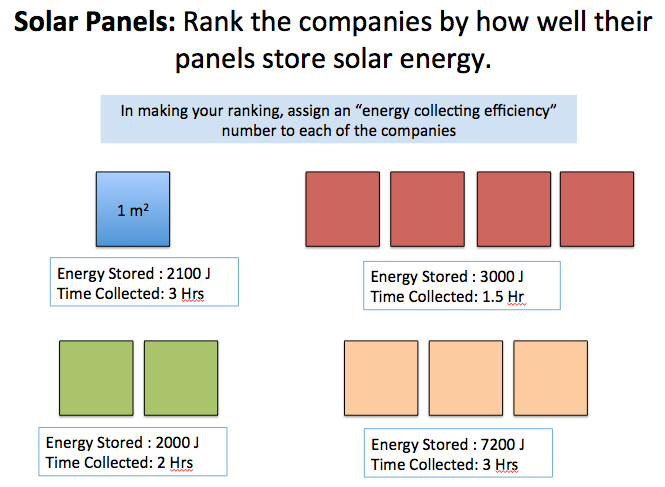
III. Invention Task: Students were given the following task for an invention task

Screen Shot 2016-02-05 at 1.20.40 PM

Students caught on to this pretty quick. We had some (rather limited) discussion, which led into direct instruction described below.

IV. Direct Instruction on Intensity, Power, and Energy, plus an Example Problem: I leveraged the invention task to introduce the concepts of Intensity. After briefly introducing the idea, I applied it to a problem about using a lens to focus light (How much energy passes through lens each second; what is the intensity of the light after focusing).

V. Student Problem-Solving: Students were given two problems–one about how much energy an ear drum absorbs at a rock concert; and another problem to estimate how big the largest solar array in america must be.

VI. Direct Instruction and then Clicker Questions to Extend the Intensity Idea:  Had some brief direct instruction and clicker questions to extend the idea of intensity to a sound spreading as a spherical wave (1/r^2). Some of the instruction and questions were meant to pose this as a way of explaining why sound loudness decreases with distance—and to distinguish dampening (energy transforms to thermal) vs energy spreading (same amount of energy becoming less concentrated). After class, a student had lots of questions about this and the 2nd Law of thermodynamics.

VII.  Direct Instruction and Clicker Questions on Decibel Scale: This was brief, mostly to give student an intuitive sense for the decibel scale, rather than a formula sense.

VIII. Problems we didn’t get to: Students were supposed to end the day with a problem applying the idea of intensity decreasing in a spherical wave to calculate how the sound intensity level in dB decreases, but we were tired and running out of time.

Notes: With no lab on the day, it was kind of a slog, but not as bad as some no lab days can be. There lots of opportunities for student to think, discuss, work problems, etc,… but ultimately we needed a little more space in the day for play in order for us not be exhausted. This should be my new design principle–is there enough play?

Day 3 Physics II Brain Dump

This is our first day of waves, after a week of studying oscillations. [Sorry again for the wordy brain dumps, but documenting what I’m doing is just easy to off-load this way].

  1. Warm-up: As they walk in, students are asked to grab a microphone, plug into a Logger Pro, and play around with sounds. The default setting on Logger Pro is about 0.03s of data collection so its a good time scale for seeing things. Students are given some suggestions as what to try such as singing a note like “ahh”, “ooh”, “whistling a note”, “snapping their fingers”… but encouraged to explore. Lastly,  students are asked to find a sound that looks the most sinusoidal and apply the curve fit method to determine the frequency of that sound. I circulate around a fun conversations with students about what they are seeing, ask them what it means that the frequency is 250 hz etc. Students also had lots of interesting questions, too. I ended this exploration with some brief bridging commentary about our transitioning from talking about localized oscillations (e.g., mass on a spring) to waves … by means of asking the question, “How does the oscillation in your vocal chord show up as an oscillation inside the microphone?” and that our study of waves will be about how oscillations (or vibrations) are transmitted from one location to another through a medium.
  2. Direction Instruction with PhET Simulation and a Slinky: I motivate the need to step away from sound waves to spend some time studying waves in a situation that is more concrete and more visible–waves on a string. With the PhET simulation (and later the slinky), I show some wave pulses and talk about the typical transverse wave stuff (each of the objects is moving up/down), even though our eyes track what looks like an an “apparent” motion to the right. Then I orient students to the wave-speed. I repeat a bit of this with the slinky, focusing on each coil is doing, vs what the pulse appears to do.
    • First Clicker Question is what effect making a bigger pulse on the slinky will have on the wave speed. Students vote, discuss, and then we observe. A big idea here is that you while you can control with your hand motion what Amplitude and the Width the Pulse has, you can’t control how fast that pulse moves away from you.
    • I then ask students to think about what if anything we could do to change the wave speed. I then model how increasing the tension changes wave speed. We then use plastic slinky vs a metal slinky to show the effect of mass.
    • Students are introduced to the relationship for wave speed: involving Tension and linear mass density. I don’t say much about linear mass density except to show an equation and say how you would measure it.
    • 2nd Clicker Question: With a piece of string, I go about measuring its linear mass density: I measure it’s length with a meter stick and put in on the scale to find the mass, and calculate its linear mass density. The clicker questions asks students how the linear mass density would change if I cut the string in half. Students did surprisingly well with this… most offered explanation that both numerator and denominator. It’s here that I turned attention to the meaning of linear mass density–
    • 3rd/4th clicker question is just a question about how the wavespeed on a guitar should compare as string thickness goes up and tension is changed using pegs. This was all pretty easy for students after all the demos.
  3. Problem Solving: Students are then asked to put this into problem-solving. Once again, I opt for no sample problem. Just some “must haves” for what must be on a whiteboard. The problem they worked was mostly just an application of the ideas of linear mass density, what factors effect wave speed, but the problem also gave data in which you must infer the wave speed.  Specifically, it gave the length of the string and the time for a pulse to across it (50 ms). More than one groups treated a value of time as 50ms instead as a speed of 50 m/s… Other than that a few groups had difficulty with square-roots and simplifying expressions. Next year I will make the problem a little more challenging by adding extraneous information about the amplitude of the pulse (links back to the demos).
  4. Measuring Speed of Waves:  Going back to the slinky, I ask some questions that lead me into measuring the speed of a pulse on the slinky. The strategy was basically to send a pulse down the slinky and time how long it takes to get to one end, bounce back, and arrive back at me.  This becomes the model for how students will do this for the speed of sound lab. The speed of sound lab I do is pretty much the one published by Vernier in “Physics with Vernier”. Students place microphone on open end up a PVC pipe, and close off the other. Students snap their fingers to create a “sound” pulse. They can observe that finger snap pulse return again and again. They can use that data and reasoning in order to make distance traveled for clock reading plot to get speed of sound: Every group but one got speed between 335 m/s and 345 m/s.
  5. Direct Instruction on Sinusoidal Waves: Back to the PHET Simulation. Mostly here I’m showing that when the source itself undergoes simple harmonic motion, the resulting wave takes a sinusoidal form. This is also a place where wavelength gets introduced, and connection between wave speed, wavelength, and frequency gets introduced.
    • I first take some time to “pause” the simulation and talk about this as a “snap shot” graph (this is language from Knight book, and I like it), really a Amplitude of the Wave vs. Position along the String graph. I talk about how you can in a single “snap shot” graph you can see wavelength (crest to crest) but you can also see wave speed by noting that the location of crests appear to move forward in subsequent snapshots.
    • I then ask students to pretend putting a motion detector underneath one of the green “pieces of string” on the simulation, and talk about what the graph would look like from the motion detector. Using the language from Knight, we call these history (or story) graphs. Each piece just undergoes SHM, what we studied last week. I do some comparison and contrast of Snapshot vs. History graphs as a way to distinguish wavelength from period.
    • Students practice reasoning about these graphs with clicker questions. One clicker Question in particular shows a “snap shot” graph of a sinusoidal wave and you are also told wave velocity is to the right. Students are asked which direction a point on the string is moving–up, down, right, left, not moving. We spent a lot of time discussing this, as it got the heart of understanding lots about waves and these representations. A few other clicker questions lead into introducing the relationship between wavelength, wave speed, and frequency. This could use some tweaking.
    • Finally, a bit of pre lab discussion points out how “easy” it had been for us see wavelength with a string. You take a snapshot and measure crest to crest. Using PhET simulation, I take time to show them something else about wavelength, by focusing attention on the motion of two pieces separated by a wavelength. The two pieces always bob up and down exactly together–whenever one is up, the other is up. So on and so forth. I also point out that at half wavelengths, the pieces of string are always doing the opposite. I introduce the language of “in phase” and “out of phase”, and tell them that we can use the “in phase” and “out of phase” technique to identify the wavelength for waves you can’t see so easily. This leads us into the final lab exploration for the day. I need to add some clicker questions to this, so it’s less me lecturing.
  6. Final Lab Exploration: So, this didn’t quite work out because of some equipment issues (the speakers in the laptops basically can’t play pure tones very well), but the idea was that students were going to use a tone generator to make a pure sound and record data with a microphone. From the data, they would then determine the frequency (using the curve fit method). Then they would predict what the wavelength should be, based on the relationship between wavelength, wave speed, and frequency. Then, they would use the “in phase” method to check their predictions–moving a second microphone to a distance equal to wave length–show that the two oscillations are in phase. Move a second microphone to a distance equal to 1/2 wavelength–show that the two oscillations are out of phase. We ended up doing this very informally, without any lab write up.

Thoughts: One of the things that I’m enjoying about this semester is we are doing a lot of “back-and-forth” between lab work, discussion, and direct instruction. While I am very comfortable managing this, that’s not going to be the case for others in the department. There’s a lot of comfort in putting laboratory stuff at the end of the day… their is a lot of concern about students finishing at different times, etc. I’m curious what advice people have for this. I feel like I’ve learned over time how to manage this (probably not optimally I’m sure), but it’s definitely an area of concern for instructors.

Day 2 of Physics II Brain Dump

[Sorry for the brain dumps, but…]

Day 2: Energy and Frequency Relations in SHM

  1. Clicker Question Review of SHM Graphs: Day 2 started with a review of what was learned in Day 1. We quickly ran through two clicker questions that showed a position vs time graph for a horizontally oscillating object and students had to identify the sign of the net force and velocity at different points along the graph. In discussing where velocity  = 0, we had two nice ways of talking about this-one being that at a turn around v= 0 (e.g., like free fall), and two that the slope of the graph was zero. Similarly, in a location with negative velocity, we could describe particle as moving from right to left or point to slope as being negative. Students had a harder time (at first) identifying the sign of Force correctly from the graph.
  2. Direction Instruction with PhET Energy Skate Park: I pulled up PhET simulation “Energy Skate Park” that begins with the skater in the bowl. I had previously set y=0 to be the bottom of the bowl (so that E = Kmax= Umax). I quickly oriented students to the simulation as an example of an oscillation that at least approximates SHM.
    • Then I posed the question, “On this skater’s path, could you point to a location where the skater has maximum kinetic energy? Where could you point for maximum potential energy? Where could you point where the skater has both kinetic and potential?” As usual I emphasized that students should explain how they know / can tell. Students in pairs discussed for a bit. In bringing it back to discussion, I reminded them of the terminology “energy transformation” and the importance of choosing a system to do energy analysis. Since I was projecting the simulation on the whiteboard (not screen), I also marked various locations with “Umax”, “Kmax”, and “U+K” on top of the simulation
    • The next thing I brought up was the Energy vs. Position graph on the PhET simulation. I oriented students to what the axes were plotting, but didn’t explain anything about the graph. I asked them to turn to their partner and “see if they could make sense of what this graph was showing about the energy, and see if they could explain it in a way that an smart 8th grader would understand”. In circulating, there was a lot of peer teaching going on. Back in whole class discussion, my job was to emphasize a few key ideas, using graph as away to anchor it. Total Energy is a constant; and at the extremes, the Total Energy was all Potential (E = U max); and at the equilibrium position, the total energy was all kinetic (E = Kmax). Anywhere, in between the energy E = K + U.
    • The last thing I did was connect the discussion to the reading and in doing so quickly formalizing some of this to quantitative relationships in the text.
  3. Energy Problem Solving: I opted not to do an example whiteboard problem. Students had already learned about solving energy problems last semester, and now it was just a matter of applying it to a new situation. So they just had to jump into a problem–one that asked them to determine the energy of mass-spring system and also to find the location(s) where the spring had half its maximum speed. While students were quick to find the total energy, many groups struggled with the second part (applying COE). For some, it was a matter of not knowing how to embed half the maximum speed into the problem. For others, it’s because they didn’t approach the problem as energy conservation–several pairs of students tried solving the problem by setting K = U, Rather than E = K + U. [We see this in 1st semester two, maybe from too many problems where something falls through gravitational field and we ask about the speed at the bottom].  It was helpful that the simulation was still up, so we could point on the skater, “Where do you think skater has about half his max speed? Is that a location where it’s all K, all U, or a combination of the two.” This helped some groups get a correct expression, but not all groups. Next time, if I were to do this problem, I would first do a qualitative clicker question, “At which of these positions do you think the mass has half it’s maximum speed?” with some choices that are maybe not even have any numbers, just general locations. The interesting thing is that the mass reaches half the maximum speed in traveling a very short distance from returning from the extremes, due to how strong the force and thus acceleration are when the spring is stretched by a large amount. I tried to infuse these discussion as I circulated, but it would have been better to have the discussion upfront. This would have helped to motivate / orient students to the problem, and made the problem seem about helping us to resolve the debate rather than just finding an answer to a question.
  4. Very Brief Direction Instruction- Deriving how Energy Depends on Frequency and Amplitude: I did a one-step derivation on the front board, which took an idea from Day 1 and an idea from Day 2 and put them together. Last time we have learned that v = (2pi)fA, and today we learned that E = 1/2 m v_max^2. Putting these together, we can see that an oscillating system’s can be energy either because it has a large amplitude or because it is rapidly oscillating. I did some silly demonstrations with my body and talked about a few examples connected to the real life. I then pointed out something using the vertical oscillating spring… that it’s fairly obvious how to change the amplitude of the vertical spring–I just grab it and pull it farther. This gives it more potential energy and so the system has more energy. But the relationship at the board suggests that the system could have also have more energy if it were to vibrate with higher frequency. We had observed last time that the amplitude did not change the frequency, so how can you change the frequency of an oscillating system?
  5. Qualitative Lab First: What factors effect frequency? Each pair in class was given a meter stick and some three pinch clamps. In the lab exploration, students placed the part meter stick off the edge of the table (while securing the end on the table), and plucked it so that it vibrated. Students were tasked with seeing how they could get the frequency to change. They are then strongly guided to explore how “stiffness” and “mass” effect frequency. Students vary the stiffness by changing the amount of the meter stick that is off the table. Students vary the mass by adding the pinch clamps to the end that hangs off the table. In circulating around, it’s important to ask students question about amplitude vs. frequency—the lab is about frequency and you can’t take it for granted that students have learned to “see” the two separately. It was also important to ask them about what they had found, how that made sense to them, etc. Some groups made sense of their results by linking to Newton’s Laws (stiffness creates a larger force, mass creates more inertia). Others made sense of it by linking to every day situation (guitar strings, fishing line). This was a fairly rich laboratory activity—enough room to play and enough room to think. This also helps bring in sound to the study of early, because you “hear” the metersticks as they oscillate. It’s fun to start the meter stick hanging mostly off the table and get it wobbling and then pull it shorter and shorter rapidly to see and listen to the frequency change.
  6. Quantitative Lab Second:  With students armed with their new Logger Pro skills of fitting sinusoidal data (and using the fit to extract period/frequency info), we moved to quantitative part of the lab. Students had to set up a vertical oscillating spring again, same as day 1. While each group had a nearly identical spring (a spring constant around 15 N/m), they each had a different mass, ranging from 75g to 300g. Each group had to collect data from logger pro & motion sensor to get the period / frequency for their setup. We amassed our data together in a Desmos file to plot Period vs. Mass. The day was running out of time, so we didn’t have time to go further (model the data, link to relationships in text that relate period to spring constant and mass, etc). What I did like about the Qual –> Quan lab structure was the following: Everyone got to qualitatively explore the terrain of variables (and to make sense of it), but no group got bogged down in data collection because they each contributed just one data point. Next time I do the quantitative part of the lab, I would put up the Desmos file with ONE data point that I had collected ahead of time. I would ask them to predict where they expect their data point might fall (based on their mass), and then to predict the shape of the graph. This would help bridge the gap between the qualitative / quantitative, get them engaged in thinking about other people’s data, and help us connect with the theory better.

Day 1 of Physics II Brain Dump

Day 1 of Oscillations (Day 1 of a Unit of Oscillations of Waves; Day 1 of the 2nd Semester physics)

  1. Unit Motivation: I began this unit with a rather silly demonstration. I had a function generator send a sinusoidal signal into a speaker; an oscilloscope showed what was happening with the electrical signal. I started with the frequency set low enough so that we could see the speaker moving, but not hear it. In front of the speaker, I placed a microphone which then plotted the pressure changes. After briefly orienting students to the setup, I used a fairly standard, “What do you notice? What are you wondering?” line of questioning.  This ultimately led into a brief orientation to what we would be learning this semester (oscillations, waves, sound, electricity, etc). I also used this as an opportunity to motivate why we would spend this week studying two simple (and boring) oscillating systems (pendulum and mass-spring). With these, we didn’t need any specialized equipment to observe these systems– either to understand its mechanisms or to take careful measurements. I alluded that learning about these systems would pay off in terms of understanding more interesting things like sound, electricity, and light.
  2. Observing Kinematics Graphs for SHM: As a demo, I showed students how to setup a vertical oscillating spring.  [Side Note: In this class, we don’t set up any lab equipment for them; students must go get what they need, setup any apparatus, any put things away. Last semester, I had done some setup for students, especially when it involved rods and clamps. But this semester, I am having students even do those, so students are becoming more familiar with how to quickly set up things with table clamps and right angle clamps.] While playing with the spring, I also briefly introduced some language students were familiar with from last semester, such as equilibrium position and (linear) restoring force. Anyway, with a motion detector, we observed the motion of the mass-spring system and I recorded just the position vs. time graph. Students were then given a laboratory exploration to first predict and then observe the velocity vs time graph and acceleration vs time graph, focusing on how they line up. There were some additional questions for them to discuss about where is it moving fastest, where is the velocity zero, where is the acceleration greatest, etc.
  3. Direction Instruction on Sinusoidal Graphs: Back together as a class for some direct instruction, I introduced sinusoidal functions a way of mathematically describing the graphs they’d just seen. I used a Desmos file to show them what effect the parameters had on the shape of the graph (corresponding to Amplitude and Period), pointing out that the mathematics allows us to control Amplitude and period separately. Some of this involved reminding them about frequency and period which they had learned last semester for circular motion, and part of this involved making more connections to their reading assignment.
  4.  Modeling and Practicing a Logger Pro Lab Skill-Curve Fits for Sine Graphs: Next, I modeled how to use a curve fit in Logger Pro to model their data, and how to decode the parameters that Logger Pro provides. Students were sent back to practice this new skill, since it’s a technique we will be using a lot over the next 3 weeks.
  5. Clicker Question and Mini Exploration-Does Amplitude effect Period:  Back as a whole class, the question was posed to students, how the period would change if the amplitude was increased? [I didn’t actually use the words period or amplitude… we watched the vertical spring again, and I drew attention to how far I pulled it and how much time it seemed to take to go back and forth. I then drew attention to pulling it farther (and without letting go), asked, how will the time to go back and forth compare? We discussed this clicker question–> then instead of resolving the issue with debate, we set out to do more mini-experiments. Students of course found that amplitude didn’t effect period, and we had the clicker question debate to make sense of why that answer seemed plausible. I related it back to mathematics—with the math we saw that the Amplitude and Period could be changed independently. With the physical system, too, you could change the amplitude without changing the period.
  6. Direct Instruction on Maximum Speed and Maximum Acceleration: This is probably the weakest part of the day, but with limited time, I talked about how we had seen with the position vs time graph, the “Amplitude of the Graph” corresponded to the maximum distance that the mass got on either side of equilibrium. On the velocity (and acceleration) graphs, the “Amplitude of the Graph” would correspond to the maximum speed (and maximum acceleration) that the object would achieve. I opened up another Desmos file and walked students through what factors seemed to effect the maximum speed— changing the amplitude or changing the frequency made the maximum speed greater. I related this to their reading, where they had an equation that related maximum speed to amplitude and frequency. This section could have been improved with just one or two clicker questions, where students predict what will happen to the maximum speed when I change Amplitude, and then the frequency. We’d could have then observed on the simulation after having collected our thoughts. I didn’t specifically go through the observations and reasoning about acceleration, but pointed out where in the reading they had seen this.
  7. Problem-solving: Example and Whiteboard. With some new quantitative relationships in their belts, we needed to do some problem-solving. I don’t always do an example problem, but I did today, because I wanted to model a skill of making good sinusoidal graphs. In the problems, there was not a specific question, but rather information about an oscillation was given, and the task was to draw the position, velocity, and acceleration graphs. This required having to work out period, amplitude, maximum speed, maximum acceleration, whichever wasn’t known. The specific modeling I wanted to do, was identifying “land marks” in the graph. For example, in a position vs time graph, before scribbling a graph, marking some places that you can reason about where the particle will be—half way through the period it will be on the opposite side. Half way through half way, it will be back in equilibrium. Once you’ve identified those landmarks, it’s easier to draw the sinusoidal graph correctly. Anyway, after I modeled solving the problem, students got a problem of their own and worked them out in groups on the whiteboard.

Blog at WordPress.com.

Up ↑