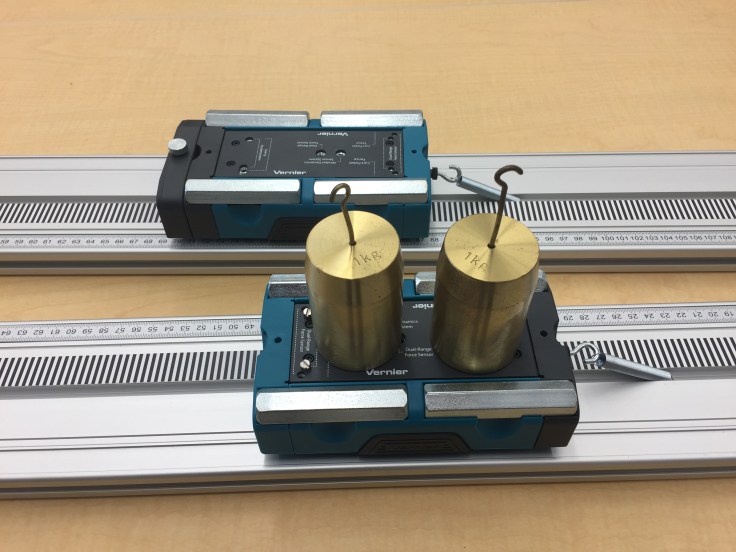
More on Forces: Challenges and Analogies

Today in Physics was an assortment of challenges related to mass, weight, and friction, ranging from easy to hard. None of the situations was inherently hard, but what makes them hard is seeing the situation for the problem you need to see it as. Students productively struggled, and along the way really strengthened our understanding of static friction, normal force, net force, and Newton’s 2nd Law.

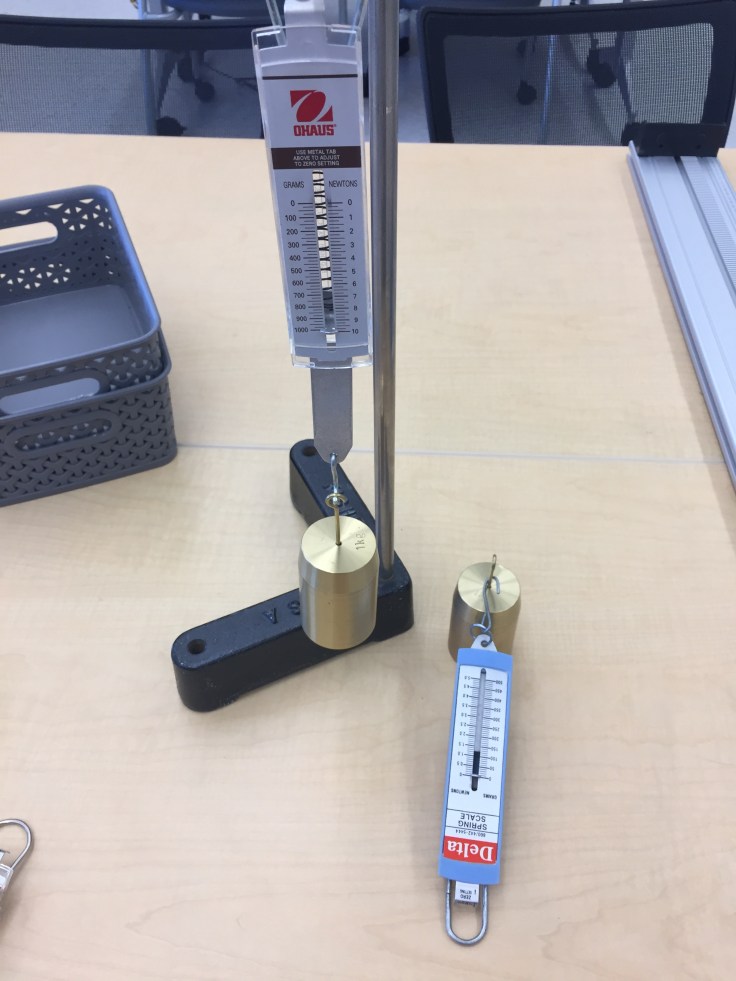
  1.  An object hangs from a scale. From a spring scale reading, determine unknown mass.
  2.  A mass is suspended from above by a rubberband and below on a surface. The bottom surfaces has a force sensor reading that is shown to students. Students have to predict the force reading for the rubberband above and then check.
  3. A mass is pulled by rubber bands both from above and below. Again, students can see the force reading from below, and must predict scale reading above.
  4. An object with known mass rests on a rough surface. Students have a force probe and are asked to determine an estimate for coefficient of static friction. Then they are asked to put an unknown mass on top of the first one, and determine the mass of the unknown.
  5. Building on task 4, they are also asked to connect the original known mass to a rubber band that pulls up slightly on it (vertically, but not enough to lift it off the rough surface). They can read how much force the rubberband is exerting with a spring scale, and they have to predict how much force it will take to budge the object.
  6. A Half-Atwoods setup is shown. Students have a 1.0 kg block, moving along horizontal surface, with hanging mass being equal to 500 g. Students are asked to use a force sensor  and a motion detector to determine a value for the kinetic friction force, and the coefficient of kinetic friction.

Students were encouraged to work all the stations, but had to turn in three carefully worked out problems: Station 2 or 3, and station 4 or 5, and station 6.

For each problem students had to draw a pictorial representation, which identified the object of interest, its boundaries, and the contact forces. They had to draw a free-body diagram that included a separate Fnet vector. They had to include the readings of any data they used. And then show the work they did to arrive at their predictions, and for the ones you could check, how they compared.

Before we did this, we had a short conversation about mass and weight, and reviewed big ideas from forces so far. Over the course of discussing, reviewing, and circling around during the challenges, I made good use of our “forces” and “teams” analogy.


A Fnet Analogy: This is going to drive the force ontology people crazy: 

I’m finding it in class very useful to think of forces drawn on a FBD as showing what individual “players”, and the net force as what the “team accomplishes together”.  We’ve been using this analogy to organize our problem-solving without algorithms.

During the review, I talked about we can extend this analogy since we have learned more about the individual players–their behavior and personalities.  Weight, for example, is a player who always does the same thing, no matter what anyone else is doing. His job is to pull downward with a force of 9.8 Newtons for every kg. He doesn’t change what he is doing in response to what other team members are doing, or in response to what the motion is. Normal is quite different… the normal force is always adjusting what he is doing, depending on what other forces are doing. It’s useful to think of him as being lazy, he will pick up whatever slack is left over, but he will only do what he has to. Tension and normal are pretty similar in this way, except that one only pushes, the other only pulls, and when multiple tensions  and normals are at play, they have to work out a compromise as to who does how much. Finally there is friction, and friction is not so much lazy as “reactive”… Static friction sits around waiting to react to any other player’s efforts to get things moving. But he is only so strong, and can be overpowered. Once static friction is overpowered, he can only rely on a weaker form of himself, kinetic friction, and he works do brings thing to a stop if he can.

 

Half Atwood’s with Static / Kinetic Friction Boundary!

I haven’t even started thinking about this beyond just asking, so join in!

Say you have a half-atwoods setup with friction on the horizontal object. You start with a light enough hanging vertical mass such that the tension is not large enough to break  static friction. Everything stays put, and so the tension is equal to the weight of the hanging mass.

Let’s say you then keep adding mass until it breaks static friction. The moment you break static friction, two things change:

  1. The tension in the string lessens, and
  2. and we switch from static to kinetic.

What are the different possibilities of things that can happen? Under what circumstances do they happen?

Static Friction Demo Stations:

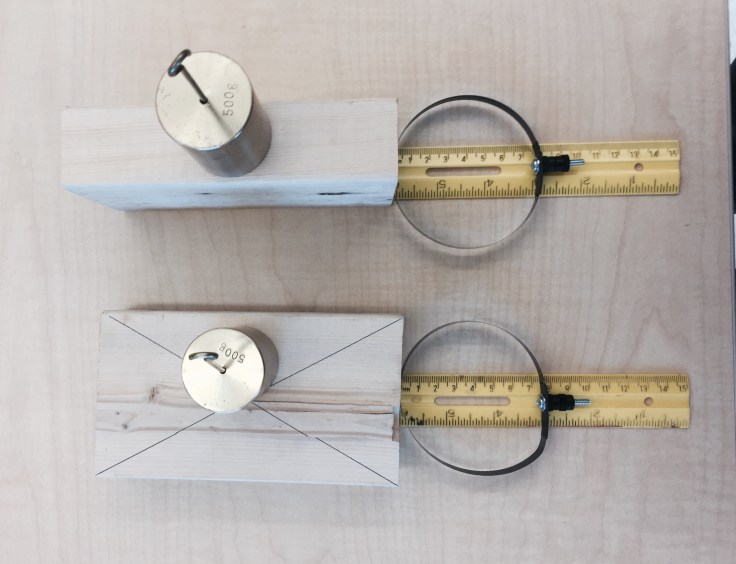
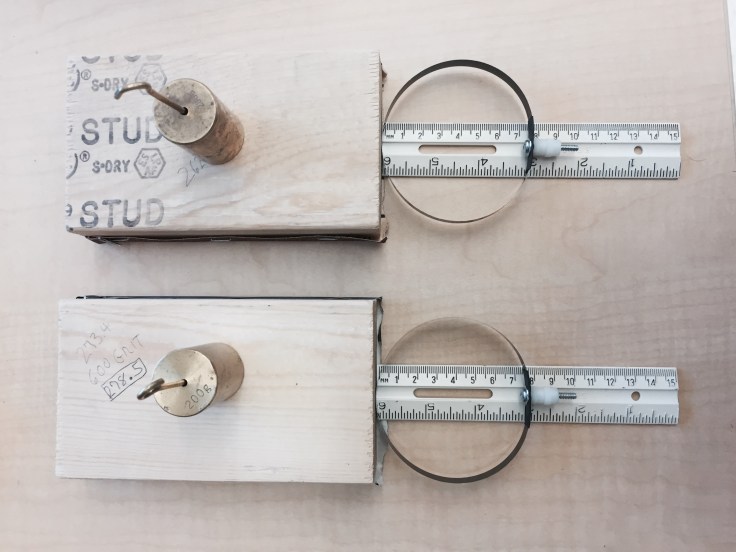
I developed 6 static friction stations over the weekend for our introduction to friction in introductory physics. Most of the stations present students with two objects that need to be “budged”, and some hopefully accessible (visible or tactile way of telling) which one is harder to budge.  Students are asked to predict which one they think will be harder to budge, and to articulate their reasoning.

Station 1: Material

IMG_5868

The first one (above) is 2 identical blocks wrapped on the bottom with sand paper of a different grit. Students tend to know that material should make a difference, but often select the wrong one. The rougher feeling sand paper is not grippier! [Makes me wonder why do we sometimes say that coefficient of friction has to do with the roughness of the surface? Rubber is quite grippy, but no one would describe it as rough. Some rocks surface feels quite rough but are pretty slippery.] I’ve been asking students afterwards to feel the two and tell me which one they think they would rather have on the bottom of their shoe and why?

Station 2: Surface Area

FullSizeRender 15

Station 3: Mass

The second one (above) has identical blocks (and masses) placed with different surface area of contact. It’s common for students to think that more area will allow it to be more grippy. Students are surprised that it doesn’t seem to make a difference. Later, we’ll address why that might be the case.

FullSizeRender 12

The third one (above) has objects of different mass, which students tend to get correct (although not necessarily for the right reason). Mass comes up in two other demos.

Station 4: Vertical Lift

FullSizeRender 13

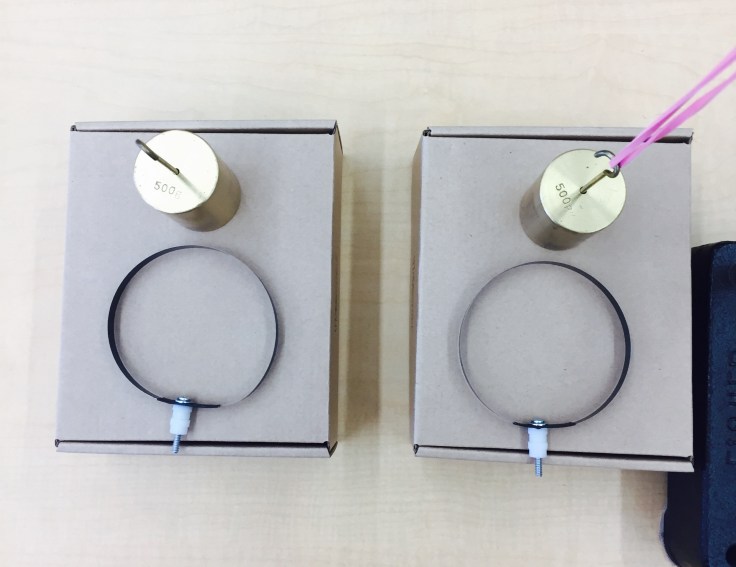
The fourth one (above) has two identical masses, one sitting on a surface, but the other identical mass is being pulled up slightly with a rubber band (thus lessening the normal force) Students tend to get this one correct, but getting them to articulate why they think so is a bit of work.

Station 5: Lifting vs. Dragging

IMG_5872

The fifth one compares barely lifting (vertically) to barely budging (horizontally across a grippy surface). It’s a 1.0 kg block, so it takes about ~10N to lift. So far, students mostly think it will take more than 10N. The reasoning I hear has been, to lift it vertically, only the weight is opposing you, the air isn’t offering any resistance… to move it horizontally, you have to contend with both weight and the friction. Students are confounded!  After, I try to get students to shop through their minds of objects in their house that they think they could budge, but not lift.. it’s easy to come up with some. This definitely gets us in the stickiness of the different between mass and weight.

Station 6: Heavy without friction or light with friction

IMG_5879

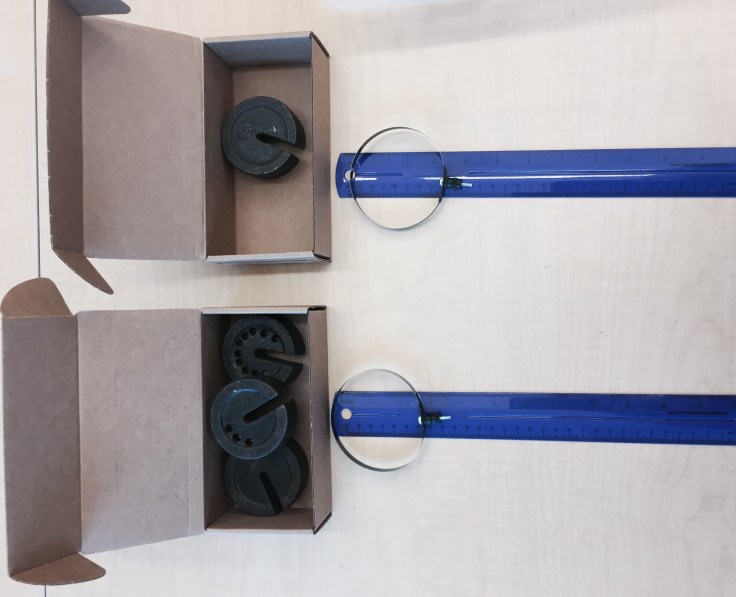
The sixth one has a heavy frictionless cart, and a light friction cart. Students pause to think here, quite a bit. In talking with students, it seems they are conflicted. What is most surprising to them is that any force gets the heavy cart to budge!… I’m going to have us watch the “million to one ” video from PSSC, after I think.  Five and six together really get at tough ideas, not just about friction, but about mass/weight/N2nd Law, etc…

I’ve made a few changes to the setups from the pictures, including labels for the objects (A and B), and coloring that makes it easy to identify that one that has a friction pad.

Edit:

Next time, I want to do the first three to establish that mass and material matters, surface area does not. Doing the discussion with all six was too much. Have that discussion, first, and solidify those ideas.

Then, return to the issue of mass with the last three — mass matters, but not in the way you might think.

Possible to also refine idea of material… so 3 to establish what does and doesn’t matter, and then follow ups to refine our idea of how and in what way material / mass matter!


Gun and Drew: Leveraging Veritasium’s Video to Improve Our Discussions

We got a lot of leverage in the Teaching of Physics out of watching this new Veritasium clip, “The science of thinking…


First, “Gun” and “Drew” are great shorthands, and the examples in the video make it easy to relate to. (It actually reminded me of Liza and Ellen from this lesson and this revision as shorthands, although in a different way). The humor embedded in the video, together with these shorthands, allowed us in class to be more jokey about our thinking and who was behind it. Knowing that we all have a Gun and a Drew made it fun to share what Gun and Drew were thinking, rather than embarrassing to be wrong. It almost, depersonalized our thoughts… as if we were sharing the thoughts of the different characters in our mind, rather than sharing our “real thinking” (whatever that means).

Second, it helped us to value each other’s pauses and to honor wait time (it was evidence that the person was letting Drew do the hard work he was meant to do). I have one student is often apologizing for being a “slow thinker”, and this video helped her (and us) to see this slow thinking as exactly what you are supposed to be doing.

I’m thinking of showing it in my regular physics class…


More on the Pestering Case Study

I forgot to mention another thing I have learned through our struggles with L’s pestering. L’s pestering used to be more physically aggressive, often pushing. At the time, I think I saw it as bullying? I’m not sure at this moment how the pestering and bullying are or aren’t related. But anyway, L definitely had the power to make the other children upset by pushing them or stealing toys, and it was something he was definitely exploring and trying out. Like, “Oh you are going to scream when I push you? I wonder if you’ll always do that… What if I only pretend to push you but don’t actually push you? Oh, cool, this is kind of fun… oh if I steal this toy, you are going to scream, and then an adult is gonna come swooping in. I’m game for that… ”

So, one thing I have realized recently about acts of “pestering” or “bullying” is that it actually takes two (or more) to make that dance happen. One person starts with a bid–an action offered as a pester or bully, and the second person has to respond by acknowledging it as so. Only in retrospect, can the initial act be declared a pester or bully. It is like a contract–an offer and an acceptance. One way to address the pestering and bullying is to work on preventing the offer (or bid) from happening–that is to work to stop L’s behavior. But it is just as important to work on the other side–that is help the children to refuse the offer. This lines up with the notion that such problems are community problems (not just individual problems), and everyone must share responsibility for helping to repair trouble.

One way we worked on the kids being better at refusing acts of pestering, was through the development of physical and emotional resilience to physicality. We didn’t necessarily know we were doing it at first, but we quickly noticed its effects. Several months ago, we started teaching the kids to rough-house. It started with mostly the expert rough-housers (i.e, Bethany and Brian), mostly manipulating the kids’ bodies around, keeping it feeling exciting and even a bit scary, but still safe. We would push them over playfully, bear hug them and roll them across the carpet, pretend to smash them, throw them into something, let them jump on us. Over time, as the children became more expert at rough housing, multiple novices playing might roughhouse with expert at the same time and then gradually it became more and more the novices rough housing with each other. Rough housing offers lots of opportunity to encounter episodes of getting into trouble during play and working on its repair. The children also learn how to brace their body for a fall, to tense their muscles before a dog pile, to communicate when it’s too much, to stop when someone has communicated it’s too much, to recognize when to take a break, and whether to relax for a while or recover quickly to get back in the action.

The children also just got used to rough physical contact, which took away the power that L had to get them upset. Before, L would push and get screaming, whining, yelling in response. Now, L would push, and they could just brush it off, or ignore it, or walk away, or even push back. The skills they developed during rough housing gave them the physical and emotional skills to refuse to accept his pestering / bullying bids. And so gradually, L stopped making so many offers…

The second way that the children learned to refuse L’s bids is something we actually learned from one of the children, Ar. One day, L came over to Ar and just kept saying, “No!” right in his face, which would have more normally been responded to with even more and louder, “No”s and whining high pitched voices, and screaming. This time Ar decided to respond playfully, by saying No in a singsongy and goofy way, basically dancing and singing happily as real good “no no” song. L decided to join in on the silliness together. Another time, we saw A responding to pestering bids with smiles and tickles. L decided to playfully accept the tickles. Once we realized what A was doing, we all started doing it more. Maybe L would use his body in some weird way to invade someone else’s space, and that would become a dance move we would all try out. I want to be  clear, that this is different than taunting L back or mocking L. Instead, Ar modeled for us how to respond playfully, not vindictively or mockingly. Ar had turned L’s bids to pester into bids to be silly. In doing so, we all learned how to counter offer or redirect the bid into something else.

Finally, I realized that even seeing L’s pestering as pestering was problematic, because it wasn’t pestering until someone (an adult, a child) oriented to it as such. We got better at seeing the bid as full of more possibilities than just pestering, and seeing that we all had at least some role to play in pestering. It wasn’t just “L’s” pestering… it really was trouble occurring at the community level, not the individual. Trying to solve the problem at the individual level was probably not going to be as successful. This isn’t to say that we have worked it all out, or that we don’t fall into the pester trap. But it’s changed my view, from “L is pestering again” to “How did we fall for that again?”, or “What lead me to respond that way this time?”

Anyway, maybe there are people who read here that don’t want to read about daycare, and if so, I’m sorry. But it’s the most interesting learning/teaching work I’m immersed in these days.

Daycare may make me a better teacher, but I have a long way to go…

I wrote a post recently on “intervening for productive talk“, and I realized in re-reading it how much my teaching is being changed because of daycare. Specifically, the bit about not coercing participation and also plainly telling students the things I notice about their participation, is totally from daycare. Anyway, here are just some of the things I’m learning in daycare, which I should use more in the college classroom:

  1. How children act has a lot to do with how they feel. How they feel has a lot to do with their environment and relationships. In helping with day care, I’ve learned to pay more attention to how children are feeling, and work to promote environments and relationships that helps them feel safe and engaged.
  2. I’ve learned to discern the difference (or least aim to) between disruptive behaviors that are the result of boredom vs negative feelings. Some unproductive behaviors I have also learned to see just as “habits” that have become compulsions. The child literally is struggling to physically stop their body from doing something. Others I have learned to see as resulting from lack of skills. An example comes from one child L who has been struggling with “pestering”–  a normal way we all see “pestering” is sort of like identifying that person as “being a jerk”. It’s easy to experience it in that way, but we’ve learned to see his pestering in different ways including: L sometimes pesters when he is bored with the current collaborative play, but doesn’t know how to “elaborate” or “extend” the play. One of his habits when play has gotten boring is to turn it into pestering. If I see the early stages of pestering, I’ll suggest a way they can elaborate their current play. This morning, L and A were pretending some lego blocks were spray water guns and were spraying the coffee table. When L got bored he turned to pretend spraying A in a pestering manner. So, I helped them to extend their play by suggesting they get some rags from the play kitchen and see if other things in the house needed cleaning. The two of them were off and playing. Other times, L pesters when L approaches another group wants to see what they are doing. I have come to see this as L lacking skills to enter play. When L comes over to a group that is engaged in something and I see early signs of pestering, I’ll try to model for him a few options of things to say,”What are you guys doing?”, “Hey do you want to go over to the sandbox with me?”. I also can see L’s pestering as reflexive and out of habit and compulsion. For example, L was very engaged in building blocks with me and other children (and not seeming bored), but he got distracted when some blocks fells over and he started pestering one of the other children with those blocks. I just quietly said, “That’s not what were doing right now. We’re focusing on building now.” And L refocused on the building that he actually wanted to be doing for another 10 minutes. In essence, I was just reminding L about what he wanted to do, and what he was accidentally doing. Finally as we’ve had more and more conservations with L about what pestering is, sometimes we’ll just remind him that he’s pestering again.
  3. “Sports-casting” (narrating what you see children doing) is one of many powerful tools for developing language, but also for developing my own and their awareness. This includes narrating what children are doing / using words to describe their feelings / identifying problems in the environment to promote awareness, identifying options and choices. It can be overdone, and it needs to be done is an observer mode, not in judgment mode.
  4. Everyone needs to share responsibility for problem-solving trouble that arises during play. For example, we generally have a rule that if you don’t like the way you are being touched, you need move your body. Or If someone is screaming, and you are the one touching them, move your body. This is the default rule. Of course, if you are sitting somewhere special doing something special, you shouldn’t have to move your body. Or if you do move your  body, you shouldn’t have to keep moving your body to be safe. But still, having the default be: “If you don’t like something, walk away.” is a good one. Before, sometimes one kid would be hitting another kid (not necessarily in a way that would hurt, but maybe), and the kid being hit would just there are cry and wait for the adult to fix it. In that scenario, the child is acting as if “only adults have responsibility to repair trouble.” Bethany spent probably 4 months using the phrase, “move your body” before the children started using that phrase themselves. We’ll often hear, “I’m moving my body” from the other room. In doing so we have modeled and practiced skills for noticing and repairing trouble. Another useful skill we have learned has been learning to recognize when you are feeing overwhelmed, and need some time away.
  5. Moralizing at children is the worst.  I’ve learned to recognize when I’m getting roped into it. Bethany and I get a good laugh, when I get roped into moralizing. It’s good to go easy on yourself.
  6. A really really good day care day is NOT a perfect, trouble-free day. In fact, a normal day is all about moving into and out of trouble (and trying to repair that trouble),that’s how we navigate the day. Too much trouble with too little repair makes us all exhausted. And that certainly happens. But the best days actually involve cycles of repairing trouble (rather the absence of trouble), learning about new kinds of trouble, and succeeding or struggling to repair it.
  7. I am learning how to “prioritize the continuity of play”. When trouble in play arises, the goal is not to “moralize”, “punish”, “make it a teaching moment”,  the highest goal is repair trouble so that play can continue. And I am so not even close to being successful at always doing so, but knowing that’s the goal, really changes how you view things.
  8. I am learning to see caregiving routines as “the important work that we are doing together” rather than the “obstacle to doing something else.” For example, on a wet winter day, for us, it takes a single caregiver about 40 minutes to get all the children properly dressed and outside (including diaper changes). If you see that 40 minutes as the obstacle to getting outside, you are going to be really really frustrated. If you see those 40 minutes as the primary activity that we are all learning about (and trying to get better at) then it changes everything. Even things that don’t take long, like wiping hands and mouths. I’m learning to slow down and tell children about I am about to do, and wait for them to give me a signal they are ready. I invite them more often to help, and because of it, we are all calm, and they all learn to care for themselves quicker. The 2-3 year old kids here can all wipe their own hands and face, put on and off their shoes and boots, get on their jackets, put on and take off pants, get into and out their booster seats, etc. This never would have happened if we had seen those things as obstacles to rush through.

I though I was going to write a lot this post how I see it as connected to college classrooms, but I’ll save that for later. For now, I’ll just leave a few comments. First, think I don’t do enough work to see students’ lack of engagement are stemming from feelings they are having (and how the environment or relationships students have in class) contribute to those feelings.  I also don’t take enough responsibility to see and re-see students’ trouble in or with a class through different lenses (e.g, different ways of seeing L’s pestering). I also think that in teaching, we have non realistic ideas of what good teaching days look like. A good teaching day isn’t when everyone “completely understands your example problem”, and then “perfectly works through whiteboard problems”… A good teaching day should involve cycles or trouble and repair (of different grain sizes), and the best days of teaching sometimes are filled with big troubles with big repairs. Finally, I want to try to prioritize inquiry (or problem-solving) in my interactions with students. Whatever I do, the goal should be to intervene in ways such that I can walk away and students continue to inquire or problem-solve. How will I act differently with my students when I see this as the primary goal above all? Last, there are times in the curriculum, where we rush through “care giving”…and I want to be more aware of when I’m going that, and the negative impacts it has when we do this to students, and what skills they don’t learn because we hurriedly do it onto students.

blah blah blah… it’s nap time.

Solving N2nd Law Problems by… Thinking

Last year, when we were going through the first year of piloting new curriculum, I lamented about the struggles students had with the algorithms we were (and often do) teach to solve Newton’s 2nd Law problems, and was wondering about non-standard algorithms, like these. Here’s how I’ve avoided the pitfall this year:

1. Qualitative Representations and Reasoning Galore (before getting Quantitative): In kinematics, students always had to draw qualitative position vs time and velocity vs. time graphs before writing down any equations, and I almost never let students use an equation that didn’t describe a graph that they had drawn. In addition, I was a stickler for drawing good motion diagrams (velocity vectors and acceleration vectors drawn using the appropriate color coding scheme). This helped to frame class as primarily about sense-making qualitatively. We spent a lot of time making qualitative predictions of graphs and testing against motion detector data, and then practiced using those graphs to solve problems. This was present in all activities, labs, clicker questions, and problems. This has carried over to forces quite naturally.

2. Slower Pace in Forces: Last year, there was too big jump from “what are forces” and “N2nd Law” to solving complex problems involving statics/dynamics all with vector components to worry about. With that escalation of complexity, we fell back on “monkey see, monkey do”, which undermined students’ natural problem-solving sense. This semester, so far, we have only done force problems where students have had to worry about either horizontal forces or vertical forces– not components. Last year we jumped right into hard problems…. But this slowed pace has meant that I have not yet worked an example problem for students to see an expert solving problems with forces, and students are, I think, showing a lot of competency to solve challenging 1D problems involving  Newton’s 2nd Law. Instead of doing example problems, after our intro to forces, we did a lot of FBD clicker questions and practice, Net Force Ranking tasks, acceleration ranking tasks. And I did model and scaffold expectations for doing a good job of representing the forces. But mostly I just equipped them with skills for representing clearly, and for thinking about what net force is, and how it is related to the individual forces.

3. Forces Always with Kinematics: So far, I have refused to divorce solving force problems from motion considerations. Their first force questions began with “Given these forces”, what distance and speed will the object achieve, and “Given this motion detector data, what can we say about the unknown force?” and finally, “Given this force vs. time data for the elevator”, what can you say about the mass, speed, and distance of the object. I can’t describe how important this has been to (1) the class feeling continuous in our course of study, and (2) in helping students’ developing confidence. The problems students are solving a hard (not because they are hard forces problems), but hard because they require students to apply newly learned knowledge and integrate that with skills they have been mastering over the past 5 weeks.

A Caveat about what my students can and can’t do: If an instructor in my department saw my students’ work, they would probably be impressed by my students’ ability to represent the motion and forces of some of these complex scenarios, but they would likely be scared at the lack of “clean neat algebra work” involving Newton’s 2nd Law. They would see my students as “hodge-podging” their way through through the arithmetic. And it’s kind of true, but I see this as productively grappling with thinking about net force and how individual forces come together to create a net force, and how net force causes an acceleration. And It doesn’t mean my students don’t struggle with the math– they have struggled with deciding whether to add or subtract some of the force values they are having to think about. For example, a group last week, had subtracted two force numbers (that they actually needed to add). When they got their answer for the unknown force, they recalculated the net force, and what acceleration that would cause, and found that it didn’t match the acceleration given in the problem. They did this checking without prompting, and they called me over for help, because they had an approach that they though should work, but knew that something was amiss. To me, that’s what productive struggle looks like, and students in that group were really primed to start talking with me about what they did and what didn’t make sense. Someone could argue that my students would not have made such a silly add/subtract error if I had just taught them to write Fnet = T1 – T2. But I think they would have gotten the right answer without ever having thought about it, or if they had made an error, they never would have stopped to think about whether it was sensible.

So what now? Wait until we need a better algorithm. 

Right now, My goal is to not introduce /model an algebraic algorithm until my students come across a problem that breaks them. My guess is that it’s going to be either statics problems with non-orthogonal forces, or interacting systems (where systems of equations are needed). I’m not really sure when this sort of arithmetic, step-by-step, sense-making approach will break down, but I’m pretty sure that it will break naturally, or that at least I can put us in situations that  it’s increasingly likely to break down. So I’m happy Right now for them to be gaining confidence, learning to think about Newton’s 2nd Law, and solving problems through the process of representing and thinking (rather than following an algorithm). At some point, I figure I am going to model solving a problem in a manner my colleagues would recognize as legitimate, but it will only be after we encounter a problem that really demands it.

Ramble on Intervening for Productive Talk

This semester in physics I’ve been much more aware and much more willing to intervene when unproductive talk takes hold of a class discussion.

Some of my cues for unproductive talk include:

– matter of fact tone of voice (as opposed to students offering up a possibility for thinking).

– too few contributions that are about what doesn’t make sense (e.g. “What I don’t get is”, “what I’m still stuck on… “)

– too few revoicings / add ons. I need to hear a certain ratio of follow ups like, “ok, so agree with so-and -so…” or “I hear what so-and-so is saying about xyz, but…” I’m also fine with changing subject with, “ok, so one thing I think we haven’t even thought about yet is… ” because it’s letting everyone know that a new idea is coming.

So how do I intervene: 

Over time, we have just had a lot of conversations about “normal feeling friend talk” vs “awkward feeling power talk”. I have modeled what it sounds like, and we have talked about examples. So one way I can intervene now is just to say, I want to interrupt for a second and just let you know that I’m Feeling like this conversation is starting to sound awkward to me. Does anybody feel like they have a normal sounding contribution to make? If not, that’s OK, I just wanted to point it out. This is done usually in a light-hearted way, and students have often been able to follow up with good normal talk.

The second intervention is based on conversations about how it would feel if you were having coffee with a friend, and you just told them either some good news or bad news, and your friend just said nothing or the next thing they said was about something completely different. I model how a friend might respond by revoicing, and elaborating. And I talk about how that’s how we want to talk in class… good friends don’t just say nothing or change the subject. Early on I would interrupt and make us practice. On good days, students are doing a lot of this on their own.

An important intervention is recognizing when the task or question (or me!) is actually the problem making it awkward. Sometimes the conversation is bad not because people are talking awkwardly, but because I’ve done a poor job antcipating what was needed or appropriate. I have also been the person using a poor of tone of voice, and I have said so in front of my students. “Why am I talking this way. Maybe I’m the problem today?” It’s good to model that we all just sometimes fall into a way of talking, that we never intended. Abandoning or changing a bad task is important. 

Early on I frequently interrupted student to quickly say, “tell them not me” if they were addressing me, and even hid on the floor behind tables if needed. Again, I kept these light hearted. Doing this early and often means I do it rarely now.

Recognizing when a conversation has gotten so exciting, that so many people are bursting with new ideas, that we need to go back to small groups. Like now! It’s easy to create a situation where small talk is boiling over and the speaker isn’t being listened to, or you as instructor are having to intervene in harsh ways. When I see this happening, I almost always say, “it looks like everyone needs a moment to chat with their group.” 

Having a way to end a conversation where some havereached  resolution and are bored , but some are still confused, and maybe others are just exhausted. This is hard. It’s fine for this to happen sometimes, but if this starts happening too often and with the same people, Boredom becomes resentment, confusion becomes despair, and exhaustion becomes frustration. One of my go to moves is “choose to be an explainer or an explainee” I tell students maybe you feel like you don’t yet get it and you’d like to hear an explanation. Maybe you feel like you do get it, but it would be nice to try to voice that explanation a loud. Every student gets to choose whether they hear or practice an explanation. I tell them that I recognize that we may be moving on before everyone is fully ready. 

Another  move I use from time to time is to ask to hear from someone who changed their minds, to say what their initial idea was, and what they heard that convinced them to change their mind. This doesn’t always work, but it gets us focused on arguments, and the learning process of being convinced. It also often invites new people into the conversations. 

Another place I intervene is in group work. I try to offer non-judgmental observations about things I notice. Yesterday, a group of two males and two females were working at the whiteboard. The two guys were facing each other near the wrhiteboard, and the two female students were boxed out. I came over and watched for a while, and it persisted, so I said, “I want to tell you something that I’m noticing. And I’m not assigning any blame here. … ” I described what I saw, and noted how this kind of thing can happen without anyone intending, but I also told them that this kind of thing happening unintentionally again and again is a problem. I told them that they didn’t have to actually change anything, but that they should make conscious decisions about it rather than letting it accidentally happen and not even noticing. The followed up with the group later to ask how things were going, and I thought and they thought it was much better.

Another intervention I’ve done is intervening with the outsider. Sometimes a group of 3 will be working closely, but 1 in the group hangs back. Instead of prodding them to get involved, I’ll often just say, “I notice your hanging back. Sometimes when I hang back, it means I’m actually carefully listening and watching, but other times it’s because I’m disengaging or feeling left out. ” I try to ask them about how engaged they feel right now. I might leave by just saying, “maybe later you will feel like getting involved again, and if so that’s great. Let the others know if and when you are ready.” I try to keep the pressure off, because my goal is not to coerce participation but to equip them with awareness of their current choices and possible options for making different choices. 

As much as believe in that last statements, if I am explicit about my expectations for group work on a particular task. I try to hold students accountable, and I will apply pressure in situations where I feel it’s warranted. Even then, I try to make it matter of fact, not judgmental. “This tasks works best when everyone is …”, “I expect everyone to be… ” I will often be sympathetic, but firm. 

I’m sure there’s more I can say, but I think I’m done writing for now … 

Day 3 and Day 4 of Forces:

Day 1: What are forces? What is evidence that a force is happening? What do forces do (qualitatively)…

Day 2: Representing forces (FBDs ) and N2nd Law Lab (Collect data with Half-atwoods)

Day 3:  Discussion of N2nd Law Lab (whoa we needed it!), and Horizontal Dynamics Problems

  • We spent a lot of time discussing the Lab from time! Boy was that needed. Students were struggling with the a vs. F graph, what it was even about. Partly this was because we spent all our time in kinematics look at __ vs. time graphs. Also, each point on this graph was a different experiment, from which data came from two other graphs (velocity vs. time and force vs. time)! We spent time re-talking about the slope, etc, and eventually worked toward determining the mass of our cart.
  • Problem 1 was finding distance and top speed for a race car, given the total forward amount of force and total resistive amount of force. We had some clicker questions about identifying what forces act on the car before solving it. I set up the problem, qualitatively, and then students were assigned to work a specific numerical problem from here:  [Note / Edit: Next time, for clicker questions, I would have buggies out riding along a path of brushes, to help examine and look at forces…]
  • For Problem 2, which they worked on their own from the start, was a cart on track being pulled both ways by half-atwood setups with different masses.The force by one string was measured with a force probe, and the motion of the cart was measured with a motion detector. They had to predict the reading on the other force sensor. They had to identify forces, draw free-body diagrams, determine the value of a single force that when acted on the object causes the same acceleration, and then determine the unknown force.  After working that demo problem as a group, individual students were assigned to work an individual problem from here:

Day 4:  Mass/Weight Lab, and Riding Elevator Problem

Students started day with a quick mass/weight lab (50-500 grams) using known masses and vernier sensor. We talked about what their was notice about our graph, and students offered idea like, “it looks linear”… “it looks like the amount of force is about 10x the mass”… another student said 100g gives about 1N of force. They had to use their noticing to predict what the scale would read with 2.0 kg, and we tested that idea. We then tested 1.0 kg, and saw the reading more precisely as 9.8 N/kg. We talked a bit about the formalism of the book’s equation, w = mg, and how g as 9.8 N/kg was totally different than 9.8 m/s/s… a strange coincidence.

We then talked briefly about defining g in this case as gravitational field strength, and weight forces more generally , and a bit about what a scale actually reads, and what are the proper conditions necessary for a scale to “read” the weight.

Then students, were asked to work an elevator problem.

1st: students were asked to draw multiple representations for an elevator ride, with 5 stages. At rest, speeding up, cruising upward, slowing down, at rest again.

Students had to make pictorial representation with Brian identified as the object of interest (standing on a scale), and identify contact and long-range forces acting on Brian. Then a motion diagram with clearly dashes (—) to delineate stages, how v change and the a vector clearly labeled within each stage.

Students then had to make stacked velocity and position vs. time graphs (with —) used to delineate the stages, and then draw a FBD (showing individual force magnitudes) and Fnet. Then use that to help them make a Fnet vs time graph, and a F(reading on scale) vs. time graph.

Once, students had an answer, I made them discuss with another group that was nearing completion. Those groups got the vernier scale and Lab Quest Mini, to go take data and compare to their graph. I talked with each group about assumptions about constant acceleration (and how the graph they see may not be exactly constant force).

If students graphs matched their qualitative predictions, they were then given data from a run I did that morning, and asked to find

  • my mass
  • the elevator’s top speed
  • total distance traveled.

Students were asked to measure the height of one floor in our building and use this to assess their answer. Students did a great job and most groups had a lot of fun.

Blog at WordPress.com.

Up ↑