By far, one of our favorite toys growing up was construx. We were definitely the son’s of an engineer.
Photos Courtesy of Shawn Ferry
Brian reflects on his physics teaching

By far, one of our favorite toys growing up was construx. We were definitely the son’s of an engineer.
Photos Courtesy of Shawn Ferry
I’ve elaborated some, in the hopes of clarifying, but here is the gist of the students’ question:
When you throw a ball up in the air, we know it loses kinetic energy, because it’s obviously slowing down. We also know we can describe that loss of kinetic energy in terms of the work being done on the ball due to the gravitational force from earth. But what about the rate at which energy is being lost? Since we also know we can determine the rate at which energy leaves the ball by considering the quantity F.v. , then we can say when the ball is moving fast it loses energy quickly, and when the ball is moving slowly it loses energy slowly. This also makes sense from a potential energy perspective, because when you are moving fast you cover more distance, so the potential energy term mgh also changes quickly. But right at the top, when the ball is not moving, it has zero kinetic energy; but also the rate at which energy is being transferred to / from the ball is zero.
Question: How does the ball go from having no kinetic energy to having some kinetic energy a moment later? Think about it. For the ball to have kinetic energy, it has to be moving; but for it to get moving there needs to be a flow of energy; but for there to be a flow of energy, it needs to be moving already.

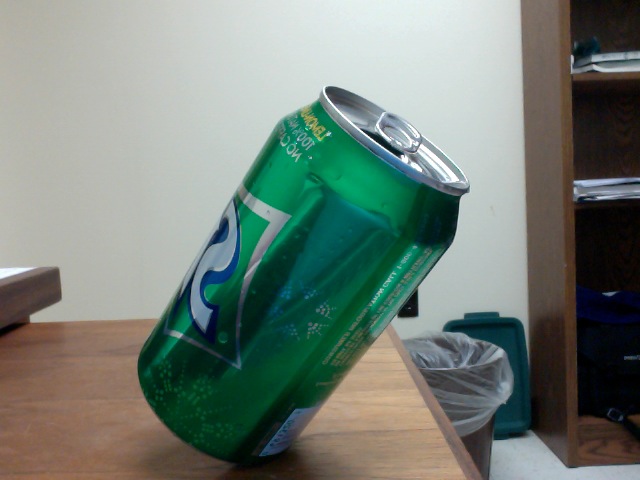
What range of fluid ounces in the can make this possible?
For the record, as a college student, I would have hated classes with interactive engagement. Largely, this is because I wrestled in college. During the wrestling season, which was basically September through March when you include pre-season, all I could manage was to show up to class and take notes, and maybe squeeze in an hour or two of homework before crashing into bed. Had I been asked to interact with other human beings in class, I probably would have punched someone in the face at least once a week. Ask my college roommate: a starving, exhausted, physically and mentally abused college wrestler does not enjoy the company of others. He does not enjoy talking, thinking, socializing, and he especially doe not like being touched–most forms of touching during the wrestling season are violent.
My days usually went like this. Wake up at 6:00 am, take pain meds, go run somewhere between 4-6 miles. Come back home and eat an orange. Go to class for a few hours. Take pain meds. Eat a bowl of cereal. Hit the weights. Have a power nap. Grueling practice for 2-3 hours. Take pain meds. Eat another orange and another bowl of cereal. Spend an hour doing quantum mechanics homework. Spend an hour doing electricity and magnetism homework. Go to bed. Wake up in the middle of the night from pain and take pain meds. Go back to sleep.
I should expand upon what being in class meant. Being in class meant I was a zombie, intellectually functioning just enough to listen, observe, and write. For me, class served as an exhaustively detailed syllabus, telling me important information that I would need to learn later. While I never missed lecture (unless we were traveling for wrestling, or I was having surgery due to wrestling), I never once attended a TA-led recitation, a review session, or a professor’s office hours. In lecture, I could be a zombie. The risk of having to interact with someone was far too great in these more intimate settings, plus, I really really didn’t want to learn in class; I just wanted to receive my detailed syllabus and go back home. Home was where pain meds, food, and a bed was. I could learn on my own time, when I wasn’t immediately starving, exhausted, or in pain.
Partly here I exaggerate, but not that much, especially in the real depths of the wrestling season, where you are practicing twice a day, traveling every weekend, and sustaining life with a meager 3-4% body fat. It’s not just the physical toll. The wrestling season requires the maintenance of a particular mental state. That mental state includes an immense commitment to the idea that wrestling is the only important thing going on, that pain and suffering is rewarding, an ability to ignore feelings such as hunger and thirst, and a readiness to attack and destroy in a ruthless unemotional way.
I don’t know why I’m sharing this story. I don’t know what the moral is. It’s just what was on my mind this morning.
I tend to use some group exams in my inquiry course. I’ve been meaning to write up something about it for a while. So here is a brief intro.
Flavor #1: Learning through Discussion
In the first part of this kind of exam question, students are provided with some novel phenomena on the topic we have been studying. They must write up their individual prediction about what will happen or what they will observe and (more importantly) write explanations. In the second part, they get to discuss with their group for as long as they want. After discussion, they have several options:
(1) If they change their mind, they have to do two things. First, write up their new predictions with explanations. Second, re-visit their prior prediction and discuss what was the flaw or problem in their prior reasoning. What did they fail to consider? What ideas from class were they being inconsistent with? What situation would there reasoning have been correct, and how is this situation critically different?
(2) If they didn’t change their mind, they also have to do two things. First, they have to clearly explain an idea they heard that was different that theirs, explaining that idea as best they can. Second, they have to respond to that explanation by pointing out the flaw in the reasoning.
If I’ve done a good job picking the question/ situation, no groups will have all individuals with the same prediction, and a majority of students will be able to put the pieces together for a good explanation after discussion (but few before). If a group does end up with all the same ideas, I can make them conference with another group, I can ask them to anticipate why a person might think the opposite would happen and the rebut that, or I can give them a canned explanation to consider and respond to. I’ve tried each in the past, and they each have benefits and flaws. Conferencing with another group takes up time for both groups. Asking them to both anticipate and respond to an argument is harder than hearing someone else’s argument and responding. Me writing a canned response is different than having to listen, argue, and contend with a peer.
The way I grade as following. No points are necessarily taken off for a wrong prediction. I am more focused on the explanation and ideas, looking for clarity of ideas and for a gapless causal explanation. Any conclusions and ideas that are inconsistent or contradictory to our class’ ideas and evidence are merely noted. However, if any inconsistencies are not explicitly noted and reconciled in the second part, students will mostly likely lose some points overall. Note here that it is not enough for the student to have the right explanation afterward. Students must return to their prior explanation and address it. On the other hand, if students are sticking with their original explanation, I am really looking for them to respond to other arguments by not merely repeating their idea. They must attend to the argument and discuss a flaw in it.
Flavor #2: Learning through Investigation
This kind of exam is similar to the first, except that students must go make an observation after initially predicting. If they predicted wrong, then they have to revisit their explanation by both writing a new explanation that can account for what they observed and discussing the flaw in their reasoning. If they predicted correctly, I have some of the same options available to me. I can make them construct an alternative prediction and rebut it, and I can make them respond to a canned explanation.
Often times I combined learning through discussion with learning through investigation, and it becomes a more length task.
Some Comments
These exams really rely on the instructor to pick the right tasks. Picking a good task critically depends upon an instructor knowing the limits of their students’ understanding and how far those ideas can stretch. Having colleagues to bounce ideas off of can be really helpful in developing these tasks.
Grading these exams can be a bit time-intensive, and it certainly requires professional judgment. It is critical to use the same criteria for evaluating these as students’ written homework, but I try to avoid over-rubricizing these exams.
Offering these exams requires that students have had many opportunities to write and critique explanations, and to have had practice and feedback on constructing counter arguments.
During the exam, I circulate around and listen to conversations. I often get called over by groups who feel stuck, possibly not being able to make sense of the observation that differed from their prediction. I typically encourage them to either (1) continue discussing, (2) grab a whiteboard, (3) look through their lab notebooks, or (4) make some sketches.
Group exams certainly have some concerns. Do some students benefit unfairly from being in a “good” group? Are some students hurt by being in “bad” group? I haven’t done the analysis, but it would be interesting to look at variation of exam scores across and within groups.
In a Later Post: I hope to discus a specific example. The question I picked. What was my reasoning behind using this question based on the ideas our class had developed, and why I thought students would be able to stretch these ideas to make sense of the task together but not individually. I also want to give some examples to show range of student work.
Here are some non-physics-specific impressions after my first semester here:
Academic misconduct (i.e.., cheating) is way more common than it should be. We had a serious outbreak of cheating this final’s season, across many courses. Upon further review of cases, it seems that some students had been cheating the entire semester. In other cases, students accused of cheating seemed only to care if they’d still get a D, so they wouldn’t have to retake it. There is something wrong with this level of conspiring and dismissiveness. Our department is currently reviewing our own policies.
Way too many students study way too little. Unofficial polling in our general education courses suggest that most students don’t read the text, and most students spend little to no time studying outside class except for maybe the week of an exam.
Working full-time and going to school full-time is a juggling act not well-balanced by most students.
Public universities have too many general education requirements. I’d like to think if we build great courses, students will come. Maybe that’s crazy of me to think. Instead, we require them to come, and they don’t read or study. Go figure.
Grading and assessment in college typically swings way too far on the side of reliability (i.e., fairness and consistency) than on validity (i.e., meaning and value). I’m not saying consistency is not important. I’m saying that being consistently meaningless is a big problem.
There is something perverse about graduate classes being small and general education courses being large. To quote a colleague, “Those who need the most support for learning are put in the worst learning situation ever.”
I have been getting ready for my second go at intro physics by
Last Semester Reading Quizzes
Last semester, for example, students would have read a lecture about speed and velocity, and they would have come in, sat down, and taken a five question MC reading quiz. Questions would have been like, “In physics, the study of motion is referred to as _______ a) energetics b) dynamics c) kinematics d) kinesthetics e) mechanics” and “Which of the following is not a scalar quantity: a) distance b) average speed c) average velocity d) time” . My undergraduate TA would have graded the quizzes while I circulated around helping students answer some computer questions. Students would have gotten a score back.
Next Semester Standards-based Assessment
Now, I’ll have students come in and take an open-ended question targeting a particular standard. On this day, it will be: I can distinguish position, change in position, and distance. The question could be something like this, “Starting from the 4-m mark, Brian walks to the 10-m mark, then turns around and walks a distance of 7 meters. What distance did Brian travel? What is Brian’s final position? What is Brian’s change in position?” Students have to show some sketches, some work, or explanations in order for me to consider assessing it.
After the quizzes, students will then go to the back of room and answer to some computer questions. While I don’t think these computer questions are always great, I am deciding not to tweak these, for now. While they work on the computer questions, I will be writing feedback on what they did and wrote. I’ve piloted this, and it doesn’t take me long to give feedback. Now, during this time, I won’t be circulating around to help, but I will have a undergraduate TA in the room. While working on the computer questions, students and the TA will have the goal of keeping track of any questions/confusion that arise and to write them at the front board. Groups who finish early have the goal of checking out the questions at the front of the board, and trying to understand and address them for the whole class.
The second standard of the day “I understand the difference between average speed and average velocity” is not assessed until the end of the class, after we practiced and talked about those ideas with whiteboards.
White-boarding Last Semester
One of the difficulties with white-boarding and discussion has been that, while the problems that students are assigned are “on topic”, they were not necessarily designed for the purpose of driving a meaningful conversation or to make sure students make contact with an important skills, concept, or distinction. Rather, it seems the problems were designed to just give them practice solving problems similar to those they will be expected to solve on the exam. Many of the instructors in our end of semester meeting remarked on how unproductive the board meeting discussions had been. Many had given up on them at some point during the semester. Part of the blame certainly goes to the problems that were picked. A lot of the blame goes to lack of professional development about board meetings–discussing their purpose, learning about some skills on how to effectively manage them, and having a chance to observe a well-run one. Part of the blame also goes to not having specific learning goals in mind for the discussions–my sense is that students in most classes were just presenting what they did. The work student did wasn’t a jumping off point for anything intellectually worthwhile, but merely a routine to get through.
White-boarding Next Semester
To begin, I am picking problems and collections problems with much more deliberation. For example, on this day, I think there will be three different problems about back-and-forth motion. Each group will just do one, but they will all be related somehow. What I am leaning toward right now is having each problem end up having the same average speed but different average velocities–one negative, one positive, and one equal to zero.
Second, I am articulating goals for discussion and how they connect to the problems. See, with these problems, we have something to talk about during discussion. How can we all have same average speed but different average velocity? What is average speed telling us? What is average velocity telling us differently? What does it sign of average velocity tell us? Sure, maybe, other interesting issues or conversations will arise, and we can go in those directions. But I have goals and directions in mind that I can drive at, and I have set up the problems to drive at those discussion points.
I also have planned out challenge / extension problems*:
* In the future, I’d like to see these kinds of questions as mini-capstones… that students have to work out some number during the semester to get an A.
Another difference next semester is the instructions I am giving students. I’ve written about this before, but the instructions students are given are very equations-focused. Next semester, I will focus more on representations. Students will have to draw a motion map and a position vs. time graph before solving for summary information, including final position, change in position, total time, average speed and average velocity. During discussion, we’ll talk a lot about the representations, as well.
At the end of the day, I wrap back to the second standard of the day. Students take the assessment, and this time they self-assess instead of me assessing.
Laboratory Activities
On this day of class, students are supposed to do a lab measuring diameter and circumference of various pipes to get an experimental value for pi. Previously, they would have been instructed on using the slope method, and students do this. But even with explicit instruction, students seemed to have no idea why finding slope would give Pi, and why it would be any better than just averaging all their data. My actual plan is to move this lab to the very first day of class, which was used to go over class syllabus and take the FCI.
So, my version next semester goes something like this:
Some of us have talked earlier about the problem of the big four kinematics equations. In the text for my intro physics class, students are given these four equations:
Anyway, the strategy students are told is to select an equation that both has the variable they are looking for and has the other variables they do know. I sat down and thought about the logic of this approach for a while, and decided that if we really think this is what is best for students (which I don’t), we should also give them this equation:
Yes, of course, it’s ridiculous. But giving them this fifth equation is no more ridiculous that giving them the four above either. In fact, giving them the fifth at least completes the absurdity to its logical conclusion. And I’m all for that. See, given six variables, you need five equations to relate each one. Now, students will never have to worry about having to use two equations.
Take that algebra-based physics!
So another question we asked students was this one…
The times and positions of an object are given in the table below. What’s a good estimate for the speed of the object at the instant t=2?
| t(s) | x(m) |
| 0 | 2 |
| 1 | 4 |
| 2 | 10 |
| 3 | 20 |
| 4 | 34 |
| 5 | 52 |
Here’s what I’m interested in knowing…
First
If you had to write a multiple-choice version of this question, what options would you give students, and why? In other words, what approach or thinking underlies each choice? Are any of your choices degenerate?– meaning that the answer could point to very different thinking/approaches?
Second
What’s something you would want to ask a student as follow up (either generally or to particular answers)?
So I have the green light to turn my reading quizzes into a mini-sbg experiment next semester. Each standard will end up being counted for 3pts of what was a 5pt reading quiz, the other 2 pts will come from students completing ungraded online questions about the reading (JiTT style). Every standard will be graded yes or no, and it can’t be taken away from the student once they get a yes. I’ll be allowing students to request reassessments through the exam that covers that material. If they show mastery of any standard from their work on that test, or any later test, they can ask me to change it, but I’m not allowing infinite reassessments.
The standards are an attempt to balance basic things students need to know, things I think are important, and things they need to be able to do to perform well on the exam (which I have no control over). “Synthesis” is not a standard, but is basically what they can expect to be able to do on the exam. It also reflects the kind of problems we practice in class as groups. It is not part of the standards, but it points to what they should practice after they have passed all the standards.
Through Test 1
Motion 1: Back-and-forth Motion
M 1.1 I can distinguish position, change in position, and distance
M 1.2 I can interpret position versus time graphs
M 1.3 I understand the difference between average speed and average velocity
Synthesis: I can solve a multi-stage constant velocity problem
Motion 2: Accelerated Motion
M 2.1 I can distinguish average velocity from velocity at an instant
M 2.2 I understand and can apply the concept of acceleration
M 2.3 I can interpret and set-up 1-D acceleration word problems
Synthesis: I can solve 1D acceleration word problems
Motion 3: Freefall
M 3.1 I understand the signing conventions for the acceleration due to gravity
M 3.2 I can describe and show how velocity changes for an object in free fall
M 3.3 I can set-up and organize information for a 1D free-fall problem
Synthesis: I can solve 1D free-fall problems
Interactions (1 dimensional)
I 1.1 I can identify when forces must be (un)balanced given description of motion
I 1.2 I can identify the direction of net force given a description of motion
I 1.3 I can identify the Newton’s 3rd law pairs corresponding to an interaction
Through Test 2
Trigs and Vectors
T 1.1 Given all sides of a triangle, I can calculate sine, cosine, and tangent
T 1.2 I can find components of vectors given magnitude and angle
T 1.3 I can find magnitude and angle of a vector given its components
Projectile Motion
PM 1.1 I can indicate velocity, acceleration, & net force along path of PM
PM 1.2 I can reason about projectile motion as superposition of two motions
PM 1.3 I can set up a projectile motion problem
Synthesis: I can set-up and solve problems involving projectile motion
Forces 1: Identifying and Summing Forces
F 1.1 I can identify forces acting an object and draw a free-body diagram
F 1.2 I can write a sum of forces statement given a free-body diagram
F 1.3 I can make inferences about unknown forces using Newton’s 2nd law
Forces 2: Understanding Empirical Force Models
F 2.1 I understand and can apply empirical force models for friction
F 2.2 I understand and can apply empirical force models for springs
F 2.3 I can find the components of weight along and perpendicular to a ramp
Synthesis: I can setup and solve “forces on ramp” problems
Uniform Circular Motion
UCM 1.1 I understand and can apply relationships among T, f, and ω
UCM 1.2 I can identify the direction of acceleration & velocity for UCM
UCM 1.3 I can identify centripetal component of net force for UCM
Synthesis: I can solve a uniform circular motion problem
Through Test 3
Energy 1: Work and Stored Energy
E 1.1 I can identify when a force is and isn’t doing work in a given situation
E 1.2 I can calculate the work done by a force & relate to energy transfer in/out of system
E 1.3 I can identify factors that indicate that energy is stored in KE, PEg, & ,PEel
Energy 2: Energy Conservation
E 2.1 I can identify whether or not energy of a system is constant or not
E 2.2 I can identify the kinds of energy that are relevant in a given situation
E 2.3 I can use COE to write an expression relating two states of a system
Synthesis: I can set-up and problems involving work and energy.
Momentum
M 1.1 I can identify systems that do and don’t have total momentum conserved
M 1.2 I understand the difference between elastic and inelastic collisions
M 1.3 I can write a COM expression for completely inelastic collisions
Synthesis: I can solve a multi-part problem involving COE and COM
Angular Kinematics
AK 1.1 I can relate angular position, angular velocity, & angular acceleration
AK 1.2 I can relate angular quantities to their tangential counter-parts
AK 1.3 I can determine the direction of torque due to a force around a pivot
Synthesis: I can solve angular kinematics problems
Static Equilibrium
SE 1.1 I can calculate the torque due to force that is not perpendicular to r
SE 1.2 I can state and apply the conditions for static equilibrium
SE 1.3 I can write correct sum of force and sum of torque statements
Synthesis: I can solve a static equilibrium problem
Rotational Dynamics
RD 1.1 I can use the rolling-without-slipping relationship to relate v and ω
RD 1.2 I can make qualitative comparisons of moment of inertia
RD 1.3 I can write apply COE to write a relating expression for rolling motion
Through Last day of Class
Oscillations 1: SHM
O 1.1 I can show how energy changes through SHM
O 1.2 I can show how (net) force changes throughout SHM
O 1.3 I understand the factors that do and do not influence frequency
Oscillation 2:Waves
O 2.1 I can relate wavelength, frequency, and wave speed
O 2.2 I can reason about the factors that do and do not influence wave speed
O 2.3 I can write expressions relating wavelength to length for standing waves
Fluids 1: Static Fluids
F 1.1 I can make inferences based on force, pressure, and area relationships
F 1.2 I can quantitatively reason about pressure changes in a liquid
F 1.3 I can qualitatively reason about densities and buoyant forces
Fluids 2: Dynamic Fluids
F 2.1 I can reason about the flow rate of incompressible fluids in pipes
F 2.2 I can reason about changes to pressure and speed relate in air flow
Thermo:
T 1.1 I can identify what changes and what’s constant in a given a gas process
T 1.2 I can relate the concept of specific heat to energy transfer




 Teach. Brian. Teach.