Baby SBG Jump

So I have the green light to turn my reading quizzes into a mini-sbg experiment next semester. Each standard will end up being counted for 3pts of what was a 5pt reading quiz, the other 2 pts will come from students completing ungraded online questions about the reading (JiTT style). Every standard will be graded yes or no, and it can’t be taken away from the student once they get a yes. I’ll be allowing students to request reassessments through the exam that covers that material. If they show mastery of any standard from their work on that test, or any later test, they can ask me to change it, but I’m not allowing infinite reassessments.

The standards are an attempt to balance basic things students need to know, things I think are important, and things they need to be able to do to perform well on the exam (which I have no control over). “Synthesis” is not a standard, but is basically what they can expect to be able to do on the exam. It also reflects the kind of problems we practice in class as groups. It is not part of the standards, but it points to what they should practice after they have passed all the standards.

Through Test 1


Motion 1: Back-and-forth Motion

M 1.1   I can distinguish position, change in position, and distance

M 1.2   I can interpret position versus time graphs

M 1.3   I understand the difference between average speed and average velocity

Synthesis: I can solve a multi-stage constant velocity problem


Motion 2: Accelerated Motion

M 2.1   I can distinguish average velocity from velocity at an instant

M 2.2   I understand and can apply the concept of acceleration

M 2.3   I can interpret and set-up 1-D acceleration word problems

Synthesis: I can solve 1D acceleration word problems


Motion 3: Freefall

M 3.1   I understand the signing conventions for the acceleration due to gravity

M 3.2   I can describe and show how velocity changes for an object in free fall

M 3.3   I can set-up and organize information for a 1D free-fall problem

Synthesis: I can solve 1D free-fall problems


Interactions (1 dimensional)

I 1.1  I can identify when forces must be (un)balanced given description of motion

I 1.2  I can identify the direction of net force given a description of motion

I 1.3  I can identify the Newton’s 3rd law pairs corresponding to an interaction

Through Test 2


Trigs and Vectors

T 1.1   Given all sides of a triangle, I can calculate sine, cosine, and tangent

T 1.2   I can find components of vectors given magnitude and angle

T 1.3  I can find magnitude and angle of a vector given its components


Projectile Motion

PM 1.1   I can indicate velocity, acceleration, & net force along path of PM

PM 1.2   I can reason about projectile motion as superposition of two motions

PM 1.3   I can set up a projectile motion problem

Synthesis: I can set-up and solve problems involving projectile motion


Forces 1: Identifying and Summing Forces

F 1.1   I can identify forces acting an object and draw a free-body diagram

F 1.2   I can write a sum of forces statement given a free-body diagram

F 1.3   I can make inferences about unknown forces using Newton’s 2nd law


Forces 2: Understanding Empirical Force Models

F 2.1   I understand and can apply empirical force models for friction

F 2.2   I understand and can apply empirical force models for springs

F 2.3   I can find the components of weight along and perpendicular to a ramp

Synthesis: I can setup and solve  “forces on ramp” problems


Uniform Circular Motion

UCM 1.1   I understand and can apply relationships among T, f, and ω

UCM 1.2  I can identify the direction of acceleration & velocity for UCM

UCM 1.3  I can identify centripetal component of net force for UCM

Synthesis: I can solve a uniform circular motion problem


Through Test 3


Energy 1: Work and Stored Energy

E 1.1  I can identify when a force is and isn’t doing work in a given situation

E 1.2  I can calculate the work done by a force & relate to energy transfer in/out of system

E 1.3  I can identify factors that indicate that energy is stored in KE, PEg, & ,PEel


Energy 2: Energy Conservation

 E 2.1  I can identify whether or not energy of a system is constant or not

E 2.2  I can identify the kinds of energy that are relevant in a given situation

E 2.3  I can use COE to write an expression relating two states of a system

Synthesis: I can set-up and problems involving work and energy.


Momentum

M 1.1  I can identify systems that do and don’t have total momentum conserved

M 1.2  I understand the difference between elastic and inelastic collisions

M 1.3  I can write a COM expression for completely inelastic collisions

Synthesis: I can solve a multi-part problem involving COE and COM


 Angular Kinematics

 AK 1.1   I can relate angular position, angular velocity, & angular acceleration

AK 1.2   I can relate angular quantities to their tangential counter-parts

AK 1.3   I can determine the direction of torque due to a force around a pivot

Synthesis: I can solve angular kinematics problems


Static Equilibrium

SE 1.1   I can calculate the torque due to force that is not perpendicular to r

SE 1.2   I can state and apply the conditions for static equilibrium

SE 1.3   I can write correct sum of force and sum of torque statements

Synthesis: I can solve a static equilibrium problem


Rotational Dynamics

RD 1.1   I can use the rolling-without-slipping relationship to relate v and ω

RD 1.2   I can make qualitative comparisons of moment of inertia

RD 1.3   I can write apply COE to write a relating expression for rolling motion


Through Last day of Class


Oscillations 1: SHM

O 1.1   I can show how energy changes through SHM

O 1.2   I can show how (net) force changes throughout SHM

O 1.3   I understand the factors that do and do not influence frequency


Oscillation 2:Waves

O 2.1   I can relate wavelength, frequency, and wave speed

O 2.2   I can reason about the factors that do and do not influence wave speed

O 2.3   I can write expressions relating wavelength to length for standing waves


Fluids 1: Static Fluids

F 1.1   I can make inferences based on force, pressure, and area relationships

 F 1.2   I can quantitatively reason about pressure changes in a liquid

 F 1.3   I can qualitatively reason about densities and buoyant forces


Fluids 2: Dynamic Fluids

F 2.1   I can reason about the flow rate of incompressible fluids in pipes

 F 2.2   I can reason about changes to pressure and speed relate in air flow


Thermo:

T 1.1   I can identify what changes and what’s constant in a given a gas process

T 1.2   I can relate the concept of specific heat to energy transfer


Participation Requested: Anticipating Student Approaches

An undergraduate student I work with gave the following problem to a bunch of students enrolled in two different calculus-based physics course.

An object undergoes constant acceleration. Data from the object’s motion is shown below.

Time (s)

Velocity (m/s)

0

10

1

8

2

6

3

4

4

2

5

0

How far did the object travel during those 5 seconds?


First:

I’m curious, how you initially think about / approach this problem.

Second:

I’m curious what you would predict are all the different things students did (both correct and incorrect).

Third:

I’m also curious if there are any viable methods that you think were not likely be taken by students.

Transforming Content

In the intro physics course I teach, students take FCI on first day of class, and then again just yesterday. I don’t expect very high gains.

Although, there are many interactive features of the classroom (e.g., clickers, white-boarding, small-group discussion), the course content, materials, and pacing is very traditional. Thus, the same old physics course has been dressed up in reforms, but very little has fundamentally changed.

Often, interactive classrooms can facilitate three kinds of changes to content:

  • First, they can facilitate a transformation of what physics content is. Often this begin with a teacher who is starting to reconceptualize what that content is, and the interactive features of the classroom serve as a catalyst to drive that “content-reconceptualization” reaction.
  • Second, they can facilitate a change in the relationship between students and that transformed content. By giving students places to create, share, and negotiate the meaning of physics content in public ways, the possibility emerges that they become authors of content, not merely passive consumers.
  • Third, they can facilitate a change in the way teachers view the relationship between themselves, their students, and the content. Whether it be a view that students arrive in the classroom with misconceptions that impede learning or they arrive with resources that are assets for learning, the views are one in which students are viewed as already having a relationship with physics content–one that must be attended to as part of their learning.

These three changes are all about physics content–What the content of a physics course is? Who makes the content of a physics course? And where the raw materials of physics content lie?

This is the biggest obstacle I see for this course–not what new reforms practices to put in place, but how to begin a transformation of the content of the course. The three transformations above speak to different entry points to such change–changing teachers views of content, changing the contact students make with content (curriculum), and changing teachers views of learners of that content.


Stellar Stories

Last night, my 6-year-old niece and I were outside in the country on a clear night, looking at the stars, telling stories. Here is what she had to say:

“Stars are bright because they visit the sun during the day, and burn bright throughout the night.”

“Stars like to be in certain places more than others. In some places you can only see three of four stars, but in other you can you see a hundreds, or a million and three.”

“Stars hide whenever you turn on a light. But when you turn off the light, the stars come back out to dance, like at a party. Let’s pretend we are stars. First, we’ll turn off the light and hide behind the car. And then we’ll, turn it on and dance in the street.”

“When you look at the stars from the edge of the yard, they are over there, but then when we move to the house, the stars move. This happens because stars move in circles. See.”

“That bright star is from aliens–aliens that like to hop. They don’t hop too high, just little hops. Aliens grow and play. ”

“The moon isn’t out here, because it’s probably at my house.”

“Why are they called stars? They don’t look like the stars. Like the ones I draw. They just look like points. This is how you make a star. Those stars look nothing like stars.”

“I heard cows jump over the moon, but I don’t believe it… I don’t believe it, because cows are lazy.”

How we created a context

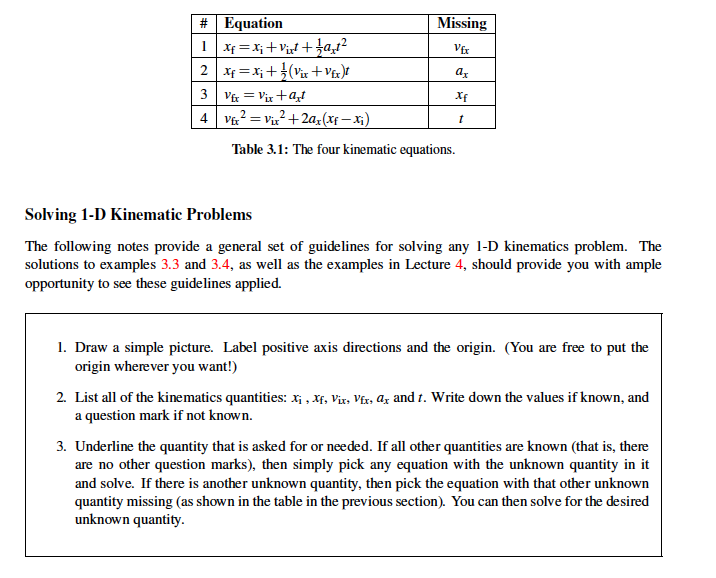
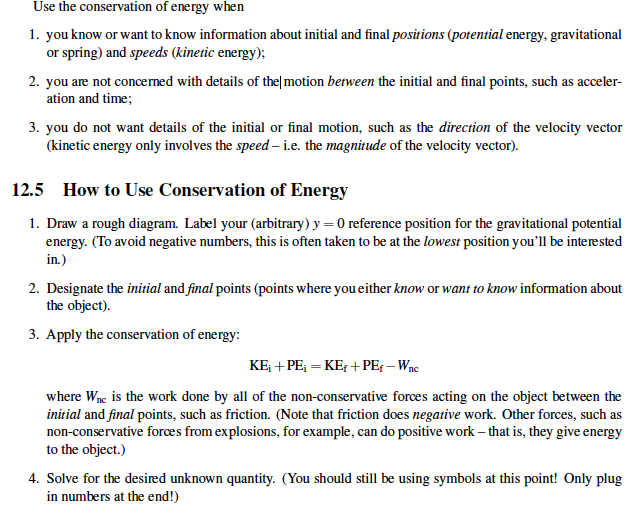
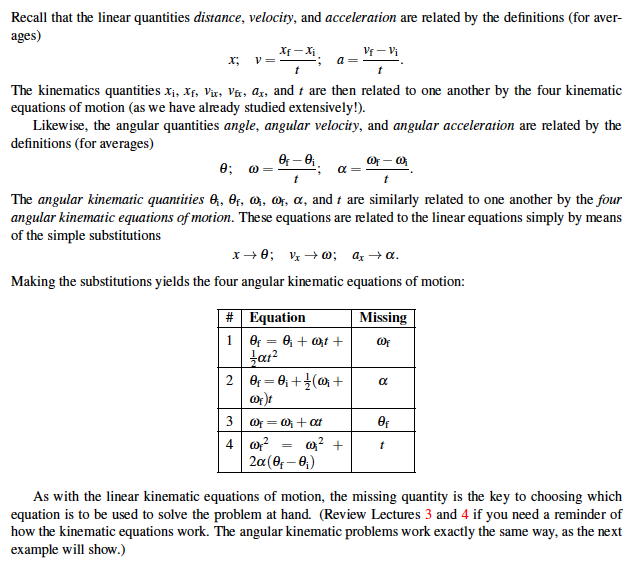
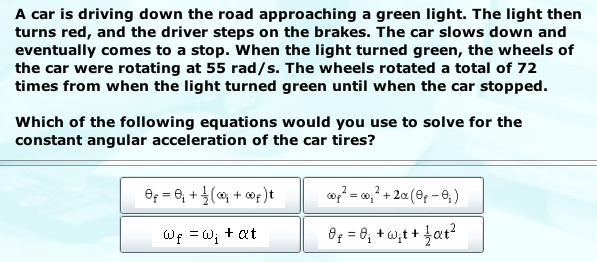
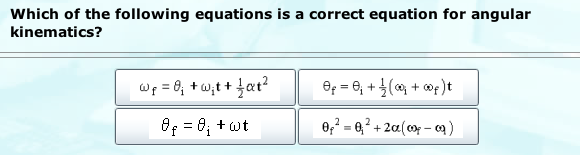
A course that emphasizes physics as a set of formulas to master has so many negative consequences. In this course, even I find myself at times needing to say something like, “Well, the formula for the force due to a spring is just different than the formula for the potential energy stored in a spring. One of them is F = -kx, and the other is PE = 1/2 k x²” It pains me to even think about speaking this… Well, actually, I take that back, it’s not so much the sentence itself; it’s the existence of a context in which such a sentence might actually make sense that is the real issue I have. So the question becomes, how did we create this context in our course?

I try to show you below how it’s not been terribly subtle.

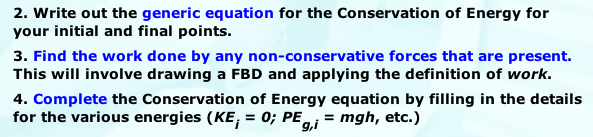
Example #1:  Part of the directions given to students for solving 1D-kinematics problems on whiteboards

Example #2: Part of the directions given to students for solving projectile motion problems on whiteboards

Example #3: Part of the directions given to students for conservation of energy problems


Example #4: An excerpt from their readings on 1D kinematics

Example #5: An excerpt from their reading on conservation of energy

Example #6: Excerpt from their reading on angular kinematics

Example #7: Some computer exercises for them to work on for angular kinematics

….


Love this question

A very thin hoop is placed at the top of a ramp. Will the hoop (start to) roll without slipping?

Without doing the experiment, what would you want to be able to measure to help you decide? Why would these measurements help? How would you go about measuring them?. Once you’ve measured these things, how will you use those measurements to help you decide.

Seven Things I am Realizing

Only 7 of the million things I am realizing this year:

#1: Organization. I need to become better organized. In past, when most of my job was mostly being a researcher or student with teaching just on the side, I could be pretty dis-organized about teaching and it had few consequences. Once teaching became most of my job, organization has become key, but I’m way behind the curve on this one.

#2: Teaching Colleagues: Teaching an inquiry course like the one I am trying to do with the future elementary school teachers requires a lot of time and mental effort, and it really benefits from having teaching collaborators.  In the past when I’ve taught this kind of course, I was either co-teaching it or had plenty of people around who had taught a similar course. This year, this course I have is a lot harder to teach by myself, without colleagues to talk about the student ideas’ I am hearing. I am finding myself much worse off because I can’t engage in nearly daily discussions about where we might go and what we could do next.

#3 Evaluator/Teacher: There is a bit of me that really likes the fact that I don’t write the exams for my physics course, and there a bit of me that hates it. I like it, because it clearly puts me in the role of teacher and not evaluator. It’s my job to help them learn.  It’s someone else job to write a test that tries to assess that learning. I don’t like it, because I don’t feel like the tests are a good measure of learning.

#4 For students, especially students from other countries and certain minorities, academic and social isolation can be a big problem. I don’t know what to do about it, but it is something I am more and more aware of being here.

#5: I was really, really lucky not to have to work and go to school at the same time during college years. This was in part due to scholarships and in part due to my parents. So many students I know here work full time. Sure, I wrestled full-time in college. But wrestling was something I loved and I did it by choice. If I stopped wrestling, I wasn’t going to evicted or starve. Oh wait, I did starve myself often due to wrestling.

#6: It is a struggle to find time and mental space for research. This is both because I am teaching more, and teaching new classes. But it is also a struggle with fewer colleagues around. I am very very thankful for colleagues who keep tabs on me: Those who ask me to be part of writing or reading groups. Those who offer to help getting a paper out the door. Those who ask if I want to work on writing a grant together. Those who invite me to give talks. Without those people, it would be easy to disappear.

#7: In teaching, a lot of things matter in the day-to-day management of a classroom. Sometimes it’s the big things. Sometimes it’s the little things. I’ve learned that even if you have a handle on at a lot of the important stuff, it is still easy for things to go bad and go bad quickly because one small thing. Having established some rapport with your students (as individuals and a class), especially, about who you are as a teacher and how you care about your students as learners, can go a long way toward not letting a slip become a fall.

Student Projects: Ideas vs Concepts

Here is an introduction from a student project in my physics course, who investigated issues of symmetry in projectile motion:

“Why choose this subject to investigate? Out of all the options to research, why this one? The main and best reason I can give to explain why I chose this is just out necessity… In class, …through visualization [of motion diagrams]we began to realize a possible connection between the upward and downward segments of the path. We started to see the motion as reversing itself after the object reached the top of its path. It was from this, that we as a class began to form that idea that if you throw something up at a specific speed, then when it comes back down and gets to the same height that it must be moving at the same speed.”

And here is another introduction from a different student studying the same phenomena

“The purpose of our experiment was to determine if the speed of a ball being thrown up is equal to the final speed of same ball going down. The motivation for this experiment was in part based on Galileo’s own experiments with gravity. Galileo, an Italian physicist, determined that the force of gravity is constant and objects fall at a constant acceleration toward the earth. He determined this by dropping two cannonballs of different size off of the Tower of Pisa. The law of parabolic fall states, “The distance traveled by a falling body is proportional to the square of the time it takes to fall.”

There are likely many different things to see and ways of responding to these different introductions. But, these two different introductions tell the story about the difference between ideas and concepts. Kevin Pugh, an educational psychologist, writes here about ideas: “Ideas are possibilities that must be acted upon and tried out… Ideas are ways of being in the world… They are inseparable from human experience.” Writing about concepts, he states, “Concepts are established meanings (classics)…When intellectual products attain classic status, they become isolated from the conditions in which they had an original significance and from their potential consequences for everyday experience. As a result, their importance is reflexively accepted, but not fully appreciated…”

Teaching Physics…

I am planning out a course that I’ll be teaching next semester for called, “Teaching Physics”. A major question I am wrestling with is, “What do I hope these students to walk away from this class knowing and being able to do?” Some thoughts that crossed my mind today.

Less than two years ago, Andrew Heckler opened a colloquium at the University of Maine with his take on the most compelling and important contribution of physics education research. From my best memory, he said something like this: “Our community is coming to the conclusion that it’s impossible to teach physics well without knowing how your students think and relate to physics content.”

Several decades ago, J. Minstrell wrote that it is a necessary part of teaching physics for “you and your students to know their initial conceptions before commencing a unit of study… Both the teacher and students must be aware of, and verbalize, students’ initial ideas.”

David Hammer wrote in the lates 90s: “A curriculum succeeds, not by guiding the flow of learning and instruction, but by helping to establish an arena of activity rich with opportunities for student and teacher discovery.”

There is something particularly interesting about Jim Minstrell’s recommendations for getting started in teaching physics. He doesn’t suggest you go out and start reading Physics Education Research articles. He doesn’t suggest you start using research-based curriculum materials. (Although I doubt he would recommend you not do these things). What he does suggest is this: Start by listening to your students’ ideas. Start by providing both your students and yourself with opportunities to learn about their ideas. Start by asking questions and constructing activities that engage those ideas. This is also reflected in David’s notion that the curriculum doesn’t succeed because it guides student thinking, but that it provides the teacher and students opportunities to find out about each others’ thinking.

At the end of the day, it is your students you need to come to know about. It is your students’ own mind that they need to know about. Yes, research materials can  help you create opportunities to learn about your students’ ideas. Yes, research articles can help you refine what it is you think you are listening for. But the work of learning about your students ideas is always now. …

What does this mean for my course? I’m not sure, but more and more I think I am committing to teaching this course in such a way that the students in my class experience student thinking– through examinations of actual student work, through observations and reflections of live clinical interviews I’ll conduct in class, through their participation in learning activities with students we invite to class, through interviews they will have to conduct, etc. Yes, we’ll get to reading some physics education research and examining research-based curriculum and teaching strategies, but not until we’ve spent time thinking about our own ideas about what students are thinking and doing, and why they might be thinking and doing those things. I’ll try to provide them with the opportunities to discover student thinking, and I’ll discover what ideas they have for thinking about student thinking. At some point, I’ll invite them to learn about how physics educators and  researchers think and how they have aimed to create curriculum and instruction based on what they think. I hope to do this partially by reading, but partially by inviting those people into our classroom.

I don’t see much reason why we can’t talk to researchers and educators over video. I don’t want the things we experience to be distant. Not distant student data or quotes. Not distant curriculum and curriculum developers. Not distant researchers.

How to get started? by J. Minstrell

Advice from Jim Minstrell on how to start teaching for the understanding of ideas
1. Start by listening to your students. By listening carefully and trying to understand their explanations, their predictions, or even the motivation for their questions, you can gain insight into their present understanding.
2. Ask questions that are qualitative. Avoid questions that require the manipulation of formulae and/or technical words unless you specifically want to find out whether they can correctly pick and grind a formula or to find out what a particular word means to them. I believe questions that ask for a qualitative explanations or comparison can be used effectively to probe understanding of ideas.
3. Ask questions that are relevant to common situations. There is a tendency to try to think up some bizarre situation to “trap” students into displaying their “alternative” conceptions. This isn’t necessary. In fact, it appears that many students have more trouble describing or explaining a common situations, probably because it is so similar to situations for which the initial conceptions were developed.
4. Ask questions that require inferential thinking. Once I know my students clearly know the observations, I want to know how they structure the phenomena to give them meaning. I typically ask for a prediction, a generalization, or an explanation. “If you do this, what will happen? Explain why you think that will happen.”  “You’ve now made several observations of … what can you say in general about the situation? What do all the observations together tell you about the nature of…”   “Explain how… happens.”   “We see that … happens. How would you interpret that?”
5. Clarify the observation first. Prior to probing their organization of thought, you may want to ask for their observations. Frequently, I find their perceptions were different from mine. In other words, before you ask them to explain or interpret, you may want to find out whether they saw the phenomenon as you did.
6. Listen (or read) carefully in a non-evaluative way to the answers given by your students. This is probably the most difficulty aspect. As teachers, we are prone to jump in and steer the students straight by telling them what to think. Students are prone to look to teachers for feedback as to whether they have the “right” answer. Fight this, if you want to know what they think. Be neutral in your comments about what students say. Help the students clarify their ideas, but do not evaluate those ideas yourself. Get them to evaluate their own or each other’s ideas. Students will be more willing to say what they believe if they are not graded on their specific answer early in the development of their ideas. There will be a time for grading later after ideas have been developed and used. When you are reading quiz or test results, rather than simply classifying answers as right or wrong, try classifying them as to the type of argument. What I find is that students often get the wrong answer for very good reasons, and they sometimes get the right answer for very weak answers.
Conducting these investigations in the classroom has changed the nature of my instruction. The focus is now on developing the understanding of ideas and applying ideas, ideas that are related to students’ own thinking. We are not matching through a textbook interpreting the ideas of some distant authority; we are building our own ideas.

Blog at WordPress.com.

Up ↑