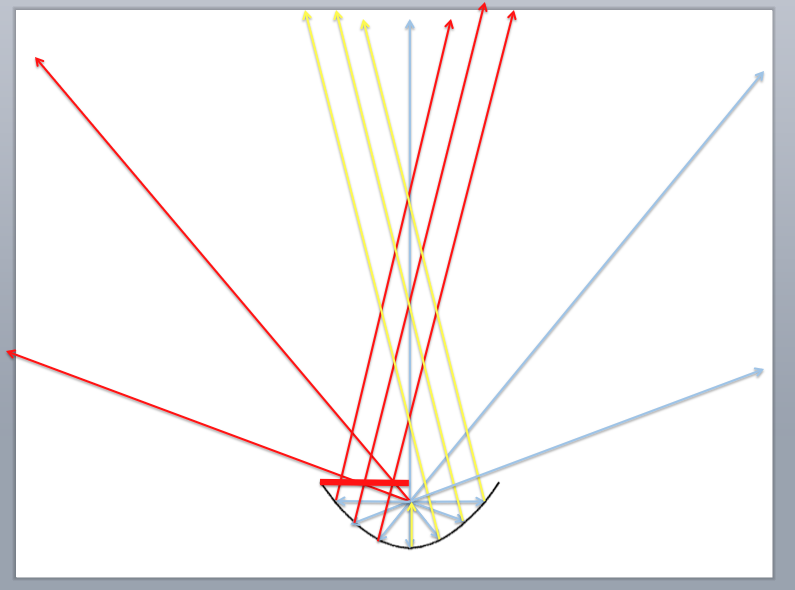
The drawing below is my explanation for this picture
Brian reflects on his physics teaching

The drawing below is my explanation for this picture
Acceleration as Simple but Vast Idea
So take the definition of average acceleration: a = Δv /Δt. Simple right? Well, yes, but not really. In order to really understand this definition, you’re going to have to explored a vast array of ideas, including ideas like
If an object is slowing down, its acceleration is in the opposite direction of its velocity
If an object is speeding up, its acceleration is in same direction as velocity
If an object is turning, there will be (a component of) acceleration in the direction of the turn.
It takes time to speed up or slow down. Some things speed up quickly and others speed up slowly and this has to do with an object’s acceleration.
Given a constant acceleration, speeds change linearly –an object gains (or loses) the same amount of speed in any equal interval of time.
A greater change in velocity in the same amount of time indicates a greater acceleration
The same change in velocity in less amount of time indicates a greater acceleration.
A greater acceleration will result in a greater change in speed in an equal amount of time.
A greater acceleration will result in an object taking less time to change its speed.
When an object is accelerating, the distances covered are not equal for equal times; objects cover more ground during times in which its moving faster and less when it’s moving slower.
Also, if you’re human, you’re going to have to become aware of and then wary of, a variety of other possible problematic ideas, like
Faster objects have more acceleration
A greater increase in speed means more acceleration
No velocity means no acceleration
Objects moving with same acceleration move in identical ways.
And we haven’t even begun to worry about having procedures for determining or estimating velocities at particular times or procedures for subtracting two velocities. We haven’t concerned ourselves with when it might be appropriate to model a situation with constant acceleration. We haven’t concerned ourselves with the difference between average and instantaneous velocity, or with strategies for selecting convenient intervals of time for carrying out one’s work. We haven’t talked about graphs and other representations. It turns out that acceleration is a high density idea.
Some Place Generative to Start:
Changing topics a little bit, one of the questions I have been thinking about is this: Given that there are so many ideas packed into definitions such as acceleration, which ideas are most generative? That is, which ideas serve as a good starting point for generating the entire set of ideas? Given such a good starting point, are there other ideas that come along for the ride? And I don’t mean logically generative–like you could derive certain ideas from others. I mean generative from a human learning perspective. What ideas serve as productive anchors or as productive leaping off points… So, now, I’m think, “Isn’t it odd to juxtapose the words anchor and leaping off point?” Like, one implies, “keeps you grounded somewhere.” The other implies “strong base from which to leave.” Those are totally different metaphors for generative starting place.
I also think about this a lot: Does the generative starting point need to be correct? or like a baby-version of correct? If I go with the anchor analogy, then yes, the generative starting point should be correct. It’s like “home base”–the place you are tethered too so you don’t get lost. It’s a trustworthy place to ground your thinking. But if I use the leap-pad analogy, then the most generative starting point can actually be a place you never return. It’s the place that launches you to the next place, which may be quite different, and possibly even wrong. I think we tend to operate under the tacit assumption that the starting points should be “anchors.” I think we have a hard time thinking about what a generative (but incorrect) launch pad would look like. I know I do. But still, I keep returning to the idea, because it has so many implications for how we might think about teaching, learning, and assessing progress.
This year, as has been the case other times, I won’t know exactly everything about how students are going to be assessed in one of my courses. There are multiple reasons for this:
(1) On the first day of class, students will help decide how their notebooks will be assessed based on on activity where we examine several scientists notebooks and try to reach some consensus about what the purpose of notebooks are and what should be included in one. From this, I will draft a rubric for which students will have to self-assess by pointing me to various points of their notebook that show evidence for standards and criteria that are set. While I have ideas that will contribute that will almost certainly make it the rubric, there are certain criteria that are bound to emerge to be particular to this class. Students will assess their notebooks three times during the semester. I’ll use these rubrics, in addition to examining their notebooks for completeness, in order to provide “grades” for this part of the course.
(2) Students are also accountable to the people and knowledge that is developed and made public within our class–including investigations carried out by other student research groups, various models of physical phenomena as they develop–including the ones that are proposed and later discarded, evidence we collect, arguments we construct, and foothold ideas we establish along the way. Of course, a lot of this will be very closely aligned with canonical scientific understandings; but they will also be embedded in our specific classroom discourse, the particular investigations we carryout, and the arguments we construct. I know that we will make contact with ideas such as “light travels in straight lines”, “light goes out in all directions”, and rules about how light interacts at various surfaces, but I’m not just assessing them on whether or not just “know” and “understand” these rules. I am assessing them on their ability to make claims, to explain and construct arguments, and to do so in ways that are accountable not only to this knowledge, but to the ways in which our class has come to know and understand them and to talk about them. While there are specific criteria explained to the students for what it means to be accountable to knowledge and the communities that generate them, the conceptual substance of the knowledge for which they will be held emerges within the curriculum rather being imposed at the start.
(3) Participation is a part of the grade for this course, but not in an attendance sort of way. They are assessed on their participation in the community–as a participant who contributes to the development of knowledge and the activities which serve to generate it. In the class, students work both as part of a “research group” and “writing group” to which they are accountable for making contributions both as developers and critics. Students also play a role in sharing work from their research groups to the whole class. As with the notebooks, students have to self-assess and submit to me evidence of their contributions to the knowledge community. Of course, students are not expected to participate the very same way. The self-assessment rubric allows students to participate differently, but it still must be significant and substantive. One of the biggest part of the self-assessment is them telling where they could improve their participation. Once again, there are specific criteria I share with students and ask them to provide evidence, but what exactly it looks like to be a contributing member within a community varies from person to person and from class to class, just as it does from community to community within science.
It sounds like there is a lot of ambiguity. I think there is and there isn’t. So I have decided this. The goal I have for myself, during and after this semester, is to work on better articulating each part of the course such that I might be able to create more specific learning standards. The nature of the course makes some of this difficult, but I think it will still worth it in the long run.
Andrew asks us sig-fig-haters, “How would you want students to report this measurement?”
” I measured the length and width of a sheet of printer paper in centimeters. I came up with l=27.95 cm and w=21.60 cm. Each of the measurements I believed to be within ±0.05 cm. If I want to find the area, what value should I report? l×w=603.72 cm2 without regard to the number of figures being reported.”
Ignoring units for a moment, I’d be happy with any of following, plus some more:
604 ± 2
603.7 ± 1.9
“A little more than 600 cm , give or take a few”
“Most likely somewhere in between 601 and 605.”
So, beyond all of that, to me, it’s important to distinguish among three different things:
(1) The habits of mind we are trying to cultivate (e.g., here a sensitivity toward describing measurement in terms of distribution in which the actual value is likely to reside, and an understanding of why we might care to do so)
(2) A particular strategy or set of strategies we want students to feel confident using when determining those distributions (e.g., crank three times, monte carlo, calculus methods, etc.)
(3) The particular standards or conventions for reporting measurment and uncertainty when publishing for an broader audience (e.g., error bars, sig figs, confidence intervals, etc).
My thinking: If you are conflating these three, you are going to run into trouble. Of course, I want students to learn #1. But I don’t think you can learn that in the abstract. So we’ll have to talk about #1 in relation to a variety of #2’s. But doing #2’s of course doesn’t imply that they are supporting #1. Students can learn to do carry out the procedures of #2 without any idea of #1. #3 is where I think I should be really careful. Me personally, I’d hold off on demanding particular standards until students are publishing their work for an audience greater than the teacher. Different communities, even different journals, have different standards for reporting measurements and their uncertainty. Those conventions serve a purpose, but I want students to make contact with the necessity for convention when they are communicating their research to an audience (even if just peers in class), not just completing exercises for homework or on exams.

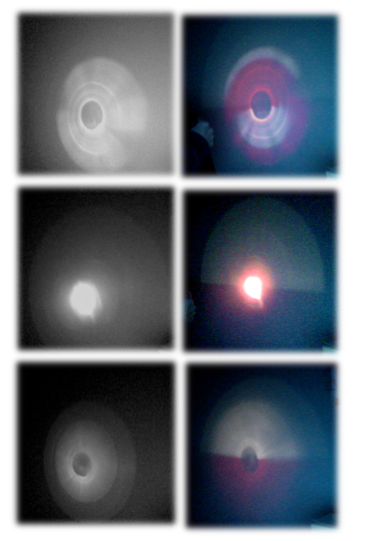
The photos on the left show what the pattern of light looks like in three different configurations of the adjustor. I am shining the light on the wall from about two feet away, and the series from top to bottom is the sequence from when the light first turns on until just before the adjustor screws completely off. The photos on the right show the light pattern from each of the same configurations but with the bottom half of the flashlight covered with a red color filter (right at the tip of the flashlight).

Here is a photo of the pattern of light I posted about yesterday. Instead of blocking out the light to make the pattern, I used a red filter.
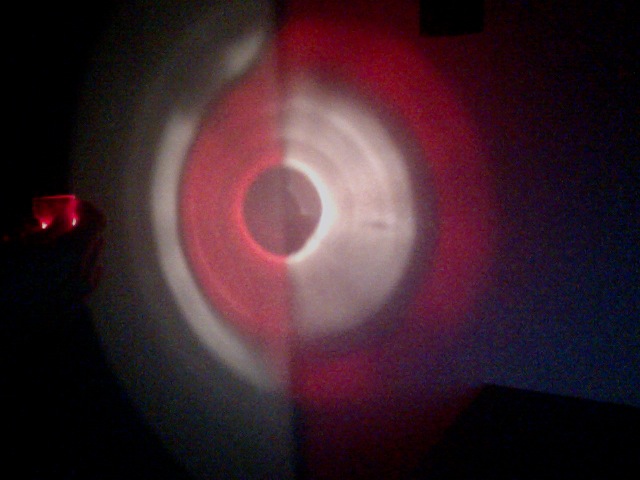


During my inquiry with maglites the other day, I came across a pattern of light that looked kind of like this by blocking out some of the light. The pattern of light was not quite so crisp and clean of course, and there were a few more details I’ve left out. Maglite shadow puppets can be bit strange, and this is certainly not the strangest.
I’ll try to get some photos up this week. But for now, the question is, “How would you make this? How do you know”
I’m working through more of the SGSI roadmap. Today, I built a pinhole theater using a cardboard box, some duct tape, a white piece of paper, and aluminum foil. The box is big enough to put your head in, the duct tape is to block out all the light at the corners and seams of the box, and the aluminum foil is covering a hole I cut out, which makes it easy to create the pin hole and then change the pinhole size or shape. Across from the pinhole is taped a white piece of paper. When I stick my head in, I just use a sweatshirt to block out the light around my neck, and look at the white paper.
To me, pinhole theatres are more engaging and interactive than pinhole cameras, because it’s like a movie.As you move, what’s showing on the screen changes.
Here are questions that I think can arise in building one and taking it outside:
Other things can come up as well. For example, when shining light on the white paper in the theatre, you need a pinhole to show an “image” (technically not an image), BUT with a mirror, a mirror always shows an image without a pinhole. How is a mirror different from a white piece of paper? Doesn’t white reflect all light?
To make sense of these questions, new investigations arise. Including shining light through holes, down tubes, onto paper, shining multiple lights through holes, shining lights through multiple holes, eventually toward figuring out how light gets from sun to objects in the world, to the screen, to your eye, and what happens to the light at each stage.
So, we have mag-lites, then pin hole theatres driving our investigations, and then I think it’s onto eyes.

In my physical science course for future elementary school teachers, I am going to begin on the topic of light, which is where we will stay for about 4-5 weeks, following a lot of the notes and facilitators guides from SGSI.
I am amazed by how much inquiry you can do with a mag-lite. Probably on the second day of class, we are going to do a maglite dissection, which will our starting point for generating questions about how light works. Here is what a mag-lite looks like when you take it apart.

I’ll ask students to examine their maglites, fiddling with any adjustment to see what (if anything) they do. I’ll ask them to take it apart, looking at each the parts carefully, and making a diagram. I’ll ask them to label their diagrams, coming up with a name for each part and a conjecture about what each part is for.
Either during or after the dissection, I’ll ask them to take some notes on things they notice and questions that arise as they do a “maglite potato head”, using different configurations of the parts to see what effect they have on the pattern of light. For example, they might try out some of the following arrangements:
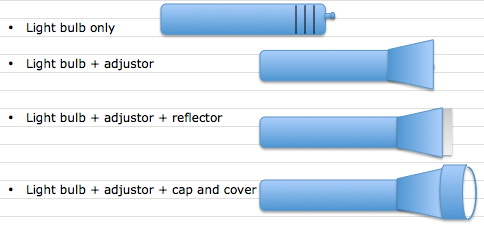
They can also hold the reflector over the shaft by hand and move it around. They can see what effect the cover has, or whatever else they want to try.
Through diagramming, whiteboarding, taking notes, and class discussion, I hope to make contact with some of the following questions:
@ adchempages wrote to me on twitter that the life lessons he aims for students to learn are the following: Discipline, Punctuality, Politeness, Deadlines, Respect, and Accountability. In this post, I elaborate on what those words mean to me.
Discipline: I interpret this as mostly involving self-discipline. To me, having discipline involves persistence with the work of moving toward one’s own goals, especially in face at adversity. It is not discipline to obey others or to fulfill the goals that others have for you.
Punctuality: I interpret this to mean to strive to act with conviction when needed, and to have one’s words be coherent as possible with one’s actions. It is not to be on time, but rather to be exact in one’s actions.
Politeness: I interpret politeness to be humble in the face of the unknown and unknowable. Politeness is the counterpart to punctuality.
Deadlines: I see this as the need to act in a timely way such that no one else is harmed by one’s inaction, especially those to which you hold community relation. The premise for this is that the choice not to act is an act.
Respect: To be receptive to possibility that you can learn from anyone and everyone and to act in ways to make learning interactions more probable and more fruitful.
Accountability: To be aware of one’s multiple and often conflicting responsibilities to self and others and to act in ways that are mindful of such conflicts. It is to treat community as part of self and self as part of community.
 Teach. Brian. Teach.