Some new (for me) misunderstanding about components

This week I learned of some new possible misunderstandings that I had never considered or observed before. I received several emails this week from students asking about what is meant by the “x-component of velocity”. If you haven’t been following, my class is somewhat of “flipped” class, where students read lecture materials online and come to class to think through conceptual problems, work on solving quantitative problems, and carryout some investigations.

So far, we’ve only been talking about one-dimensional motion, but the reading material has been using “x-component” of velocity rather than just “velocity”. I can sympathize with why someone might choose to write it this way, but I think, in reality, its cumbersome, wordy, and confusing.

So I began yesterday, by asking students to talk with their neighbors about what they think “x-component of velocity” means. After some discussion, I asked to hear idea about what it could be.

Here are the two answers we heard that I had never heard before

(1) Velocity is made up of two parts (or components), the magnitude (speed) and the direction. The x-component must be either the speed or the direction.

(2) Velocity is made up of two parts (components), the Δx part and the Δt part. The x-component of velocity means you only look at the Δx.

What this shows me is that students were trying to make sense of this vocabulary as best they could. They were thinking, “component?” well that’s like a part. What parts does velocity have? It had magnitude and direction parts. It’s also calculated using distance and time parts. The x-component must be one of those parts. To me, this is completely reasonable thing to do. It’s also a good sign to me, that at least students are reading and trying to make sense of strange terminology.

I had a brief activity ready, one involving the directions given by google maps to get various places. I gave them a few examples of paths moving along North-South streets and East-West streets, some moving along both, and some moving along a diagonal street.

At the end of the day, someone asked, “Why would I ever care to describe just the x-component of velocity (as – 30 mph) when I could just describe the whole velocity as 42 mph Northwest?” I said, that’s a really good question.

I want to be clear that vectors or finding components of vectors has not been covered in this class, and that there are difficulties in students’ understanding them. I also want to be clear that the two misunderstandings are likely the result of the format of flipped class and the choice to introduce the terminology of “components” before (I believe) it made sense to do so. I don’t think these two are deep-seated confusions; rather they are the result of asking students to read something before we’ve helped them to carve out some distinctions which would have helped them to read that text.

If you are interested in how to make readings or lectures more effective, you should read this paper, called “A time for telling” by Daniel Schwartz and John Bransford. In this article, they talk about three experiments they carried out to better understand what kinds of pre-lecture or pre-reading assignments help prepare students to learn from text or lectures.




Undergraduate TAs

In my intro physics class, I have an undergraduate TA who is both a physics major and a future math and physics teacher. My advice to him for how he could be most helpful in class was the following:

I told him that his main job was to listen carefully to students and to scout out interesting ideas that students have. I told him that I wanted him to walk around, listen, and ask questions to see if he notices anything interesting students are talking about or using. I asked him to report back to me about interesting things he notices students are doing or thinking–it could be right or wrong ideas or procedures; it could be interesting but different solutions to problems; it could be peculiar or ordinary ideas; it could be novice or advanced ideas. I told him that it was his job to help me scout out ideas, so I that I could decide if any of those ideas needed to be elevated to the level of the entire course.

I gave him several examples of what I thought were interesting ideas that occurred over the past couple of days, which I had decided to bring to the level of the whole class. Those ideas included,

Many students not knowing where the x =0  on a x vs. t graph;

Stan’s theory about why we couldn’t see any acceleration in our data for the falling coffee filter (even though it must have accelerated at some point);

That one group got an acceleration of 6,000 mph per hour; while another group got 1.67 mph per second;

One group’s idea to “half the range” for the uncertainty in time measurements vs. the TA’s own idea about using “reaction time”;

He had already been asking students questions and helping to explain things to students. I told him that he should certainly continue doing this, but that he might ask students questions in order to find out what they are thinking, rather than to just find out if they have they right answer.

If you had an undergraduate helper in your class, what would you want them to see as their job?

Goal-less problems

One of the things I do like about the flipped classroom I teach in is the use of goal-less problems.

If you click through that link, you’ll see that on exams, Kelly O’Shea asks students to:

(a) list which models apply and explain why

(b) draw useful diagrams or graphs

(c) use diagrams to help you find interesting unknown quantities

Here’s an example of the kind of written goal-less problem that have been built into the flipped classroom I teach.


Here’s an example of a video goal-less problem that I think would also be good (perhaps better) for our class.


I think for the video-goal-less problem, I could easily edit the video to cover up the odometer, and then an interesting question is, “How far does the car get?” or “Does the odometer change numbers?” A perhaps less compelling question, at least initially, would be “What’s the average acceleration?” And a higher level question would be, “How well does a constant acceleration model do here?”

There are lots of different ways to find how far the car gets:

(1) We can make an educated estimate for the average velocity, and use the average velocity idea to calculate the distance.

(2) We can break up the motion into pieces, and use speedometer reading at different times to estimate the distance of each piece, perhaps applying the constant velocity model to each section. I imagine a careful strobe diagram (or motion map) could work here, but algebra or graphing would work, too.

(3) We can calculate an average acceleration just using the initial and final speedometer readings, and then apply the constant acceleration model. You could also plot some data points for velocity at different time, make some inferences about a best fit line to either estimate the average acceleration and/or find the area under the curve.

Of course, 1-4 don’t represent completely independent thinking or processes.

I’m curious to run a mini-teaching experiment where some students get the written goal-less problem with the original directions and other students get the video goal-less problem with something more like Kelly’s directions.

I just want to see (1) how these two different scenarios “launch” in terms of engagement and (2) the extent to which these different activities lead students to make contact with important disciplinary ideas (not just equations).

With an eye toward improvement

Among many others goals, I do want to teach physics as a coherent set of ideas, principles, and models, not as a set of equations to be memorized, selected, and manipulated.

So, here’s what I’m working with now.

So with the above goal in mind, I think these directions are working against me.  To me, this sounds I’m explicitly asking students to engage in “recursive plug-in-chug” with maybe a sketch to make sure they get the signs right. So, how would I go about improving this?

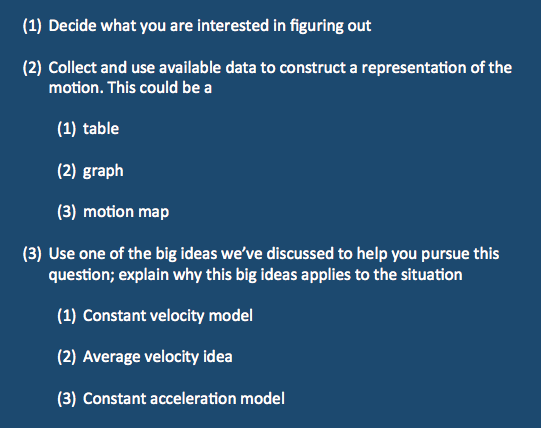
Here’s my first attempt at writing what I’d want it to be:

I’ve borrowed a lot of this from you modelers out there… you know who you are. And I don’t think these directions are necessarily linear, although maybe I do think that representing the situation early makes more sense, because it guides you to what models or ideas might be useful. I also think the average velocity idea is one of the most important ideas about there, even though I’m not sure it’s a model. Of course, sometimes representing or applying models will lead you to new questions. And asking if a model applies is a question itself. And sometimes you can jump to (3) pretty quickly and end up needing a representation to be your abacus. But the gist is this: Be interested in something, construct representations that will let you see that interesting thing a new way, apply ideas and try to break models. So maybe that’s what the directions should be.

Now, sure, being careful about signs is important (and having equations at your finger tips helps), but it’s not something you “machine” into students. I feel comfortable letting student work (especially with interesting problems, representations, and ideas) be the place where the necessity for and an interest in being careful arise together. See, the first set of directions above pretty much dictates that a “sketch and a coordinate system” will be their representation and that an algebraic manipulation of some equation will be their machinery. There are even some rules to help them figure out which equation(s) they might use (i.e., put questions marks next to unknowns). I think the implicit idea behind such directions is this one: “If we just get students to follow these steps, they’ll be less likely to make mistakes and more likely to arrive at the right answer.” Perhaps a more charitable interpretation is an explicit concern that students need clear directions and scaffolding to learn. This confuses learning and understanding with the capacity to follow directions and be careful.

Lastly, to me, the engagement-distance between “listing and solving for unknowns” and “deciding what’s interesting” is huge, and asking students to “decide what’s interesting” demands of me that I bring them perplexing problems.

An attempt to articulate what’s missing

A lot of hard work and good ideas have gone into creating the flipped class I’m teaching. I do think there’s a good base to work from, but yet still I’m finding it hard to be at ease with it. So here’s where I’m at with the flipped class curriculum I’ve been asked to teach after week one.

First, a list of wants:

(1) I want the computer exercises that students are asked to work on to

(a) be at an appropriate level for what the students know and are able to do, taking into the account that they are working in groups and there is a diversity of knowledge, experiences, and backgrounds.

(b) match what the students have been asked read to before coming to class

(c) be understandable (at level of writing) and not filled with unnecessary wordiness

This week, they failed at a, b, and c. Many of the exercises were not within students grasp. Sometimes because they were outside what I would expect them to be able to do. Sometimes because they really couldn’t have been expected to take such things from the reading. Sometimes becomes the writing of problems was cumbersome, wordy, or confusing. Sometimes all of it.

(2) I want the problems I am asked to model to be an example that touches upon key concepts, not just be an example of how they might approach their problems to come.

This week, the problem failed to do this. I know that merely going through a problem, even as clearly as possible, would do nothing to help students understand the concepts of average speed and average velocity, and the difference between the two. In the class I observed, the example problem didn’t seem to help anyone on their problems anyway (and it was presented nicely, clearly and was also well broken down), so I’m left wondering why we do them.  In my class, we did a little more work to build an intuition around the concepts, but I felt strangled by the example problem.

(3) I want the concepts and skills that are touched upon in the computer exercises to be somewhat  relatable to the example problem I model.

This week failed at this as well. The computer problems had students interpreting strobe diagrams, x vs t graphs, velocity vs. time graphs, and connecting those to written descriptions. The example problem was pretty much straight plug and chug to calculate average speed and average velocity. While all were in the topic of kinematics, they neither called upon the same concepts nor the same representations. It felt to me and students we were just being pulled along to do widely different thing, much of which we didn’t understand or understand their relationship.

(4) I want the problems students work on their whiteboards to be the jumping board for a good board meeting.

This week failed this criteria as well. All the problems were mostly just random variations. There are basically 4 questions randomly assigned  across eight groups. The problems, as far as I can see, have random numbers that lead students to have to do slightly varied procedural moves (perhaps calculating t from x and v or x from t and v in order to calculate an average velocity for a whole trip). Students have no reason to be interested in each others’ problems, because the problems are not built to do so. I’d prefer that every group either do same problem (for which there might be different approaches we can compare and contrast); or that there be 2 carefully picked problems that draw out some important skill, distinction, or concept between them.

I made the best I could from the se of questions, helping students to note certain subtleties within or across problems. But I want the problems and the problem set to drive interesting puzzles and conversations from the student end, and not need me to swoop in to notice interesting things. I believe that careful choices can make this more likely to happen (although I know there are no guarantees).

Second, What’s missing?

I know I’m picky. I know I have high expectations. But I’m trying to articulate what’s missing. I mean everything sounds good, right? Students working on conceptual problems with feedback from a computer. Students working on problems collaboratively on a whiteboard. Students discussing solutions with each other. Yet, there’s something missing. I think it’s

(1) An understanding of where students are at coming into the course (maybe the demographics have changed). Whatever the reason, the curriculum fails to meet them where they are, on day one.

(2) An understanding of how pick problems and sets of problems that help build both important procedural skills and conceptual, and that are likely to squeeze some learning out of problem solving (not just be problem solving).

(3) A coherence across the class activities that are an the appropriate grain size.

Last, what I might do

I’m somewhat torn about what to do. At some level, I’m responsible for doing much of the same things as other sections; but I have a hard time doing things that I know are just washing over students. I’m wondering how much tweeking I can do around the edges without undermining the course structure and without driving myself crazy prepping each week.

I do think that I might be able to (1) tweek the example problems so that they are more connected to exercises, (2) get students interactively engaged with my example problem so it isn’t just a lecture washing over them, and (3) be more selective about which problems I will allow student groups to work on, so that more connections can be made during discussion.

Anyway, that’s my plan as of today: Connect the pieces, engage the students, trim the fat.

Why I shouldn’t teach certain courses

Today, I tried my best not to let some bad (untimely? unfortunate?) curricular elements harm the well-being of my class and the students who come to it. The way I see it is this: It is a high priority of my job to protect my students from any undue or unnecessary harm to their sense of self-worth and ability, especially those that will function as serious liabilities for their learning in this course and beyond.

Today, in my flipped class, students were sent back to a computer, which then proceeded to blast away at their self-worth by asking questions that never should have been asked. For example, groups were asked by a computer how to find x-component of displacement from an x-component of velocity vs. time graph. Out of the 16 groups that I observed (8 in my class and 8 in another class), only 1 group  was even in the ballpark of understanding what the question was asking. In the class I observed, I only knew this because I visited each group and listened and watched. When the instructor asked, “Did everything make sense? Does anybody have any questions?”, not a single student spoke up. In my class, I knew this because every group of students knew it was their job to share with the class what was confusing. They raised their hands and called me over. I had already set the tone that we are here to learn and that confusion is where learning lies. I was and am proud of them for having the courage to stick up for their right to learn and not to just click through some computer problems that were completely incomprehensible to them. I had to explicitly tell them afterward that they could not have been expected to understand everything, rather that those exercises are merely fore-shadowing the things you will need to come to understand.

Let’s back track, a little bit. Before class, several students asked me to meet with them before class to discuss some  problems they were working on. I think the problem was about a person running 3 m/s for 30 minutes, and they were supposed to find the distance.

This is what the students had done:

3 m/s / (30 minutes / 60 seconds) =

I asked them what they did and why. And they said, “we divided because we saw that the seconds was in the denominator [pointing to the s in the m/s], and we figured we had to convert to seconds somehow. But we weren’t sure exactly how to do it.”

OK. So I decided to ask a simple question, “How far does it go in one second?” Someone answered 3 meters. OK, well, how far does it go in 2 seconds? Someone said 6 meters. Now I asked, why? Someone said, its 3 times 2. I said, “Yeah, and it’s also 3 + 3. He traveled 3 meters in the first second and  another 3 meters in the second second”. Then, I asked how far it would go in 10 seconds. It was certainly not automatic for them to say 30 meters, suggesting to me multiplication by 10s was not at their finger tips. So, then I asked them how far would it go in a whole minute, and they were able to eventually figure out that it must go 60 * 3 m/s. And then it wasn’t easy (but neither hard) for them to realize that is must be 3 * 60 * 30.

This. this stuff is ground zero for these students–quantities, rates, and ratios. Jumping to finding the area under a curve is absurd (a bit too quick to the gun?)

Let’s talk again about computer problems. Students had another question where there was written description of a motion–on object moving toward the origin, then going slower in the same direction, then stopping, then going faster in the same direction and moving through the origin. They had to pick out the right graph. Many students were struggling with this as can be expected, so I asked the following question to several groups, “Can you show me where x = 0 is?” Some students pointed to the center at (0,0), while most pointed to vertical axis.

Once again, interpreting graphs and reasoning across written and graphical representations is tough stuff, but no one had even invited them to the playground. These students were confused about why the “x” was on the y-axis and were (understandably) confusing the origin of coordinate systems with the (0 second, 0 meter) location on our position vs time graph. Total stuff I expect to see, depending on the population.

So afterwards, I took a poll. I asked them to talk with their group about, “Where x=0 is?”. After they talked, I asked for ideas, and four ideas came up. It is the vertical line (axis). It is the point (0,0). It is the horizontal axis line. It is arbitrary and could be any horizontal line. Someone brought up the fact that when you zoom in a graphing calculator, the horizontal line shown isn’t always zero. I simply just wrote up their suggestions as they gave them and I asked for why someone might think this. I then sent them back to their groups to discuss what they thought it should be after hearing all the ideas. All the groups came back saying it should either be the horizontal line of the axis or it could be any horizontal line if it isn’t labeled.  We ended up deciding that you should always label your axes, but if you find one that isn’t labeled, it’s a safe bet that the axis represents the zero value.

I was already “waaaay behind”. Note here that I didn’t say, my students were waaay behind. I think my students were probably now a little less behind than students in the other class, but the my INSTRUCTIONAL timing was behind. I refuse to leave my students behind, and that’s why I shouldn’t be allowed to teach certain courses.

First day ideas about light

In today’s inquiry course, we began our investigation about light:

At some point, we were discussing what it would look like if you were sitting in a dark room looking out into the hallway, and your friend was shining a flashlight down the hall. The major predictions that came up were these:

Idea #1: You’d see a “concentrated” beam of light. Some thought this would be like a narrow beam, others thought it would look bigger the farther it goes down the hall away from the flashlight (like a cone of light).

Idea #2: You’d see a beam of light, but that some of the light would “spill” or “leak” into the room you are in. That light  that spilled over would light up some of the room by the dorr, but they didn’t think it would be able to go around and light the whole room (like the corners).

Ideas #3: Everything in the hallway would just be “lit up” inside, allowing you to see what’s inside. Some said it would be brighter the closer you are to the flashlight (and dimmer farther away) in a long hallway, but that it would appear equally bright in a smaller hallway. Some with this idea talked about the “glow” of the light filling the space, while others talked about the light bouncing around off the walls to get everything lit up.

Idea #4: You’d mostly just see dust or particles shining in the air. Some thought you’d see dust only with a faint light (or light far from flashlight), because a strong light would just show the concentrated beam. Others thought that you would need a bright light in order to see the dust, because the light needs to reflect off the dust strongly.

 Idea #5: The side walls of the hallway would only would be dimly lit, but at very the end of the hallway there should a spot of light on the wall. If you were just looking in but not down the hallway, you’d see the dimly lit walls due to “ambient” light everywhere. But if you looked down the hall, you’d see the spot of light down at the end.

During and after observations, students noticed and wanted to talk about a variety of things, including

(1) The fact that they didn’t see a beam of light. This was the most common reaction, and several students talked about how they must have been thinking about like “cartoon” light.

(2) The fact that they did see some light get out of the hallway and into the room through the door, but it didn’t leak through, like they had expected. They talked about how the door angled the light in a particular way based on where the flashlight was located. On group mentioned how we only see the light out of the room because it hit the floor–we couldn’t see it traveling to the floor.

(3) They also saw that there was a specific starting place where the walls began to be lit, and the boundary of that lit places was curved. There were ideas about how the mirror in the flashlight causes this curviness. Other thought the circular shape of the flashlight hole was the cause. Some thought it might be both.

(4) There was also some discussion about whether the dark spaces were completely dark or just somewhat darker than the bright regions. One group explained that it didn’t seem completely dar (just much darker), and that maybe light was reflecting off the walls and getting back to those areas that don’t get direct light. This started to touch upon an idea that the reflected light might be dimmer than direct light.

(5) Some students noticed that there was a circular spot down at the end, and they used this as evidence that there must be a beam even though we can’t see it until it hits the wall. Other students said that they didn’t want to call such an “invisible beam” a beam, but something else instead. This conversation also started to touch upon ideas about what the mirror was doing. Some thought the mirror was “funneling” the light some how, making it more concentrated into a beam, while others thought the mirror was just making the light that would have gone backwards go forward.

Students also had various other questions, including :

(1) Why is the lit space curved the way it is?

(2) What would be different if we just used a regular bulb instead of a flashlight? Would different shaped bulbs make a difference?

(3) What would change if the back end of the hallway was a mirror? Would the dark spots behind the flashlight now be more lit?

(4) The shape of the light that made it out of the hallway was affected by the shape of the door. Would a circular hole make circular spot of light? Triangle hole triangular?

(5) What would change if we added lots of the dust? Would we see a beam then?

We have a lots of good starting ideas and questions, and there are lot of places that I want to work on getting them to clarify and be more specific about what they are thinking and why. I’m excited to see where we go, but I’ll have to wait a week.

New ed. researchers and how you can help

There is an undergraduate student in our physics teaching program who wants to do his undergraduate thesis around using video analysis for physics labs. I am not supervising this research, but the student has come to me for some guidance.

This is how the student describes his work in an email to me:

The research I am doing involves using Logger Pro software to analyze motion videos for physics labs. The main goals of this research can be divided into three areas.

  • Create 2-3 labs involving logger pro that can be used at the high school level, but with room for adjustments to be adapted for other levels.
  • Design a questionnaire to be given to two classes; one that is using the logger pro software in their labs versus one that is undergoing the “traditional” physics instruction without logger pro.
  • Create a comprehensive instructional guide for others to use logger pro in their own classrooms (for students and teachers).

For the most part, I feel like I can handle making the labs and the instructional guide, but I could use some guidance for the questionnaire. I also need some help in how I should put this together to make it look more like a legitimate research project than a mess of ideas put together.

Based on my experience working with graduate students on their Masters theses, I am not surprised to see new education researchers wanting to jump to developing, implementing, and testing curriculum. I am also not surprised that faculty–at least those who are not trained in education research–would encourage students to go this route. To many, it seems like the “science-y” thing to do–develop a product, run an experiment, take quantitative data, and compare outcomes.

My responsibility, as I see it, is to help new researchers do research that (1) contributes to the knowledge base on teaching and learning AND (2) helps them develop important skill for teaching. The balance between these two goals is dependent on the project and the student. What I don’t want them doing is re-inventing wheels and run wheel races. We don’t need more of that.

So the two things I would love to hear about from everyone is the following:

(1) What curriculum do you use or have you developed that for video analysis? And can you share it with me? What pedagogical philosophies or strategies encapsulate your use of video analysis? How does this fit within the bigger picture of your course?

(2) From the practitioner side, what questions, concerns, and issues do you have about video analysis? What questions could an education researcher pursue that would contribute to your practice or to your understanding of the teaching and learning you do with video analysis?

New Teacher Observation

Today, I visited a high school physics class of a brand new teacher.  Here’s the low down.

The good stuff

The students I saw were eager to learn. When you ask them questions, they engage with you and share ideas. They are capable of noticing patterns and working through problems. They are nice and carry themselves well.

The teacher has students working on problems in groups using whiteboards and they mostly work well together. They are on task almost all of the time.

These students are also willing to put their heads down and do some work. The teacher has a good command of his classroom, as well as rapport with his students.

The “getting there” stuff

The problems students are working on were end-of-the-chapter exercises, which mostly fail the Dan Meyer litmus of giving too many sub-steps. My sense is that problems being pulled are somewhat also random. For a new teacher, this is a OK starting place, because at least he is using textbooks as a resource for getting students to do things. It’s not the worst he could do, but we’ll want him to start choosing problems not just because they are on topic but because they help students make contact with problems that will nudge them forward in their learning.

The students are basically just playing plug-n-chug games with equations–part of this is because the problems are built this way. But another reason is because we have a new teacher who doesn’t know yet how to emphasize reasoning and understanding of concepts. When I asked students what the symbols mean, they didn’t know. The good things is that students will engage with you and work out the meaning in their group if you ask them about it. Someone needs to be there to ask good questions, and that’s something we’ll want to help this teacher with.

Students are working in groups, but those groups work in complete isolation of the broader classroom. There are many missed opportunities for students to learn from each other across groups. I saw lots of examples of students solving the same problem different ways, or coming to insights that either could or really need to rise to the level of the classroom. The way it played out was early in the day was that when students finished, they got assigned a new problem. Once again, not the worst things students could be doing. They are getting a lot of chance to practice problems and figure it out with peers, but we’ll want to eventually leverage what happens during problem solving for deeper learning.

The teacher at one time unintentionally steered a group of students away from a productive and correct solution path, because I think he couldn’t quickly makes sense of what students were doing and anticipate where that would lead them. This is one the hardest things to develop for teachers and is where strong content knowledge and pedagogical content knowledge is important. The ability to quickly listen, understand, assess, project into the future, and decide is one that comes with practice, practice, practice.

My overall advice would be something like:

Things are going pretty well. He is engaging students in problem-solving and having them work in groups. They are engaged and willing to put in work. The classroom also just has a nice feel to it–students are comfortable and so is the teacher. There are a lot of positive things to build on.

While students are engaged in doing problems, there needs to be more focus on concepts and understanding, not just equations. Some ways of beginning this is getting them to use multiple representations-graphs, tables, diagrams. This will help build connections. But asking them to explain their thinking–what they are doing and WHY–is always important.

With small groups, be patient and listen to your students as they work, and then ask questions about what they are doing and thinking. Figure out what they know and what they don’t know before you offer some help. Also, it helps to have some ideas ready about how to extend these problems for those groups that finish early.

Have students share some of the work they are doing so they can learn from each other, and so you can help them make connections. You don’t have to do this all the time, and you don’t have to have every group share when you choose to do it. This helps build community and also makes everyone responsible for teaching and learning.

Overall, the fact that this teacher is looking for help, for ideas, and mentoring is a promising thing. There is a lot of good things to build on, and I’m excited to see where he goes.

Average velocity, again

I’m thinking today about average velocity again, because on a certain day next week, I have to talk about average velocity. I have decided to talk a little about why average velocity isn’t typically found by adding up velocities and dividing that sum by the number of velocities you add up.

But on the very next day, I’m going to have to use this formula

Vavg = (vf + vi) /2

And I’m going to have to explain why in this case, it looks like we are just taking some velocities and dividing by the number of velocities we have–the very thing I said they shouldn’t do the day before.

So, it’s time to think about averages, again. Let’s say I have these numbers 1,2,3,4,5,6.

I can find the average of these numbers by taking (1+2+3+4+5+6) /6

But that is equal to 21/6 which is equal to 7/2 which is equal to (6+1)/2, which is just the first number added to the last number divide by two. This can, of course, be generalized to any sum of sequential numbers, and even equally spaced numbers.

This is a lot like Vavg = (vf +vi) /2, where you take the initial velocity add it to the final velocity and divide by two. This expression for the average velocity is true only for an object moving with a linearly changing velocity, similar to the way that 1,2,3,4,5,6 was a “linear” sequence of numbers.

I’m not sure it’s worth going into all this, but I just think it’s funny when you tell students not to do something, and the very next day you do that thing.


Blog at WordPress.com.

Up ↑