Theories and Puzzles of Light: Whiteboard Edition

Today, in my inquiry class, research groups reported out about their investigations.

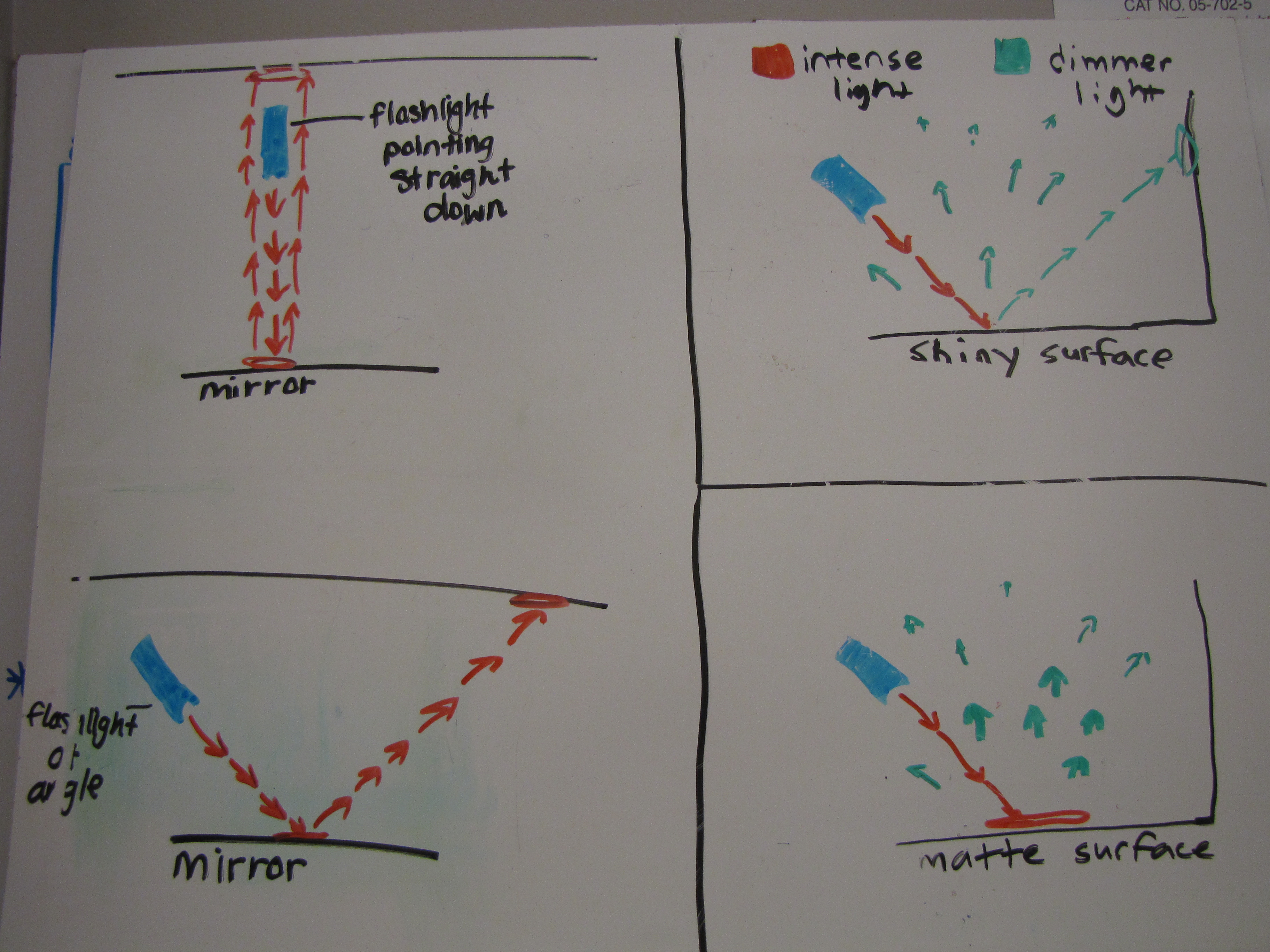
Some groups did investigations that led them to propose some theories. Here’s an example of a group proposing a theory of what they think happens when light hits mirrors, shiny surfaces, and matte surfaces base on their investigation.

Here’s another group bringing attention to a puzzle they discovered and are trying to understand. The puzzle concerns why we can see two spots of light when the flashlight shines against a whiteboard. One spot of light is big and everyone agrees where to point on the whiteboard to locate it. The other spot is smaller and we don’t all seem to see it in the same place.

Of course, the above theories are pretty much all that’s need to work out the puzzle. But our class is still far away from being in a position to do so. First, we aren’t all committed to the theories proposed above. For the moment, they are reasonable ideas, not firm theoretical commitments. Neither, do we know that those theories are the relevant ones for solving the puzzle. Neither do we really know how to apply those theories for the range of phenomena to which they do apply. Right now those theories seem to just explain where “light” goes, but we aren’t really in the vicinity of thinking about source-object-receiver models; nor are we thinking of images as explainable with where light goes. All we’ve done is generated some theories about what happens when light hits surfaces and we’ve generated some perplexing puzzles about what happens when light hits a certain surface. We have some fantastic theories and some fantastic puzzles. My job will be to help close to gap between the two.

Reflections before a weekend away from blogging…

I’ve been thinking and posting a lot about my intro physics course:

The price of being thoughtful

My thoughts on the flipped class

Misunderstanding components

Comparing Goal-less Problems

Eyeing Improvement

What’s Missing

Why I shouldn’t teach

My flipped class summary

Reflecting back on how the past few weeks have gone, I just have the following remarks to say about reform physics instruction:

Flipped classes, computer-guided feedback, clickers, projects, group work, and white-boarding are not the ingredients for meaningful learning. Rather, these structures merely create opportunity for the construction of meaningful student work, for the real-time monitoring and responding to student work, for the cultivation of learning-oriented community, for enhanced epistemic agency. These opportunities are not only contingent upon how student learning is structured, but attention must be paid to what specifically students are to be learning and how best to structure their work specifically within those arenas. These opportunities are also highly contingent upon an instructor’s attention and responsiveness to community-building and to the fostering of individual’s agency to act within that community. Realizing opportunity is quite different from merely creating opportunity.

Elsewhere, I have seen and been in classrooms where students have the opportunity to make contact with some forms of meaningful work (of one kind at least), but the conditions are such that community and agency are stifled. I have found this to be the case in many worksheet-driven, research-based curriculum. Students make contact with many important physics ideas by dragging them through well-thought-out and tested curriculum. These kinds of classrooms can get results, but I feel they often come with much collateral damage–community, agency, attitudes, joy of learning, etc. I can understand why some would advocate for the use of such materials. I think I can appreciate what value others see in them now more than ever. It is interesting to contrast my uneasiness with such curriculum with my current uneasiness. They are almost polar opposites.

I am learning that I am just not interesting in teaching under conditions void of meaningful disciplinary learning OR meaningful learning community. I want both. I don’t think it’s too much to ask for. I know that it’s hard work–especially for me but for anyone who aims for it. But it can’t be too much to ask for.

Thoughts of the day…

I want to define a kind of motion– a kind of motion in which an object starts from rest and always covers 3x as much distance during the 2nd half than the first half. Let’s say you cover 16 meters in some phase of a trip. By my rule, you would have had to have covered 12 m during the first leg and 4m during the second leg.

16 (total distance) = 12 (distance in 1st half) + 4 (distance in 2nd half).

I’m interested now in breaking down the 4 meters into two equal time parts. By my rule, you would have traveled 3 meters (in the 1st quarter) and 1 meter (in the second quarter)

16 = 12 (in the second half) + 3 (in the second quarter) + 1(in the first quarter)

The question now is, “How do I break apart either the 12 into quarter times slices?”

Let’s consider some candidates:

12 = 6 + 6 ? It turns out that this can’t work because this says that the ball would travel same distance in the last quarter than it did in the previous one, and we know that it’s traveling faster later than earlier.

12 = 7 + 5?

12 = 8 + 4?

12 = 9 +3? It turns out that this can’t work because 3 is the distance it traveled in the second quarter, and we know it had to have covered more distance.

So, ignoring non-integer possibilities, we have two options. It covers 5 meters and then 7 meters, or it covers 4 meters and then 8 meters. Two examine this further let’s look at the whole patterns we’d be proposing:

Pattern 1: 1, 3, 5, 7

Pattern 2: 1, 3, 4, 8

It looks like pattern 1 looks like it is increasing by same amount each time 2 more meters for every segment; Pattern 2 is harder to discern if there is a pattern, it changes  by 2, then 1, and then 4.

If we were to guess what pattern 1 would go on as, we’d might say 1, 3, 5, 7, 9, 11,…

Remember, my rule is that if you go 3x as far during the last half of a trip, then first half. Well, let’s see if my rule still holds:

1+3+5 = 9 is the first half distance and 7+9+11 = 27 is the second half distance.

Thus, I’m feeling more confident that the pattern 1, 3, 5, 7, 9, 11, 13, 15, 17 describes the motion of an object that always covers 3x more distance in the second half of a trip than the first half.

All, I’ve just described is, of course, just constant acceleration motion.

Is there a price to being thoughtful?

My intro physics students did really well on my warm-up questions today–and they were some tricky graphing questions that I know students typically struggle with if they don’t understand a thing or two. I was pleasantly surprised both at how many and how quickly students converged on correct interpretations with good explanations of correct answers and good arguments against compelling wrong answers.

Despite this, I’m still worried about the exam students will have to take next week. The practice exams that have been posted by the lead instructor indicate to me that the exams are really about whether or not students can quickly crank through some plug-n-chug kinematics problems. Personally, I think it’s mostly one big math test with some minor applications to physics-like topics.

I think and hope that I have taught my students to be thoughtful, and I hope this is a benefit to them and not a liability. Consider with me this example:

This week, students were trying to decide if a vertically tossed ball with speed 25 m/s would be fast enough to get 30 meters into the air. Their instinct had them split about 50/50 yes and no. We worked it out together, and found that it gets 31.25 meters, which is just 12.5 m/s (average speed)* 2.5 seconds (time it takes to lose 25 m/s at a rate of 10 m/s per second). I then asked them to work out for themselves how fast the ball would be moving when it got to 30 meters. Before they got to work, they had to write their guesses at front board. The most common guesses were 2.5 m/s and 1.25 m/s. I’ll leave it to you to think why these were the most common guesses.

One way of solving the problem is to just plug into the equation vf² = vi² + 2 aΔx, and some groups went that route. However, the way two groups of students solved it was by thinking about something a student had said the class period before. One student (Ashley) had remarked after drawing some motion maps that the speed of the ball must be the same at the same position no matter if it was moving up and down. This was a really cool insight about the symmetry of free-fall motion. I celebrated this idea and made a minor big deal about it. On this day, these groups remembered this students’ idea and realized that the problem I was asking was nearly the same as different problem–finding the speed of a ball that simply drops 1.25 meters. They determined that such a ball should take 0.5 seconds to drop 1.25 meters. And then without any calculations or plugging into formulas, they new that this meant the ball would be moving 5 m/s. They knew this immediately, because they knew well what 10 meters per second per second meant for the acceleration due to gravity.

The thoughtfulness to first think about whether or not a ball thrown 25 m/s could possibly get up 30 meters. The thoughtfulness to realize that a ball achieving a height of 31.25 meters can’t be moving all that fast by the time it gets to 30 meters. The thoughtfulness to think about other classmates’ ideas. The thoughtfulness to attend to and find symmetries that make problems simple. The thoughtfulness to put down equations and rely on their understanding of what acceleration means. The thoughtfulness to wonder why your answer of 5 m/s is bigger than what you had thought. All of this is what I’m sure is not going to be assessed on this exam. And in fact, if my students decide to be this thoughtful on the exam, they might find themselves unable to finish in time… sigh.

Today, some of my students heard the phrase, “I think maybe you’re over-thinking this,” and I worried about them hearing this. If being interested in outcomes, bartering with your intuition, listening to others, borrowing ideas, transforming problems, and wondering about your result is over-thinking problems, than over-thinking problems is exactly where I want them to be.

A Fun Free-fall Puzzle

One puzzle I have enjoyed thinking about despite its “school-science” feel is this one:

Three identical balls are thrown three different ways from the 3rd story balcony of a building. Air resistance is negligible.

The first ball is thrown vertically upward

The second ball is dropped

The third toss is thrown vertically downward with same speed as the first ball

For each ball, consider only the stretch of time between when that ball leaves the hand and just before it hits the ground:

Part 1: Rank the change in speed

Part 2: Rank the change in velocity

Part 3: Rank the change in kinetic energy

If you are really looking to test some students on their understanding of the difference between speed, velocity, and kinetic energy, this one should do the trick.

Inquiry Update: Today I Lectured… no really.

Today in my inquiry class we did three things:

First, I gave a 10-15 minute “lecture” on their collective ideas about light that have come up over the past two weeks. I did my best to summarize, represent, discuss, and provide arguments and evidence for the range of ideas I’ve heard in class. I reviewed our very early ideas about light (that many of us have since decided to abandon) such as light coming out of a flashlight like a “cartoon beam” and how light can “leak” or “spill over” off its path. I reviewed our initial observations and how those observations were different than what we had expected based on our initial predictions. Next, I elaborated upon and defended several competing ideas about the nature of light:

The idea that you’d be able to see a beam going by if you could just get a strong enough concentrated beam in a really dark area.

The idea that you can only see a beam of light when it passes through something like dust, smoke, fog, etc.

The idea that there is no such thing as a beam; rather you just see the objects in the path of light–be them dust or droplets of moisture.

I elaborated on two prevailing ideas about why we see objects like dust in the path of light: one being that the dust absorbs light, thereby making them visible; and another that light bounces of it in all directions.

I also reminded them of several of the collective observations we had made during our at home observations, including observations that led to a better articulation about the conditions under which a beam does and doesn’t seem to appear; a better articulation of what observers see standing and looking in different directions relative to flashlight; and a better articulation of the shape and brightness of lit areas from a flashlight across different distances.

Second, I asked them to discuss with their research group, the questions and puzzles they had and to note which ones they’d be interested in pursuing. Here is the list they generated:

Reflections and Absorption Questions

What is the nature of reflection? Scattering? Kooshing? Bouncing? Bending?

Is light absorbed into an object or reflected off an object, or both?

Does material make a difference in the amount of reflection?

How do glow in the dark stickers work? Do they need light to glow? Would heating work?

If light absorbs (soaks) into objects like dust or water (making them lit), why don’t water droplets stay lit when the light is turned off?

Does photosynthesis and solar panels work by trapping and holding light or absorbing it?

 Beam Questions

 Can a beam be present even if we cannot see it with our eyes?

Does their have to be something like moisture in air to see a beam? Why does dust matter?

Flashlight Questions

Does flashlight on a wall show a circle because of the mirror in the flashlight or circle shape of the flashlight? What effect does different shaped flashlights have?

What causes the bulls-eye effect? What causes changes to the bulls-eye effect? Why is there sometimes a dark center vs. bright center?

What does the mirror really do in the flashlight?

What doe the adjustor on the flashlight do?

 Other Light Questions

Why does light get dimmer over distance?

Does light travel straight or does it expand to get bigger?

What is difference between light from sun and light from something like a flashlight?

What is UV light?

What effect does the color have on light?

 Energy Questions

Is energy being transferred from particle to particle as light moves?

Is light energy? How does light energy turn into heat energy?

Third, students set out to begin deciding what questions or puzzles they were interested in pursuing, and then they investigated, discussed, and wrote in their notebooks for a little under two hours.

Several groups investigated how light “reflects” off different surfaces–some looked at white, black, and mirrored surfaces, others looked at “glossy” vs “matte”; others used different colored construction paper. Some looked more at where light went and others looked at more the brightness of the color of the light. Some groups even ended up looking at the transmitted light. The fact that we have several groups doing this with slight variations is nice, and will hopefully make contact with some of the other groups’ more complicated inquiries where they made interesting discoveries that they are struggling to explain.

One group investigated the puzzle of why there is sometimes a black spot in the middle of flashlights. They found that both the distance from the surface matters and the “focus” of the maglite matters. They ended up redoing their maglite dissections and then playing with the mirrors to see how moving the mirror around changes how the light gets focused. This group is feeling a little overwhelmed with the complexity of it all. I think they might have thought it would have been a simple, “OK, let’s just go look, take some measurements and that will be it.” Instead, the complexity of the dark spot unraveled quickly.

Another group got wrapped up in the why shining a flashlight on a whiteboard led to them seeing TWO spots of light– for one spot we could all agree where to point on the whiteboard, but the other we had a hard time showing others where we saw it to be. They also found that a regular old wood door does the same thing, even though it’s not as glossy as the whiteboard. They are intrigued, perplexed, and pretty excited I think.

Another group investigated how different colors and strength of flashlights lead to absorption, which they surmised would lead to heat. They also found that strong lights made the color fade (or change) on construction paper. I honestly don’t know why the colors fade. My instinct is see if this group will go off in a different direction, but I’m going to be careful and wait to see where they go with some careful listening and questioning.

One other group recreated our initial hallway experiment with different kinds of walls; black walls, white walls, and found that the curved boundary between dark and light was not as distinct with white walls as it was with the black walls. They have some ideas about how they might explain it, but I’m having hard time pressing them to make some drawings to show exactly how they think the light gets from the source to the walls to wherever its going next.

Sorry for the long post… I’m still kind using this blog as a teaching journal at times…

The Praxis, the FMCE, and the Intro Course

I began my independent study course for future physics teachers by asking students to collect information about what was covered on the Praxis. I then asked students to rank where they felt most/least confident. Collectively, the areas of E&M and Optics/Waves were least confident and Mechanics was the most confident.   We decided they would start doing independent study with statics, including Coulombs law, insulators, conductors, induced charge, electric fields, electric potentials, electric flux, electric potential energy. I sent them home to find any intro physics textbooks, and to begin reading and working on problems. They had 10 days to read and to begin working on problems, before we’d meet to work through problems or concepts they were struggling with.

In the mean time, I had them come in and we all took the Force and Motion Concept Evaluation (FMCE) quietly in a room together. In my mind, this would be an external check on their self-assessed confidence with mechanics. Not surprising, the students struggled. While their was some variance on their answers to particular questions, the students as a whole answered many of the questions identically wrong. In places, whole pages would be wrong for every student, with the students sharing the exact same wrong answer on more than half. (Aside: They weren’t copying, if that’s what you are thinking). This isn’t surprising as many of the wrong answers aren’t random, they indicate very specific and common misunderstandings, difficulties, or misconceptions. In addition, these students have been through the same courses, where I believe many of these difficulties are not being resolved.

The big struggles they have are:

  • Indicating a force in the direction of velocity; and the need for force to maintain velocity
  • Indicating the need for an increasing force to cause speeding up (but not slowing down)
  • Confusing velocity with acceleration
  • Recognizing Newton’s 3rd law as holding when acceleration is occurring
If you know much about the FMCE, you should know that if you are struggling in these four areas, it’s easy to walk away from this test answering a vast majority of the questions wrong. For the most part, they did well with velocity vs. time graphs but did poorly on any questions relating to Newton’s 2nd law, whether it be force graphs, acceleration graphs, or indicating the direction of force or acceleration.

A bit of Evidence to Support my Instructional Instinct

I have written in the past month about my uneasiness with the introductory physics course I help to teach. My instructional instinct was that many of the problems were not targeted properly for student learning and that there was too much emphasis on plug-n-chug routines rather than on understanding concepts.  I’m not saying that giving the FMCE to a handful of students a year or more  after the intro sequence proves anything. Rather, to me it indicates that my uneasiness has to no reason to subside. These students all did well in this intro course, and the consistency of their struggles is a possible indicator of the legitimacy of my gut feelings.

How to turn this into a learning opportunity?

One good thing is that all the students struggled. It’s not as if we have a situation where some students bombed it and others aced it. Everyone struggled and they are struggling in nearly identical ways. A part of me is excited that we have some meaningful learning to do, and that we are all “in it” together. The question for me right now is, “How do I best use this for learning?” We certainly can’t spend the semester relearning mechanics.

Units in Calculations? Not a chance…

OK, I have to weigh in the units thing:

First, I don’t carry around units in calculations. I think it creates clutter and distracts me from the important thinking I need to be doing. That clutter makes it MORE difficult to diagnose mistakes I’ve made, both during and after the fact. Sure, there are a small number of mistakes I could make which would be easier to spot carrying out units, but that benefit is far outweighed by the increase in mistakes I would make because I am bothering to work out the units along the way AND by the difficulty it will be later to gander at my work at spot more meaningful mistakes.

Second, most of the physicists I know don’t carry around units their calculations either. I don’t want to pretend that making students carrying units around is some important scientific skill. Sure, thinking about quantity and how units figure into the notion of quantity is important, but carrying around units is not a stand in for understanding notions of quantity and rate. In fact, many physicists do all they can to get rid of units, so that they don’t have to carry them around in calculations. One way they do this is setting as many units as they can equal to one.  Then, they go about carrying out their calculations with all units and constants all hidden in dimensionless ratios. Then, only at the end, do they  introduce units back into their work. I’m not saying, we should make students do this.

I don’t know where the idea that students should carry units around came from. Does anybody know?

Last thing, I am all for teaching students to do dimensional analysis, but that’s different than carrying around units in a calculation.

There, I’m done. I said it.

Anticipating and Developing the Question List

Yesterday, I had student groups think again about the questions we have about light and the puzzles that we have uncovered. We didn’t have time to talk about them as a whole class. On Wednesday, Id’d like to aggregate all our questions. I’m doing my best to anticipate the range of questions that will arise, and also trying to add in some questions of my own that stem from what they have wondered about or have made contact with:

Why did some of us see a “dark spot” in the middle of the the bullseye but others saw a bright spot in the middle of the bullseye?

Why does the circle of light on the wall get bigger and dimmer the further we hold it from the wall?

Is it a circle on the wall because of something the mirror is doing or because of the circular shape of the flashlight end?

When objects are visible, is it because they soak in the light or because light bounces off them? What could we do to help us decide?

If we concentrate bright light enough (in a really dark space) will we see the light going by or does it have to hit something like dust, moisture, smoke?

Is “reflected” light always dimmer than direct light? Does it depend on material?

Does light “reflect” off mirrors differently than a white piece of paper or a black piece of paper? [Can we come up with rules that describe what the light might be doing in each case?]

What are the mirrors really doing inside the flashlight? What would the light look like from the flashlight without the mirror?

What happens when you adjust the adjustor piece on the maglite?

Can we come up with rules for drawing the paths taken by light to predict what shape will appear when light goes through different shape or sized holes?

Does light really travel in straight lines? Or does it expand to fill space? Or does it leak and spill? What could we do to help us decide?

How (and why) is the pattern of light different from a flashlight vs. a candle, bulb, or latern?

Is the path(s) taken by light distinct or is it fuzzy?

What happens when light hit moistures, dust, or smoke that allows you to see the beam? Does this “enhance” the beam or do you not see the “beam” just see the objects illuminated?

The cool idea about light that I’m going to brag about today

In my class, we were talking about what happens when some dust floats across the path of our flashlight.  We had mostly agreed that, while we can’t usually see the path, there must be some path because the light gets to the end of hallway where we see it on the wall. I had them now white-boarding in groups, trying to show what the light might be doing when there’s not dust in the path and what happens differently when there is a piece of dust in the path.

One group, in particular, said that the light was both absorbed and reflected when the path of light got the dust particle. I asked them to say more about what they meant by absorb and reflect, and here’s what came up:

First they elaborated on the absorb idea by saying that the dust particle soaks up the light. Later, I asked them if they meant like a sponge–like how a sponge can soak up water and then it’d be wet. By their idea, the dust particle soaks up light and by virtue of having the light, the dust particle is lit. This idea makes sense to me. Without light, things are not visible. With light, they are visible. Their idea very much connects with the light is a substance metaphor. The word soak is, in fact, very similar to words students had used before, like spill and leak when talking about how light got from the hallway to the room.

The group had a much harder time talking about what they mean by reflection (and later decided to drop the word in favor of just absorb). They mostly just kept repeating the word reflecting, so I suggested that it might be easier for them to draw what they meant then to say it. They ended up drawing some lines around the dust particle going every which way, using a different colored marker than the color they had used to show the light coming from the flashlight. I asked them if those lines that had just drawn were light. They were very adamant that these lines were not light and pretty darne certain that light did not go out from the dust particle. I think they mean those lines to indicate that the object was lit or visible. Their reasoning was also very sensible to me. They argued to me that when we look directly at a lightbulb, it is bright. They seemed to be saying, “It is that brightness that lets you know it is a source of light”. Later in a whole class discussion, their argument was more precise: The dust particle was not glowing–not in the same way a the bulb does–and thus light couldn’t be going out in all directions from it. They argued that you simply see the dust because it has absorbed light; but that the dust itself was not a source of light.

At this point, the idea that objects “soak in” light to become visible is completely sensible. In fact, it is a giant step in the right direction. Previously, our thinking had been that you can see light going by you in the shape of a beam. We’ve found since then that you can’t see the beam of light, at least in most circumstances. This group’s idea explains a lot of what we have observed and come to understand: It’s consistent with the notion that we can’t see light going by and that we can see objects. It is also consistent with the idea that you can only see objects if light shines on them.  The same group even earlier had the idea that when you look directly at a flashlight that you aren’t actually seeing light, but that you are  seeing the glass (an object) full of light. They are fairly committed to the idea that we can’t see light, and they are trying hard to tell coherent story of only being able to see objects. So much so, that they don’t want to say you see light when you look at the flashlight, but that you see glowing glass. This is progress along several dimension: thinking that is increasingly accountable to evidence and thinking that increasingly internally consistent.

On Wednesday, I think we’ll spend some time doing observations and experiments to see if we can tell whether any light comes off objects that are lit from a flashlight. Based on this, we’ll have some more evidence to ponder and some more thinking to do.

We’ll also be trying to come to some class consensus about how to we’d like to draw and represent paths taken by light. Right now every group’s diagrams are so idiosyncratic that’s it’s difficult to disagree with anyone. There’s definitely a movement in my class of “We’re all saying the same thing,” and “We all agree with each other.”  I keep having to convince them that we can’t be all saying the same thing if we are all predicting we’ll see different things. This was also true today, I had to make the case that “absorbing” light like a sponge was a different idea that light “bouncing” like a tennis ball. This subject about the tendency to want to politely agree, I suppose, is for another post.

Blog at WordPress.com.

Up ↑